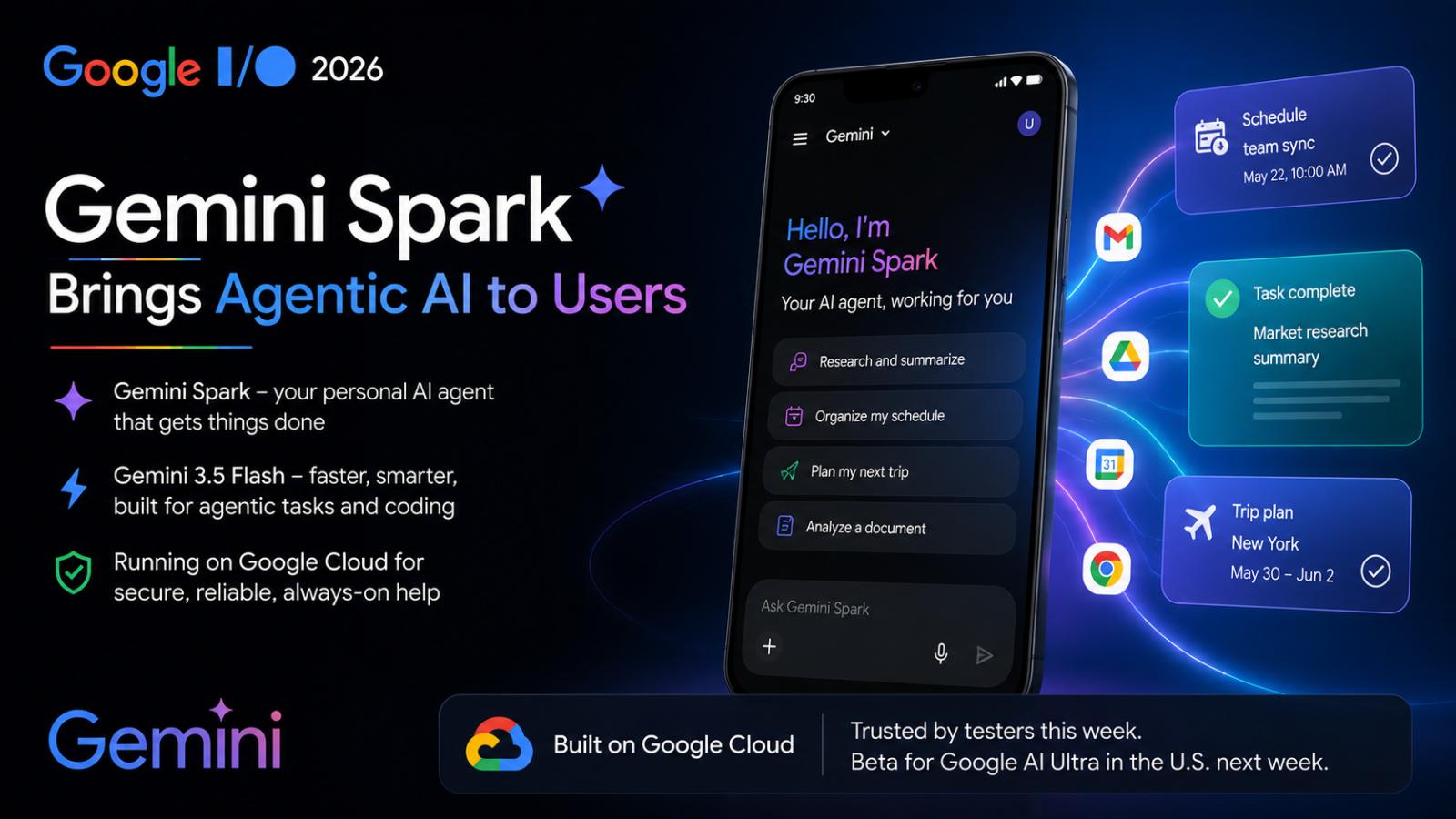
Google used its annual developer conference on Tuesday, May 19, 2026, in Mountain View, California, to introduce new Gemini AI tools aimed at making its assistant more proactive and task-focused.
The biggest consumer-facing update is Gemini Spark, a personal AI agent inside the Gemini app that Google says can help users manage digital tasks under their direction. The company said Spark will run on dedicated virtual machines on Google Cloud, allowing it to work continuously without requiring a user’s laptop to stay open.
Gemini Spark Pushes Google Deeper Into Agentic AI
Google described Gemini Spark as part of its broader move into “agentic” AI, a category of artificial intelligence designed to complete multi-step tasks rather than simply answer questions. The assistant is expected to work across Google tools first, with third-party integrations planned through MCP in the coming weeks.
According to Google, Gemini Spark is beginning to roll out to trusted testers this week, with beta access coming next week for Google AI Ultra subscribers in the United States. The feature is also expected to work through the Gemini app and later through email, chat, Chrome, and Android’s new Halo interface.
Gemini 3.5 Flash Adds Speed and Coding Focus
Google also announced Gemini 3.5 Flash, the first release in its latest model family. The company said the model is designed for agentic execution, coding, and long-horizon tasks, while offering faster output than several frontier AI systems.
The company said Gemini 3.5 Flash is available across Google products and APIs, while Gemini 3.5 Pro is expected next month. Google’s developer documentation also lists Gemini 3.5 Flash as generally available and stable for scaled production use.
Google CEO Sundar Pichai said the Gemini app has surpassed 900 million monthly active users, up from 400 million at last year’s I/O, showing how quickly generative AI tools are moving into mainstream use.
Alphabet is also increasing investment in AI infrastructure as competition grows among major technology companies. Reuters reported that Alphabet has outlined plans for up to $190 billion in capital expenditures this year, tied partly to artificial intelligence expansion.
The announcements show Google trying to move Gemini beyond chatbot-style answers and into AI systems that can act, organize, and assist across everyday digital workflows.