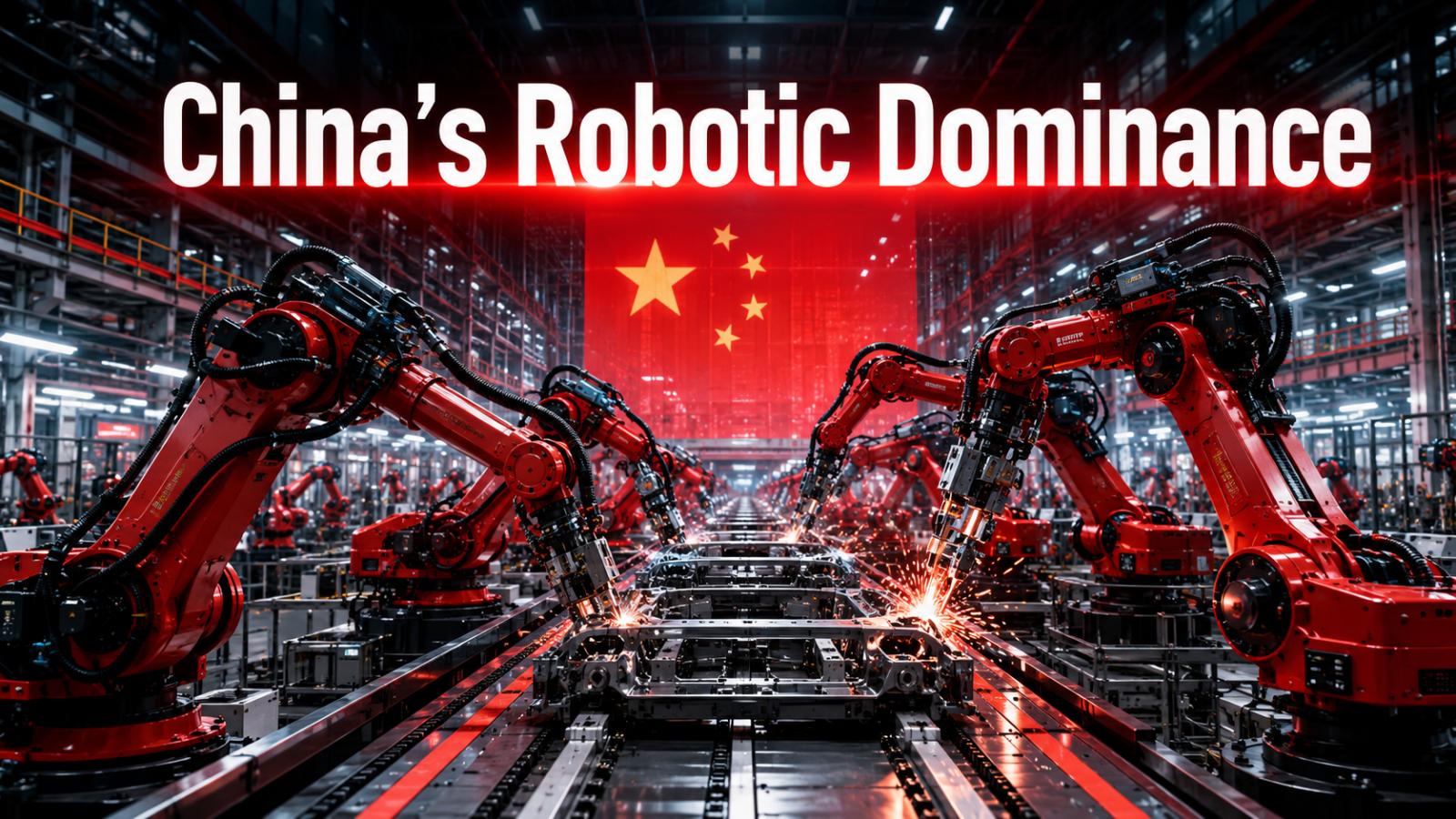
China robotic dominance is becoming one of the most important shifts in global manufacturing. Factories are no longer depending only on human labor, traditional machines, and manual production lines. Industrial robots are now helping companies produce goods faster, reduce errors, improve safety, and stay competitive in a market where speed and precision matter.
According to the International Federation of Robotics, China accounted for 54% of global industrial robot installations in 2024, with around 295,000 new robots installed. China also has more than 2 million industrial robots in operation, making it the largest industrial robot market in the world.
Why China Is Leading Factory Robot Growth ?
China’s rise in factory automation did not happen by accident. The country has invested heavily in smart factories, automation plans, robotics manufacturing, and advanced production systems. Chinese factories use robots in electronics, automobiles, metal work, machinery, consumer goods, and many other industries.
The biggest advantage for China is scale. When a country produces large volumes of goods for the global market, even small improvements in speed and accuracy can create huge savings. Robots help Chinese factories complete repetitive, difficult, and high-speed tasks with fewer mistakes.
This is why China robotic dominance is not only about using more robots. It is also about building an entire manufacturing system where automation, supply chains, skilled workers, and government support work together.
Robot Density Shows the Real Automation Race
Robot density is one of the best ways to measure factory automation. It means the number of industrial robots used for every 10,000 manufacturing workers. A country may have many robots overall, but robot density shows how deeply robots are integrated into factory work.
South Korea is the global leader in robot density, with around 1,220 robots per 10,000 manufacturing employees. This high number is mainly because South Korea has strong electronics, semiconductor, and automobile industries where precision is extremely important.
China has the largest number of robots, but South Korea shows how advanced automation can become when robots are deeply used across major industries.
Japan Robotics Still Has Global Strength
Japan robotics continues to hold a powerful position in global manufacturing. Japan is not only a major user of industrial robots but also one of the most important producers of robotics technology.
Japanese companies have long experience in automation, precision machinery, sensors, and robotic systems. Their robots are widely used in automobile production, electronics assembly, packaging, welding, material handling, and quality inspection.
Japan’s strength is not just volume. It is reliability, engineering quality, and long-term experience. This makes Japan a serious player even as China grows faster in overall robot installations.
Germany Automation Remains Strong in Automobile Manufacturing
Germany automation is closely linked with its automobile industry. German factories are known for precision engineering, high-quality production, and advanced industrial systems.
Industrial robots are widely used in German car factories for welding, painting, assembling, lifting heavy parts, and checking product quality. Germany also has one of the strongest automation ecosystems in Europe.
Even though China has moved ahead in scale, Germany remains important because of its engineering depth, machinery expertise, and high-value manufacturing. For industries where quality and precision matter more than mass production alone, Germany is still a strong automation leader.
The United States Is Moving Toward AI Powered Robots
The United States may not lead in total industrial robot installations, but it is becoming important in AI powered robots. American companies are focusing on smarter robots that can learn, analyze data, recognize objects, follow instructions, and work with greater flexibility.
Traditional robots are excellent at repeated tasks. AI powered robots can go further by adapting to changing situations. This matters in industries such as logistics, warehousing, electronics, aerospace, food processing, healthcare manufacturing, and advanced machinery.
The future of factory automation will not only depend on how many robots a country installs. It will also depend on how intelligent, connected, and flexible those robots become.
How Robots Are Changing Global Manufacturing ?
Robots are changing manufacturing in several major ways. They are reducing production errors, improving worker safety, increasing output, and helping companies manage labor shortages.
In dangerous or repetitive jobs, robots can handle tasks that are tiring or risky for human workers. In high-precision industries, robots help maintain consistent quality. In large factories, robots can move materials, test products, pack goods, and support 24-hour production.
But there is also a challenge. Countries and companies that fail to invest in automation may lose competitiveness. Low-cost labor alone is no longer enough. Manufacturing is moving toward a future where speed, quality, data, and automation decide success.
The Future of Industrial Robots
The next stage of factory automation will combine industrial robots, artificial intelligence, sensors, machine vision, cloud systems, and real-time data. Robots will become more flexible and easier to use. Smaller businesses may also start adopting automation as costs come down.
China robotic dominance will continue to influence global manufacturing, but other countries are not standing still. South Korea leads in robot density, Japan remains strong in robotics technology, Germany continues to dominate precision automation, and the United States is pushing AI powered robots.
The real competition is no longer just about who has the most factories. It is about who can build the smartest, fastest, and most efficient factories.
Conclusion
China robotic dominance is reshaping factory automation and forcing the rest of the world to move faster. Industrial robots are no longer optional for major manufacturing countries. They are becoming a basic requirement for growth, quality, and global competitiveness.
China leads in scale, South Korea leads in robot density, Japan remains a robotics technology powerhouse, Germany automation continues to support high-quality manufacturing, and the United States is focusing on AI powered robots.
The message is clear: the future of global manufacturing will belong to countries and companies that combine human skill with intelligent automation.