The Anthropic SpaceX deal gives the Claude developer access to one of the world’s largest AI computing clusters at a time when demand is testing its infrastructure. The agreement has already helped Anthropic raise Claude Code limits, but its cost, duration and control terms deserve careful scrutiny.
Colossus lease adds major AI capacity
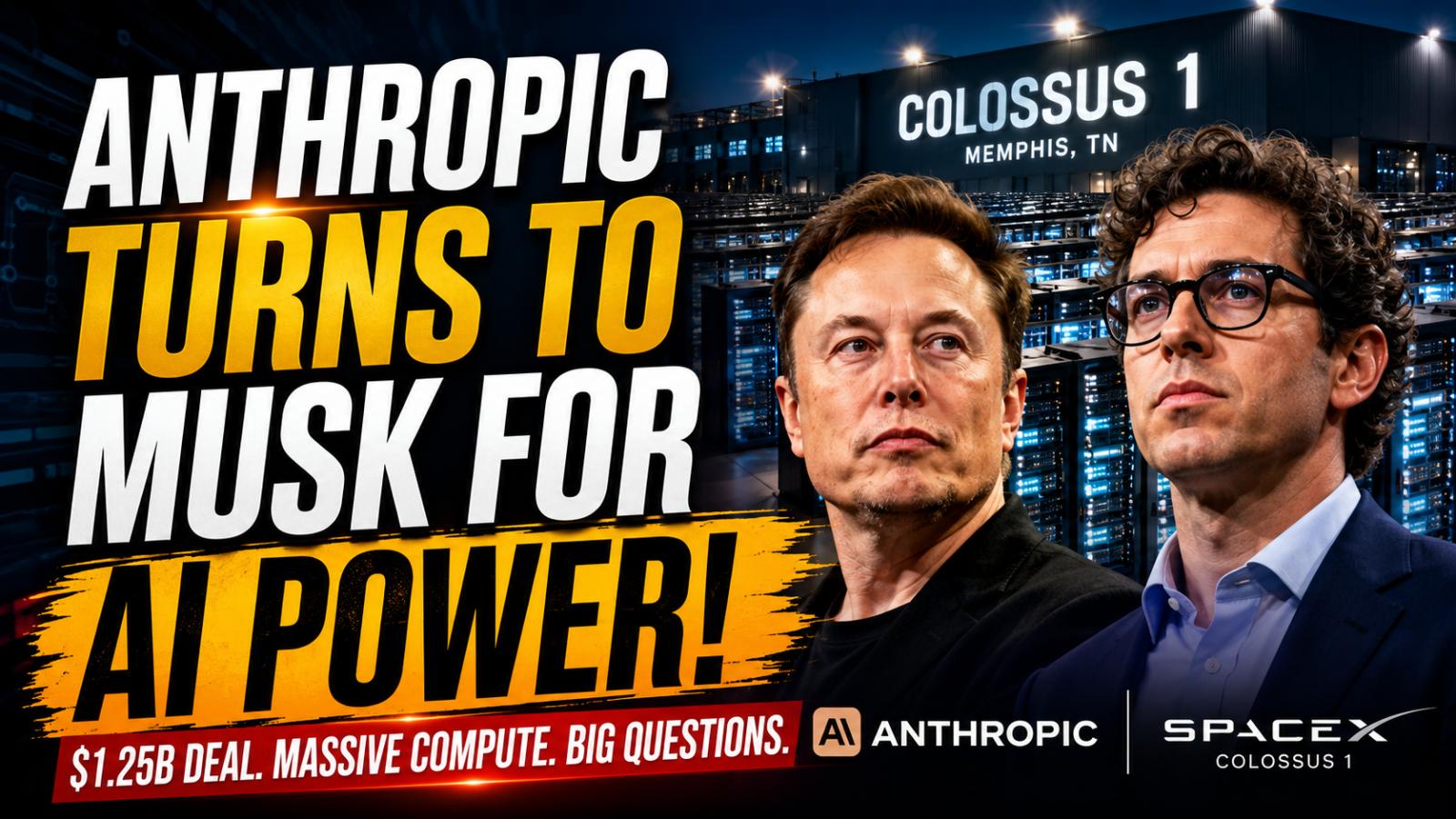
Anthropic announced on May 6 that it had reached an agreement with SpaceX to use all available computing capacity at the Colossus 1 data center in Memphis. The company said the facility would provide more than 300 megawatts of capacity and access to over 220,000 Nvidia GPUs.
SpaceXAI said the cluster includes H100, H200 and GB200 accelerators that can support model training, inference, fine-tuning and other high-performance workloads. Anthropic did not describe the arrangement as a friendship or strategic alignment with Elon Musk. It presented the deal as part of a wider effort to secure enough computing power for Claude’s growing user base.
The agreement also does not mean Anthropic relies only on Musk’s infrastructure. Anthropic has announced separate capacity arrangements involving Amazon, Google, Microsoft, Nvidia and Fluidstack. The SpaceX deal is important, but describing the company as financially dependent on Musk overstates the evidence.
Related Reading
See how Anthropic is using its expanded computing capacity in our detailed report on Claude Opus 5 pricing and features, covering the new 1-million-token context window, reasoning controls and pricing strategy.
Claude caps rise after compute expansion
Anthropic linked the new capacity directly to higher service limits. It doubled Claude Code’s five-hour rate limits for Pro, Max, Team and eligible Enterprise plans. It also removed peak-hour reductions for Pro and Max users and increased API rate limits for Claude Opus models.
These changes show why frontier AI companies are competing so aggressively for data-center access. A model may perform well in testing, but customers notice quickly when limited capacity causes slow responses, restricted usage or unstable service.
For Anthropic, Colossus gives the company ready-built infrastructure without waiting years for new facilities. That speed carries an opportunity cost: renting capacity from a direct AI competitor may reduce construction delays, but it also creates exposure to another company’s commercial priorities.
Compute cost and contract duration remain complex
Later financial reporting said Anthropic agreed to pay about $1.25 billion each month for access to capacity linked to the Colossus facilities, with agreements described as running through May 2029. However, Musk later said the immediate lease covered 180 days and included a mutual 90-day cancellation mechanism.
That distinction matters. Multiplying the monthly payment across several years produces a potential value above $40 billion, but it should not be presented as a guaranteed fixed obligation without explaining the termination rights.
The supplied claim that Anthropic has exclusive use of Colossus 1 while xAI keeps Colossus 2 also needs restraint. Official announcements confirm access to all Colossus 1 capacity, while later disclosures refer more broadly to capacity across Colossus facilities. They do not support every detail of a simple permanent split between Claude and Grok.
Safety clause claim needs careful attribution
Musk wrote on X that SpaceX reserved the right to reclaim computing resources if Anthropic’s AI engaged in actions that harmed humanity. He also said Anthropic’s team had not triggered his “evil detector” after he met senior members of the company.
The first statement attracted attention because it suggested that an infrastructure provider could influence a rival AI lab through access to computing power. However, Anthropic and SpaceX have not publicly released contractual language proving that Musk’s wording forms a defined, enforceable clause.
A responsible report should therefore describe it as Musk’s public claim, not as an established contract provision. Questions remain over who would define harm, what evidence would trigger action and whether normal cancellation rights already give SpaceX enough control without a separate safety clause.
AI infrastructure risk grows with scale
The deal exposes a wider problem across the AI industry. Leading labs need enormous amounts of power, chips and cooling capacity, but few can build everything themselves. That forces them into partnerships with cloud providers, chipmakers and sometimes direct competitors.
Anthropic gains faster access to GPUs and better service capacity. SpaceX gains major rental revenue from infrastructure originally built for xAI. Both sides benefit, but Anthropic also accepts concentration and supplier risk.
The most accurate conclusion is not that Musk now controls Anthropic. It is that Claude’s expansion increasingly depends on large external infrastructure deals whose cancellation terms, pricing and governance can shape how reliably Anthropic competes.