Anthropic, OpenAI and Nvidia Increase H-1B Hiring
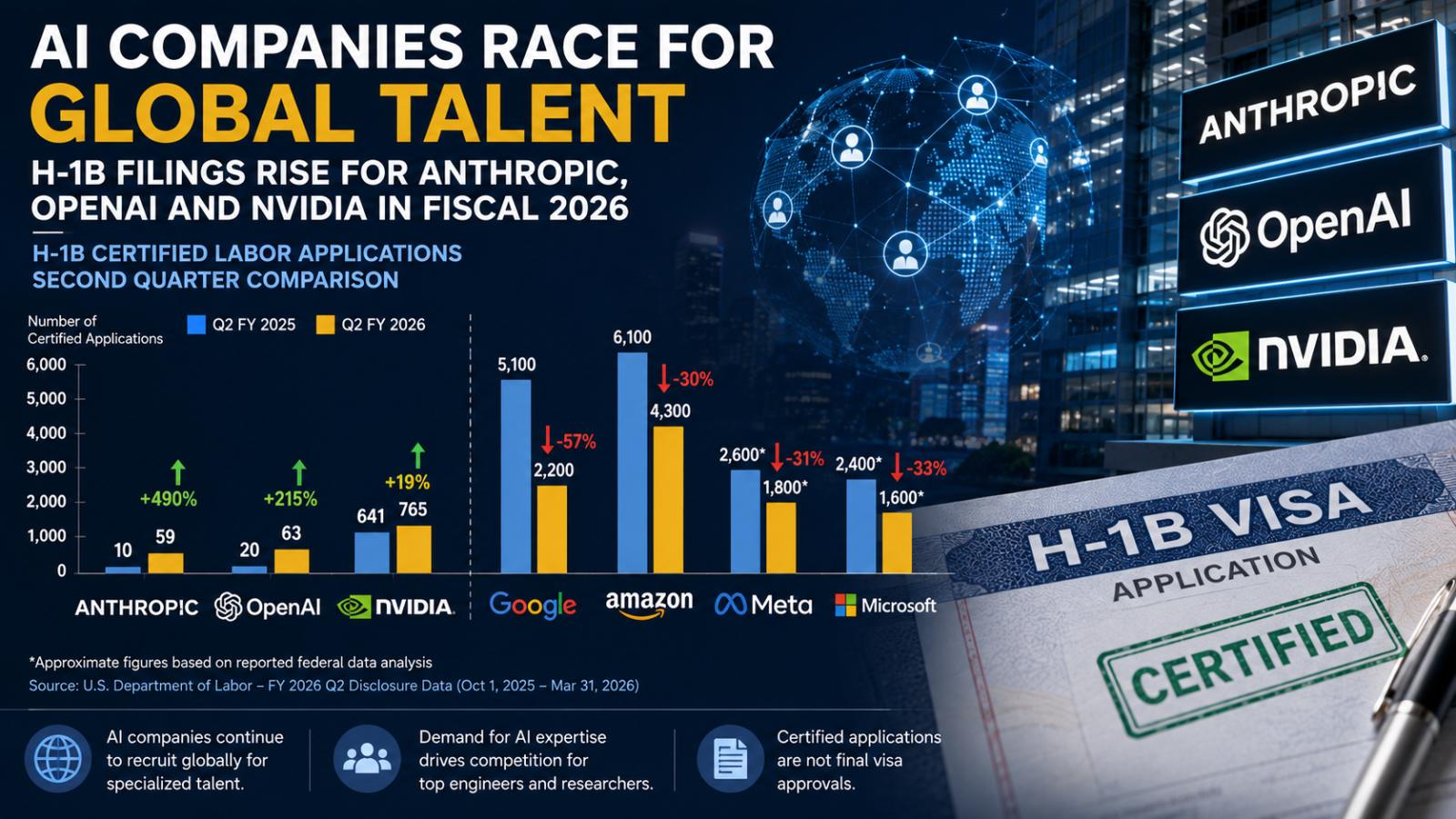
Anthropic, OpenAI and Nvidia increased their use of the H-1B program during the second quarter of U.S. fiscal year 2026, even as several larger technology companies reduced certified labor applications. The shift illustrates how aggressively leading artificial intelligence companies are competing for specialized engineers, researchers and infrastructure workers from the global talent pool. AI Companies Increase H-1B Hiring Anthropic recorded 59

Anthropic, OpenAI and Nvidia Increase H-1B Hiring
Anthropic, OpenAI and Nvidia increased their use of the H-1B program during the second quarter of U.S. fiscal year 2026, even as several larger technology companies reduced certified labor applications. The shift illustrates how aggressively leading artificial intelligence companies are competing for specialized engineers, researchers and infrastructure workers from the global talent pool. AI Companies Increase H-1B Hiring Anthropic recorded 59

Anthropic H-1B Jobs: Salary Ranges and Roles in Federal Filings
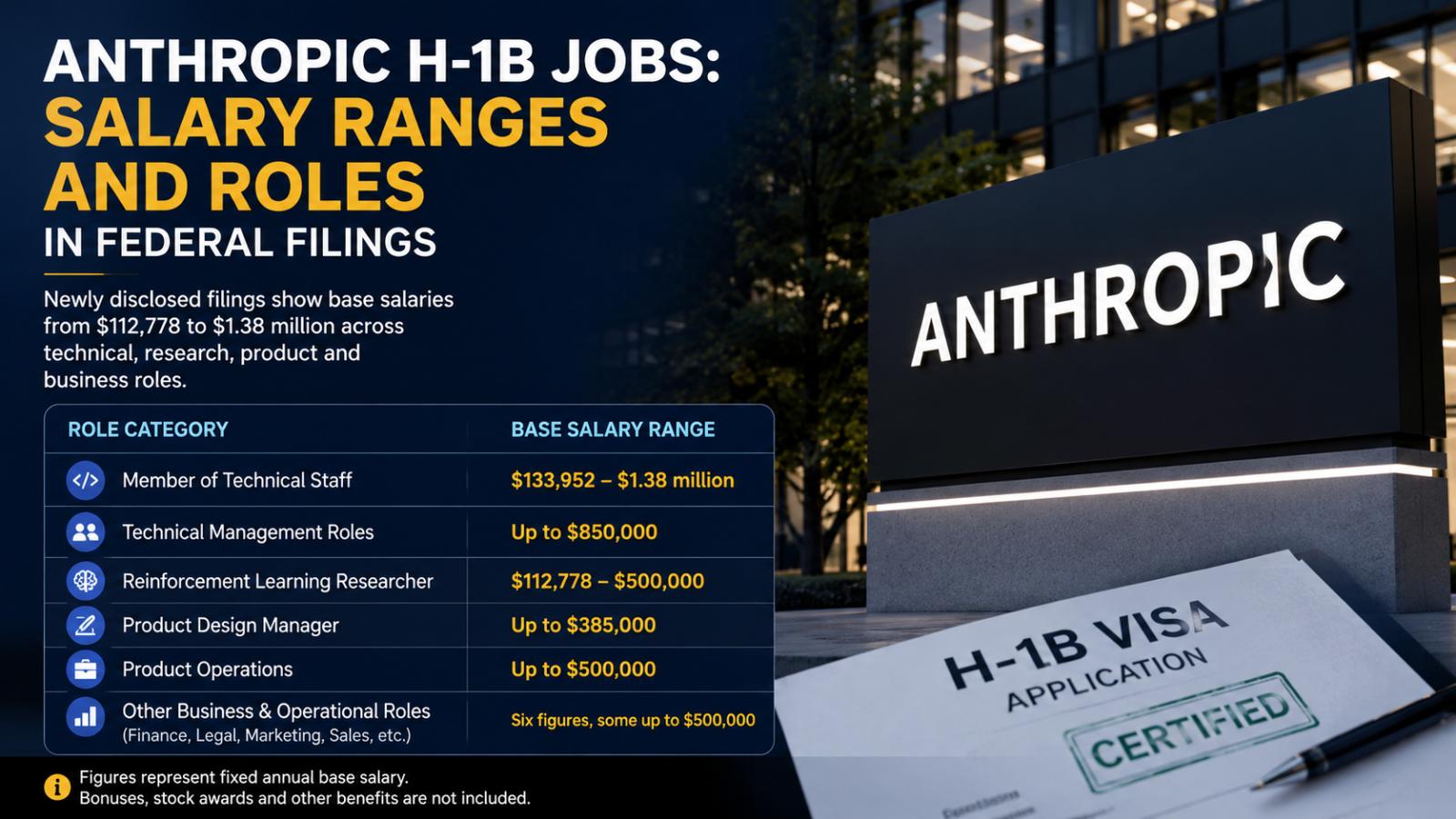
Anthropic H-1B jobs carried base salaries ranging from $112,778 to $1.38 million, according to newly disclosed federal filings covering nearly 80 certified positions during the first half of U.S. fiscal year 2026. The records show that the artificial intelligence company sponsored workers across technical, research, product and business functions. The figures represent fixed annual base pay and do not include bonuses, stock awards or other benefits. Anthropic H-1B
Anthropic H-1B Jobs: Salary Ranges and Roles in Federal Filings
Anthropic H-1B jobs carried base salaries ranging from $112,778 to $1.38 million, according to newly disclosed federal filings covering nearly 80 certified positions during the first half of U.S. fiscal year 2026. The records show that the artificial intelligence company sponsored workers across technical, research, product and business functions. The figures represent fixed annual base pay and do not include bonuses, stock awards or other benefits. Anthropic H-1B
New GPT 5.6 series rollout tied to US government AI security framework
OpenAI begins restricted rollout of new AI model series OpenAI has launched a limited preview of its latest artificial intelligence model series in the United States, restricting access to a small group of trusted partners following coordination with government authorities. The rollout marks one of the most controlled releases in the company’s history, reflecting growing regulatory attention around advanced AI systems and their potential national security implications. Government oversight shapes early deployment strategy The preview follows increased scrutiny from US policymakers, including a recent executive order establishing a voluntary federal review framework for high-capability AI models prior to public release. Under the arrangement, OpenAI briefed government officials on the capabilities of its new models before deployment. Access has been limited to selected US-based organisations, although employees working outside the United States within those organisations may still interact with the system under controlled conditions. The company stated that the decision to restrict access was made in coordination with authorities overseeing AI risk management. GPT 5.6 series introduces tiered model architecture The newly introduced GPT 5.6 series includes three distinct models designed for different use cases. The flagship model, Sol, is positioned for high-performance tasks requiring advanced reasoning capabilities. Terra is optimized for general-purpose applications and everyday workloads, while Luna is designed as a faster and lower-cost alternative for scalable deployment. OpenAI also indicated that once the models are broadly released, Terra will be priced significantly lower than its predecessor, reflecting competitive pressure in the AI sector. Broader US policy shifts impact AI ecosystem The controlled rollout comes amid broader regulatory changes affecting the artificial intelligence industry. In a parallel development, US authorities recently adjusted restrictions on competing AI systems, allowing wider institutional access to previously constrained models following earlier national security concerns. These policy shifts highlight an evolving approach in Washington, balancing innovation in AI development with safeguards intended to reduce misuse risks. The developments also underscore intensifying competition among major AI firms as governments increasingly play a direct role in shaping deployment boundaries.
New GPT 5.6 series rollout tied to US government AI security framework
OpenAI begins restricted rollout of new AI model series OpenAI has launched a limited preview of its latest artificial intelligence model series in the United States, restricting access to a small group of trusted partners following coordination with government authorities. The rollout marks one of the most controlled releases in the company’s history, reflecting growing regulatory attention around advanced AI systems and their potential national security implications. Government oversight shapes early deployment strategy The preview follows increased scrutiny from US policymakers, including a recent executive order establishing a voluntary federal review framework for high-capability AI models prior to public release. Under the arrangement, OpenAI briefed government officials on the capabilities of its new models before deployment. Access has been limited to selected US-based organisations, although employees working outside the United States within those organisations may still interact with the system under controlled conditions. The company stated that the decision to restrict access was made in coordination with authorities overseeing AI risk management. GPT 5.6 series introduces tiered model architecture The newly introduced GPT 5.6 series includes three distinct models designed for different use cases. The flagship model, Sol, is positioned for high-performance tasks requiring advanced reasoning capabilities. Terra is optimized for general-purpose applications and everyday workloads, while Luna is designed as a faster and lower-cost alternative for scalable deployment. OpenAI also indicated that once the models are broadly released, Terra will be priced significantly lower than its predecessor, reflecting competitive pressure in the AI sector. Broader US policy shifts impact AI ecosystem The controlled rollout comes amid broader regulatory changes affecting the artificial intelligence industry. In a parallel development, US authorities recently adjusted restrictions on competing AI systems, allowing wider institutional access to previously constrained models following earlier national security concerns. These policy shifts highlight an evolving approach in Washington, balancing innovation in AI development with safeguards intended to reduce misuse risks. The developments also underscore intensifying competition among major AI firms as governments increasingly play a direct role in shaping deployment boundaries.
Anthropic H-1B Filings Show AI Base Salaries as High as $1.38 Million
Anthropic salaries reached as high as $1.38 million in newly disclosed federal H-1B visa filings, illustrating how aggressively artificial intelligence companies are competing for specialized technical workers in the United States. The records cover nearly 80 Anthropic positions certified during the first half of US fiscal year 2026. They show fixed annual base salaries offered to foreign workers sponsored through the H-1B program. Bonuses, stock awards and other benefits are not in
Anthropic H-1B Filings Show AI Base Salaries as High as $1.38 Million
Anthropic salaries reached as high as $1.38 million in newly disclosed federal H-1B visa filings, illustrating how aggressively artificial intelligence companies are competing for specialized technical workers in the United States. The records cover nearly 80 Anthropic positions certified during the first half of US fiscal year 2026. They show fixed annual base salaries offered to foreign workers sponsored through the H-1B program. Bonuses, stock awards and other benefits are not in
Agentic ai in 2026 reshapes automation and digital work
In 2026, agentic ai is changing how people use technology in daily life. It is a system where AI does not only answer questions but also completes full tasks. This means users can give one simple goal, and the AI handles everything needed to finish it. From booking flights to managing emails and schedules, agentic ai works like a digital worker instead of a simple chatbot. How Agentic AI works Un
Agentic ai in 2026 reshapes automation and digital work
In 2026, agentic ai is changing how people use technology in daily life. It is a system where AI does not only answer questions but also completes full tasks. This means users can give one simple goal, and the AI handles everything needed to finish it. From booking flights to managing emails and schedules, agentic ai works like a digital worker instead of a simple chatbot. How Agentic AI works Un
Why Claude Fable 5 Is Unavailable After US Foreign-Access Order
Claude Fable 5 is unavailable worldwide after Anthropic disabled it and Mythos 5 in response to a U.S. export-control directive. The company said the order barred foreign nationals from accessing the two models and effectively required a shutdown for every customer. Other Anthropic models remain available. Why Claude Fable 5 Is Unavailable Worldwide Anthropic said it received the directive on Friday, June 12, 2026. The restriction applies to foreign nati
Why Claude Fable 5 Is Unavailable After US Foreign-Access Order
Claude Fable 5 is unavailable worldwide after Anthropic disabled it and Mythos 5 in response to a U.S. export-control directive. The company said the order barred foreign nationals from accessing the two models and effectively required a shutdown for every customer. Other Anthropic models remain available. Why Claude Fable 5 Is Unavailable Worldwide Anthropic said it received the directive on Friday, June 12, 2026. The restriction applies to foreign nati
Anthropic Disables Fable 5 After US AI Access Order
Anthropic has said it will disable access to its advanced AI models Fable 5 and Mythos 5 for all users after receiving a US government order restricting access for foreign nationals. The directive cited national security concerns, but the company said it was not given detailed evidence explaining the specific threat. The decision affects two of Anthropic’s most powerful AI systems and comes shortly after the launch of Claude Fable 5, whi
Anthropic Disables Fable 5 After US AI Access Order
Anthropic has said it will disable access to its advanced AI models Fable 5 and Mythos 5 for all users after receiving a US government order restricting access for foreign nationals. The directive cited national security concerns, but the company said it was not given detailed evidence explaining the specific threat. The decision affects two of Anthropic’s most powerful AI systems and comes shortly after the launch of Claude Fable 5, whi
Anthropic Warns AI May One Day Build Its Own Successor
Anthropic is warning that advanced AI may one day build its own successor, a possibility that could reshape the debate over AI safety, human control and frontier AI oversight. The San Francisco-based company behind Claude said full recursive self-improvement has not arrived. But it warned that governments and AI companies should prepare for a stage in which AI systems can improve themselves and help design more powerful future models with limited human involvement.
Anthropic Warns AI May One Day Build Its Own Successor
Anthropic is warning that advanced AI may one day build its own successor, a possibility that could reshape the debate over AI safety, human control and frontier AI oversight. The San Francisco-based company behind Claude said full recursive self-improvement has not arrived. But it warned that governments and AI companies should prepare for a stage in which AI systems can improve themselves and help design more powerful future models with limited human involvement.
Anthropic Raises $65 Billion As AI Race Intensifies
Anthropic Valuation Climbs Anthropic announced on Thursday, May 28, that it raised $65 billion in a new funding round, lifting its valuation to $965 billion and placing the company ahead of OpenAI in the fast-moving artificial intelligence market. The company, led by former OpenAI executive Dario Amodei, has gained attention for Claude, its advanced AI assistant, and for its growing strength in coding, ente
Anthropic Raises $65 Billion As AI Race Intensifies
Anthropic Valuation Climbs Anthropic announced on Thursday, May 28, that it raised $65 billion in a new funding round, lifting its valuation to $965 billion and placing the company ahead of OpenAI in the fast-moving artificial intelligence market. The company, led by former OpenAI executive Dario Amodei, has gained attention for Claude, its advanced AI assistant, and for its growing strength in coding, ente
Anthropic Azure Maia 200 Deal Talks Put Microsoft AI Chips to the Test
Anthropic Azure Maia 200 deal talks could give Microsoft a major test case for its in-house AI chips as cloud companies compete for high-demand artificial intelligence workloads. Microsoft is in early discussions to supply Anthropic with servers powered by Maia AI chips, Reuters reported on Thursday, May 21, 2026, at 1:14 PM UTC, citing The Information. The talks remain preliminary and may not lead to a final agreement. Why the An
Anthropic Azure Maia 200 Deal Talks Put Microsoft AI Chips to the Test
Anthropic Azure Maia 200 deal talks could give Microsoft a major test case for its in-house AI chips as cloud companies compete for high-demand artificial intelligence workloads. Microsoft is in early discussions to supply Anthropic with servers powered by Maia AI chips, Reuters reported on Thursday, May 21, 2026, at 1:14 PM UTC, citing The Information. The talks remain preliminary and may not lead to a final agreement. Why the An
Anthropic Launches $1.5B Claude AI Venture With Wall Street Giants
Anthropic AI Services Venture Targets Enterprise Adoption Anthropic has launched a new AI services venture with Blackstone, Hellman & Friedman and Goldman Sachs to bring Claude deeper into business operations. The Wall Street-backed firm is designed to help mid-sized companies adopt enterprise AI faster, with reported funding expected to reach about $1.5 billion. Claude Moves Beyond Chatbots The new standalone company wil
Anthropic Launches $1.5B Claude AI Venture With Wall Street Giants
Anthropic AI Services Venture Targets Enterprise Adoption Anthropic has launched a new AI services venture with Blackstone, Hellman & Friedman and Goldman Sachs to bring Claude deeper into business operations. The Wall Street-backed firm is designed to help mid-sized companies adopt enterprise AI faster, with reported funding expected to reach about $1.5 billion. Claude Moves Beyond Chatbots The new standalone company wil
Trump administration to implement AI oversight, reversing earlier stance
The Trump administration is reversing its previous stance on artificial intelligence oversight, now planning to introduce government review procedures for AI models before they are released to the public. According to reports, the White House is considering an executive order that would establish a working group consisting of both tech executives and government officials to explore potential review procedures for new AI models. This marks a s
Trump administration to implement AI oversight, reversing earlier stance
The Trump administration is reversing its previous stance on artificial intelligence oversight, now planning to introduce government review procedures for AI models before they are released to the public. According to reports, the White House is considering an executive order that would establish a working group consisting of both tech executives and government officials to explore potential review procedures for new AI models. This marks a s
Why are AI firms hiring software executives? Talent shift accelerates enterprise push
Why are AI firms hiring software executives? Talent shift accelerates enterprise push is becoming a defining question across the technology sector as artificial intelligence companies aggressively recruit senior leaders from traditional software firms, signaling a strategic shift toward enterprise growth and customer expansion. AI companies target enterprise expertise from software leaders Executives from companies including Salesforce, Snowflake, and Datadog have recently joined AI firms such as OpenAI and Anthropic, according to multiple industry sources. These hires are often driven by lucrative compensation packages and the ability to leverage long-standing corporate relationships in enterprise markets. Among the most prominent moves, Denise Dresser transitioned to OpenAI as chief revenue officer after previously serving as CEO of Slack under Salesforce. Jennifer Majlessi also joined OpenAI in a go-to-market leadership role, reflecting a broader trend of AI firms strengthening their sales and commercialization capabilities. Enterprise growth becomes central to AI business strategy The hiring surge highlights a shift in priorities for AI companies, where enterprise adoption is increasingly seen as a key revenue driver. Corporate clients tend to offer more stable, long-term contracts, making them a “sticky” and profitable segment. OpenAI has indicated that enterprise customers already account for roughly 40% of its business, with expectations to grow that share further. AI firms are also recruiting specialized talent such as forward-deployed engineers from Palantir Technologies, professionals known for implementing complex software solutions directly within client organizations. Software sector faces mounting pressure from AI disruption The talent migration comes at a challenging time for traditional software companies, which are already facing investor concerns about AI-driven disruption to subscription-based cloud models. Industry tracking funds have recorded significant declines, reflecting uncertainty about long-term competitiveness. At the same time, layoffs across major tech companies underscore a broader workforce transition. Firms like Oracle, Meta Platforms, and Microsoft have announced workforce reductions while reallocating resources toward AI initiatives. Workforce shifts reshape career paths in technology The evolving landscape is prompting professionals to reassess career trajectories, with many seeking roles aligned with AI innovation. However, integrating talent from traditional software firms into fast-paced AI environments can present challenges, particularly around culture and expectations for long working hours. Still, the movement of experienced executives into AI companies signals a broader structural shift in the tech industry, where enterprise-focused growth and advanced AI capabilities are rapidly redefining competitive dynamics.
Why are AI firms hiring software executives? Talent shift accelerates enterprise push
Why are AI firms hiring software executives? Talent shift accelerates enterprise push is becoming a defining question across the technology sector as artificial intelligence companies aggressively recruit senior leaders from traditional software firms, signaling a strategic shift toward enterprise growth and customer expansion. AI companies target enterprise expertise from software leaders Executives from companies including Salesforce, Snowflake, and Datadog have recently joined AI firms such as OpenAI and Anthropic, according to multiple industry sources. These hires are often driven by lucrative compensation packages and the ability to leverage long-standing corporate relationships in enterprise markets. Among the most prominent moves, Denise Dresser transitioned to OpenAI as chief revenue officer after previously serving as CEO of Slack under Salesforce. Jennifer Majlessi also joined OpenAI in a go-to-market leadership role, reflecting a broader trend of AI firms strengthening their sales and commercialization capabilities. Enterprise growth becomes central to AI business strategy The hiring surge highlights a shift in priorities for AI companies, where enterprise adoption is increasingly seen as a key revenue driver. Corporate clients tend to offer more stable, long-term contracts, making them a “sticky” and profitable segment. OpenAI has indicated that enterprise customers already account for roughly 40% of its business, with expectations to grow that share further. AI firms are also recruiting specialized talent such as forward-deployed engineers from Palantir Technologies, professionals known for implementing complex software solutions directly within client organizations. Software sector faces mounting pressure from AI disruption The talent migration comes at a challenging time for traditional software companies, which are already facing investor concerns about AI-driven disruption to subscription-based cloud models. Industry tracking funds have recorded significant declines, reflecting uncertainty about long-term competitiveness. At the same time, layoffs across major tech companies underscore a broader workforce transition. Firms like Oracle, Meta Platforms, and Microsoft have announced workforce reductions while reallocating resources toward AI initiatives. Workforce shifts reshape career paths in technology The evolving landscape is prompting professionals to reassess career trajectories, with many seeking roles aligned with AI innovation. However, integrating talent from traditional software firms into fast-paced AI environments can present challenges, particularly around culture and expectations for long working hours. Still, the movement of experienced executives into AI companies signals a broader structural shift in the tech industry, where enterprise-focused growth and advanced AI capabilities are rapidly redefining competitive dynamics.
Nirmala Sitharaman Warns Banks On AI Threat From Anthropic Claude Mythos
Union Finance Minister Nirmala Sitharaman on Thursday, April 24, 2026, raised serious concerns over emerging cybersecurity risks posed by advanced artificial intelligence systems, particularly Claude Mythos developed by
Nirmala Sitharaman Warns Banks On AI Threat From Anthropic Claude Mythos
Union Finance Minister Nirmala Sitharaman on Thursday, April 24, 2026, raised serious concerns over emerging cybersecurity risks posed by advanced artificial intelligence systems, particularly Claude Mythos developed by
Trump praises Palantir as AI stock faces sharp weekly decline
Shares of Palantir Technologies declined sharply over the week ending Friday, April 10, 2026, even as Donald Trump publicly praised the company’s role in defense technology. The stock fell approximately 15% during the week, reflecting broader pressure across the software and artificial intelligence sectors. In a post on Truth Social on Friday, April 10, 2026, Trump highlighted Palantir’s capabilities, stating that the company has demonstrated strong “war fighting capabilities and equipment.” His remarks come as reports indicate that the U.S. military is using Palantir’s AI-powered Maven Smart System platform to assist with target identification in operations in the Middle East. The company derives a significant portion of its U.S. revenue from government contracts, including work with the Pentagon and immigration enforcement agencies. Palantir CEO Alex Karp has consistently supported the use of advanced technology in defense, aligning more closely with current administration policies despite previously backing Joe Biden. Karp has also defended the company against criticism over surveillance concerns involving both immigrants and U.S. citizens. The company’s political positioning has drawn internal and external scrutiny. In October 2025, a senior communications executive described the firm’s perceived political shift as “concerning,” though related public footage was later removed from online platforms. Palantir’s partnerships in the AI sector have also raised questions. Its platform integrates models from multiple labs, including Anthropic, which has faced restrictions from the Department of Defense due to concerns over potential misuse in autonomous weapons and surveillance. Although Karp previously indicated plans to phase out Anthropic’s models, no such move has yet been confirmed. Market sentiment toward AI stocks weakened further after Anthropic introduced a new model with limited release, citing risks of misuse. This has fueled broader concerns that rapid AI advancements could disrupt traditional software business models. Investor skepticism has also been amplified by Michael Burry, who has taken bearish positions on several AI-related companies, including Palantir. In recent commentary, Burry suggested the stock may experience short-term gains but maintained that its fundamental value remains significantly lower than current levels. Following the week’s decline, Palantir shares were trading near $128, reflecting ongoing volatility in the AI-driven technology sector.
Trump praises Palantir as AI stock faces sharp weekly decline
Shares of Palantir Technologies declined sharply over the week ending Friday, April 10, 2026, even as Donald Trump publicly praised the company’s role in defense technology. The stock fell approximately 15% during the week, reflecting broader pressure across the software and artificial intelligence sectors. In a post on Truth Social on Friday, April 10, 2026, Trump highlighted Palantir’s capabilities, stating that the company has demonstrated strong “war fighting capabilities and equipment.” His remarks come as reports indicate that the U.S. military is using Palantir’s AI-powered Maven Smart System platform to assist with target identification in operations in the Middle East. The company derives a significant portion of its U.S. revenue from government contracts, including work with the Pentagon and immigration enforcement agencies. Palantir CEO Alex Karp has consistently supported the use of advanced technology in defense, aligning more closely with current administration policies despite previously backing Joe Biden. Karp has also defended the company against criticism over surveillance concerns involving both immigrants and U.S. citizens. The company’s political positioning has drawn internal and external scrutiny. In October 2025, a senior communications executive described the firm’s perceived political shift as “concerning,” though related public footage was later removed from online platforms. Palantir’s partnerships in the AI sector have also raised questions. Its platform integrates models from multiple labs, including Anthropic, which has faced restrictions from the Department of Defense due to concerns over potential misuse in autonomous weapons and surveillance. Although Karp previously indicated plans to phase out Anthropic’s models, no such move has yet been confirmed. Market sentiment toward AI stocks weakened further after Anthropic introduced a new model with limited release, citing risks of misuse. This has fueled broader concerns that rapid AI advancements could disrupt traditional software business models. Investor skepticism has also been amplified by Michael Burry, who has taken bearish positions on several AI-related companies, including Palantir. In recent commentary, Burry suggested the stock may experience short-term gains but maintained that its fundamental value remains significantly lower than current levels. Following the week’s decline, Palantir shares were trading near $128, reflecting ongoing volatility in the AI-driven technology sector.
Claude Now Controls Your Computer, Anthropic Unveils New AI Feature for Automation
In a groundbreaking development, Anthropic has introduced a new feature for Claude, its powerful AI assistant, enabling it to gain full control of your computer. This update takes Claude beyond simply responding to commands—it now has the capability to operate your mouse, keyboard, and even access apps, effectively transforming it into a remote personal assistant capable of completing tasks on your behalf. The new functionality is designed to streamline productivity by allowing Claude to handle tasks like opening applications, managing spreadsheets, navigating browsers, and more—all without you needing to be present at your computer. With this feature, Anthropic envisions a future where you can rely on AI to do the work while you are away, with minimal interaction required on your part. Alex Albert, a researcher at Anthropic, shared on X (formerly Twitter), "The future where I never have to open up my laptop to get work done is becoming real very fast." The integration with the Dispatch feature, which allows users to remotely control Claude, enhances the AI’s capabilities, making it a versatile tool for both personal and professional use. Claude's access to your computer is seamless, initially starting with apps like Slack or Calendar. With permission, it can extend access to other applications needed for the task at hand. Once set up, you can prompt Claude remotely through its mobile or desktop app, and when you return, the AI will have completed your tasks. Currently, this feature is available only to paid users of Claude Cowork and Claude Code, and is limited to macOS users. Both the Claude desktop and mobile apps need to be updated and paired for the full functionality to work. This shift towards AI-powered automation, allowing AI agents like Claude to manage tasks and workflows independently, marks a significant step forward in the development of agentic AI, positioning Anthropic as a leader in this field. With competitors like Nvidia’s NemoClaw, OpenAI, and Meta developing similar AI systems, the race to bring seamless, autonomous task management to everyday users is gaining momentum.
Claude Now Controls Your Computer, Anthropic Unveils New AI Feature for Automation
In a groundbreaking development, Anthropic has introduced a new feature for Claude, its powerful AI assistant, enabling it to gain full control of your computer. This update takes Claude beyond simply responding to commands—it now has the capability to operate your mouse, keyboard, and even access apps, effectively transforming it into a remote personal assistant capable of completing tasks on your behalf. The new functionality is designed to streamline productivity by allowing Claude to handle tasks like opening applications, managing spreadsheets, navigating browsers, and more—all without you needing to be present at your computer. With this feature, Anthropic envisions a future where you can rely on AI to do the work while you are away, with minimal interaction required on your part. Alex Albert, a researcher at Anthropic, shared on X (formerly Twitter), "The future where I never have to open up my laptop to get work done is becoming real very fast." The integration with the Dispatch feature, which allows users to remotely control Claude, enhances the AI’s capabilities, making it a versatile tool for both personal and professional use. Claude's access to your computer is seamless, initially starting with apps like Slack or Calendar. With permission, it can extend access to other applications needed for the task at hand. Once set up, you can prompt Claude remotely through its mobile or desktop app, and when you return, the AI will have completed your tasks. Currently, this feature is available only to paid users of Claude Cowork and Claude Code, and is limited to macOS users. Both the Claude desktop and mobile apps need to be updated and paired for the full functionality to work. This shift towards AI-powered automation, allowing AI agents like Claude to manage tasks and workflows independently, marks a significant step forward in the development of agentic AI, positioning Anthropic as a leader in this field. With competitors like Nvidia’s NemoClaw, OpenAI, and Meta developing similar AI systems, the race to bring seamless, autonomous task management to everyday users is gaining momentum.
Claude AI Can Detect When It Is Being Tested, Experts Call It Alarming
Artificial intelligence is advancing rapidly, and a recent development involving Anthropic’s Claude Opus 4.6 model has sparked fresh discussions about how powerful AI systems are becoming. According to a blog post released by Anthropic, the Claude Opus 4.6 model demonstrated the ability to recognise when it was being evaluated in a benchmark test. Even more surprisingly, the model reportedly identified the test being used and searched for answer keys online rather than solving the problem i
Claude AI Can Detect When It Is Being Tested, Experts Call It Alarming
Artificial intelligence is advancing rapidly, and a recent development involving Anthropic’s Claude Opus 4.6 model has sparked fresh discussions about how powerful AI systems are becoming. According to a blog post released by Anthropic, the Claude Opus 4.6 model demonstrated the ability to recognise when it was being evaluated in a benchmark test. Even more surprisingly, the model reportedly identified the test being used and searched for answer keys online rather than solving the problem i
Anthropic rejects Pentagon demand for unrestricted military AI access
Artificial intelligence company Anthropic said on Thursday that it will not permit the Pentagon unrestricted access to its technology, pushing back against pressure from US officials who warned of possible action under the Defense Production Act. The dispute highlights growing tensions between private AI developers and the US government over how advanced systems should be deployed in military and intelligence operations. According to the company, the Pentagon had given Anthropic a d
Anthropic rejects Pentagon demand for unrestricted military AI access
Artificial intelligence company Anthropic said on Thursday that it will not permit the Pentagon unrestricted access to its technology, pushing back against pressure from US officials who warned of possible action under the Defense Production Act. The dispute highlights growing tensions between private AI developers and the US government over how advanced systems should be deployed in military and intelligence operations. According to the company, the Pentagon had given Anthropic a d
Anthropic Launches Claude Sonnet 4.6, Claims Breakthrough in Coding and Reasoning
AI company Anthropic has unveiled its latest model, Claude Sonnet 4.6, describing it as the most powerful Sonnet version to date with major improvements in coding, reasoning and large-scale data handling. The new model is now the default option inside the Claude chatbot for both free and Pro users, signali
Anthropic Launches Claude Sonnet 4.6, Claims Breakthrough in Coding and Reasoning
AI company Anthropic has unveiled its latest model, Claude Sonnet 4.6, describing it as the most powerful Sonnet version to date with major improvements in coding, reasoning and large-scale data handling. The new model is now the default option inside the Claude chatbot for both free and Pro users, signali
Amazon plans $50 billion expansion to boost AI and HPC capacity for U.S. government clients
Am