




























Why are AI firms hiring software executives? Talent shift accelerates enterprise push
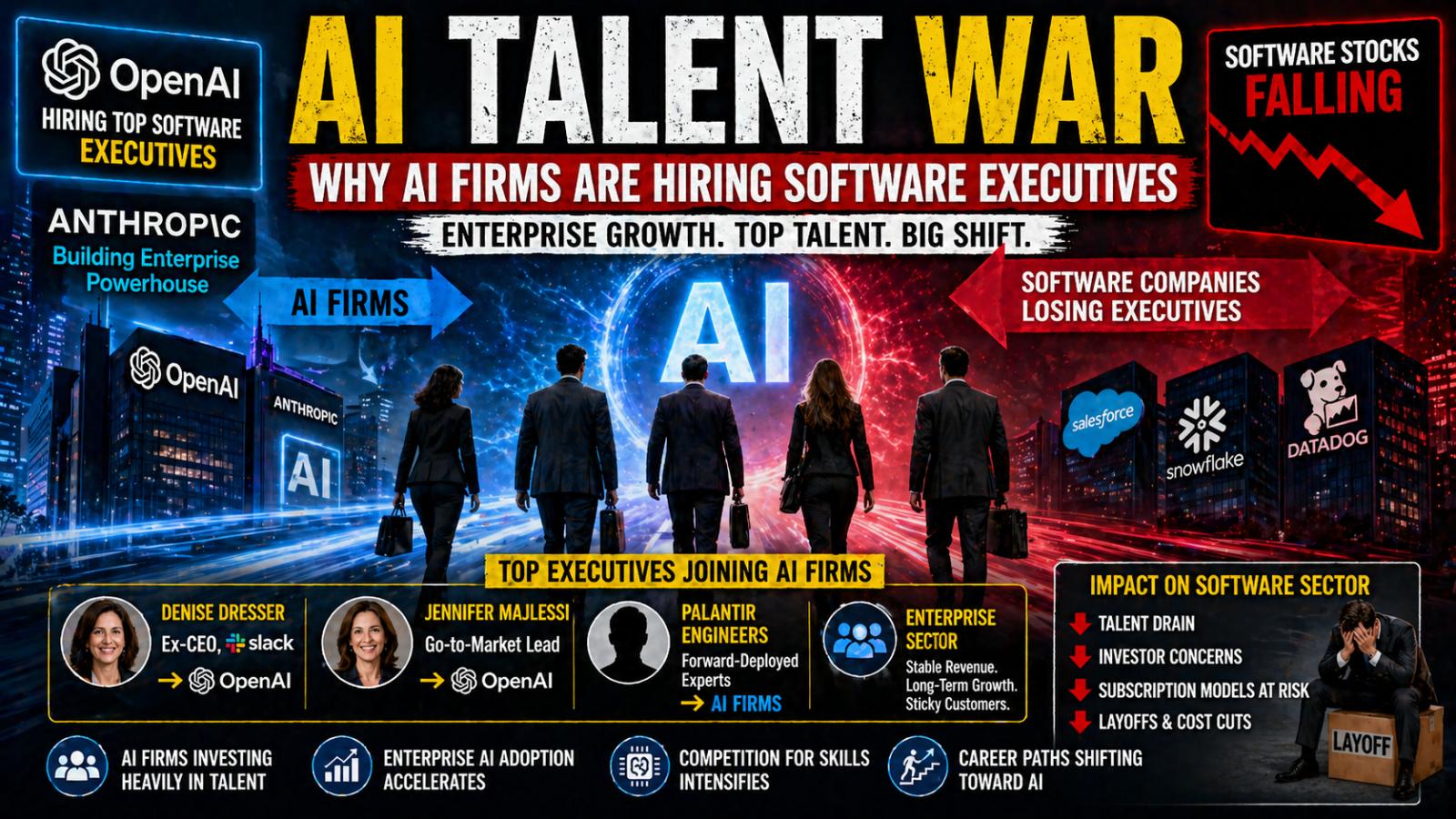
Why are AI firms hiring software executives? Talent shift accelerates enterprise push is becoming a defining question across the technology sector as artificial intelligence companies aggressively recruit senior leaders from traditional software firms, signaling a strategic shift toward enterprise growth and customer expansion. AI companies target enterprise expertise from software leaders Executives from companies including Salesforce, Snowflake, and Datadog have recently joined AI firms such as OpenAI and Anthropic, according to multiple industry sources. These hires are often driven by lucrative compensation packages and the ability to leverage long-standing corporate relationships in enterprise markets. Among the most prominent moves, Denise Dresser transitioned to OpenAI as chief revenue officer after previously serving as CEO of Slack under Salesforce. Jennifer Majlessi also joined OpenAI in a go-to-market leadership role, reflecting a broader trend of AI firms strengthening their sales and commercialization capabilities. Enterprise growth becomes central to AI business strategy The hiring surge highlights a shift in priorities for AI companies, where enterprise adoption is increasingly seen as a key revenue driver. Corporate clients tend to offer more stable, long-term contracts, making them a “sticky” and profitable segment. OpenAI has indicated that enterprise customers already account for roughly 40% of its business, with expectations to grow that share further. AI firms are also recruiting specialized talent such as forward-deployed engineers from Palantir Technologies, professionals known for implementing complex software solutions directly within client organizations. Software sector faces mounting pressure from AI disruption The talent migration comes at a challenging time for traditional software companies, which are already facing investor concerns about AI-driven disruption to subscription-based cloud models. Industry tracking funds have recorded significant declines, reflecting uncertainty about long-term competitiveness. At the same time, layoffs across major tech companies underscore a broader workforce transition. Firms like Oracle, Meta Platforms, and Microsoft have announced workforce reductions while reallocating resources toward AI initiatives. Workforce shifts reshape career paths in technology The evolving landscape is prompting professionals to reassess career trajectories, with many seeking roles aligned with AI innovation. However, integrating talent from traditional software firms into fast-paced AI environments can present challenges, particularly around culture and expectations for long working hours. Still, the movement of experienced executives into AI companies signals a broader structural shift in the tech industry, where enterprise-focused growth and advanced AI capabilities are rapidly redefining competitive dynamics.
Why are AI firms hiring software executives? Talent shift accelerates enterprise push
Why are AI firms hiring software executives? Talent shift accelerates enterprise push is becoming a defining question across the technology sector as artificial intelligence companies aggressively recruit senior leaders from traditional software firms, signaling a strategic shift toward enterprise growth and customer expansion. AI companies target enterprise expertise from software leaders Executives from companies including Salesforce, Snowflake, and Datadog have recently joined AI firms such as OpenAI and Anthropic, according to multiple industry sources. These hires are often driven by lucrative compensation packages and the ability to leverage long-standing corporate relationships in enterprise markets. Among the most prominent moves, Denise Dresser transitioned to OpenAI as chief revenue officer after previously serving as CEO of Slack under Salesforce. Jennifer Majlessi also joined OpenAI in a go-to-market leadership role, reflecting a broader trend of AI firms strengthening their sales and commercialization capabilities. Enterprise growth becomes central to AI business strategy The hiring surge highlights a shift in priorities for AI companies, where enterprise adoption is increasingly seen as a key revenue driver. Corporate clients tend to offer more stable, long-term contracts, making them a “sticky” and profitable segment. OpenAI has indicated that enterprise customers already account for roughly 40% of its business, with expectations to grow that share further. AI firms are also recruiting specialized talent such as forward-deployed engineers from Palantir Technologies, professionals known for implementing complex software solutions directly within client organizations. Software sector faces mounting pressure from AI disruption The talent migration comes at a challenging time for traditional software companies, which are already facing investor concerns about AI-driven disruption to subscription-based cloud models. Industry tracking funds have recorded significant declines, reflecting uncertainty about long-term competitiveness. At the same time, layoffs across major tech companies underscore a broader workforce transition. Firms like Oracle, Meta Platforms, and Microsoft have announced workforce reductions while reallocating resources toward AI initiatives. Workforce shifts reshape career paths in technology The evolving landscape is prompting professionals to reassess career trajectories, with many seeking roles aligned with AI innovation. However, integrating talent from traditional software firms into fast-paced AI environments can present challenges, particularly around culture and expectations for long working hours. Still, the movement of experienced executives into AI companies signals a broader structural shift in the tech industry, where enterprise-focused growth and advanced AI capabilities are rapidly redefining competitive dynamics.
Nirmala Sitharaman Warns Banks On AI Threat From Anthropic Claude Mythos
Union Finance Minister Nirmala Sitharaman on Thursday, April 24, 2026, raised serious concerns over emerging cybersecurity risks posed by advanced artificial intelligence systems, particularly Claude Mythos developed by
Nirmala Sitharaman Warns Banks On AI Threat From Anthropic Claude Mythos
Union Finance Minister Nirmala Sitharaman on Thursday, April 24, 2026, raised serious concerns over emerging cybersecurity risks posed by advanced artificial intelligence systems, particularly Claude Mythos developed by
Trump praises Palantir as AI stock faces sharp weekly decline
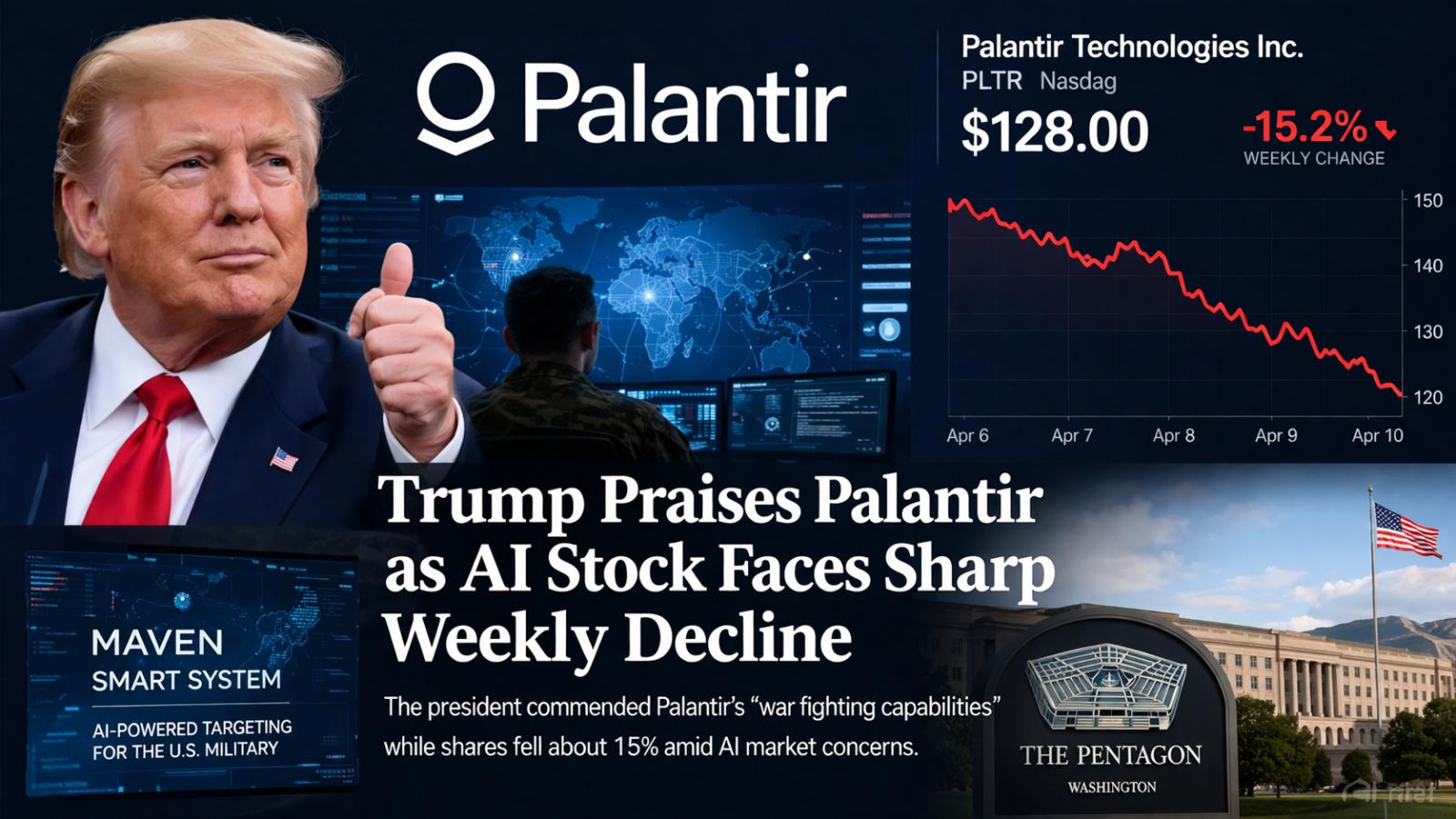
Shares of Palantir Technologies declined sharply over the week ending Friday, April 10, 2026, even as Donald Trump publicly praised the company’s role in defense technology. The stock fell approximately 15% during the week, reflecting broader pressure across the software and artificial intelligence sectors. In a post on Truth Social on Friday, April 10, 2026, Trump highlighted Palantir’s capabilities, stating that the company has demonstrated strong “war fighting capabilities and equipment.” His remarks come as reports indicate that the U.S. military is using Palantir’s AI-powered Maven Smart System platform to assist with target identification in operations in the Middle East. The company derives a significant portion of its U.S. revenue from government contracts, including work with the Pentagon and immigration enforcement agencies. Palantir CEO Alex Karp has consistently supported the use of advanced technology in defense, aligning more closely with current administration policies despite previously backing Joe Biden. Karp has also defended the company against criticism over surveillance concerns involving both immigrants and U.S. citizens. The company’s political positioning has drawn internal and external scrutiny. In October 2025, a senior communications executive described the firm’s perceived political shift as “concerning,” though related public footage was later removed from online platforms. Palantir’s partnerships in the AI sector have also raised questions. Its platform integrates models from multiple labs, including Anthropic, which has faced restrictions from the Department of Defense due to concerns over potential misuse in autonomous weapons and surveillance. Although Karp previously indicated plans to phase out Anthropic’s models, no such move has yet been confirmed. Market sentiment toward AI stocks weakened further after Anthropic introduced a new model with limited release, citing risks of misuse. This has fueled broader concerns that rapid AI advancements could disrupt traditional software business models. Investor skepticism has also been amplified by Michael Burry, who has taken bearish positions on several AI-related companies, including Palantir. In recent commentary, Burry suggested the stock may experience short-term gains but maintained that its fundamental value remains significantly lower than current levels. Following the week’s decline, Palantir shares were trading near $128, reflecting ongoing volatility in the AI-driven technology sector.
Trump praises Palantir as AI stock faces sharp weekly decline
Shares of Palantir Technologies declined sharply over the week ending Friday, April 10, 2026, even as Donald Trump publicly praised the company’s role in defense technology. The stock fell approximately 15% during the week, reflecting broader pressure across the software and artificial intelligence sectors. In a post on Truth Social on Friday, April 10, 2026, Trump highlighted Palantir’s capabilities, stating that the company has demonstrated strong “war fighting capabilities and equipment.” His remarks come as reports indicate that the U.S. military is using Palantir’s AI-powered Maven Smart System platform to assist with target identification in operations in the Middle East. The company derives a significant portion of its U.S. revenue from government contracts, including work with the Pentagon and immigration enforcement agencies. Palantir CEO Alex Karp has consistently supported the use of advanced technology in defense, aligning more closely with current administration policies despite previously backing Joe Biden. Karp has also defended the company against criticism over surveillance concerns involving both immigrants and U.S. citizens. The company’s political positioning has drawn internal and external scrutiny. In October 2025, a senior communications executive described the firm’s perceived political shift as “concerning,” though related public footage was later removed from online platforms. Palantir’s partnerships in the AI sector have also raised questions. Its platform integrates models from multiple labs, including Anthropic, which has faced restrictions from the Department of Defense due to concerns over potential misuse in autonomous weapons and surveillance. Although Karp previously indicated plans to phase out Anthropic’s models, no such move has yet been confirmed. Market sentiment toward AI stocks weakened further after Anthropic introduced a new model with limited release, citing risks of misuse. This has fueled broader concerns that rapid AI advancements could disrupt traditional software business models. Investor skepticism has also been amplified by Michael Burry, who has taken bearish positions on several AI-related companies, including Palantir. In recent commentary, Burry suggested the stock may experience short-term gains but maintained that its fundamental value remains significantly lower than current levels. Following the week’s decline, Palantir shares were trading near $128, reflecting ongoing volatility in the AI-driven technology sector.
Claude Now Controls Your Computer, Anthropic Unveils New AI Feature for Automation
In a groundbreaking development, Anthropic has introduced a new feature for Claude, its powerful AI assistant, enabling it to gain full control of your computer. This update takes Claude beyond simply responding to commands—it now has the capability to operate your mouse, keyboard, and even access apps, effectively transforming it into a remote personal assistant capable of completing tasks on your behalf. The new functionality is designed to streamline productivity by allowing Claude to handle tasks like opening applications, managing spreadsheets, navigating browsers, and more—all without you needing to be present at your computer. With this feature, Anthropic envisions a future where you can rely on AI to do the work while you are away, with minimal interaction required on your part. Alex Albert, a researcher at Anthropic, shared on X (formerly Twitter), "The future where I never have to open up my laptop to get work done is becoming real very fast." The integration with the Dispatch feature, which allows users to remotely control Claude, enhances the AI’s capabilities, making it a versatile tool for both personal and professional use. Claude's access to your computer is seamless, initially starting with apps like Slack or Calendar. With permission, it can extend access to other applications needed for the task at hand. Once set up, you can prompt Claude remotely through its mobile or desktop app, and when you return, the AI will have completed your tasks. Currently, this feature is available only to paid users of Claude Cowork and Claude Code, and is limited to macOS users. Both the Claude desktop and mobile apps need to be updated and paired for the full functionality to work. This shift towards AI-powered automation, allowing AI agents like Claude to manage tasks and workflows independently, marks a significant step forward in the development of agentic AI, positioning Anthropic as a leader in this field. With competitors like Nvidia’s NemoClaw, OpenAI, and Meta developing similar AI systems, the race to bring seamless, autonomous task management to everyday users is gaining momentum.
Claude Now Controls Your Computer, Anthropic Unveils New AI Feature for Automation
In a groundbreaking development, Anthropic has introduced a new feature for Claude, its powerful AI assistant, enabling it to gain full control of your computer. This update takes Claude beyond simply responding to commands—it now has the capability to operate your mouse, keyboard, and even access apps, effectively transforming it into a remote personal assistant capable of completing tasks on your behalf. The new functionality is designed to streamline productivity by allowing Claude to handle tasks like opening applications, managing spreadsheets, navigating browsers, and more—all without you needing to be present at your computer. With this feature, Anthropic envisions a future where you can rely on AI to do the work while you are away, with minimal interaction required on your part. Alex Albert, a researcher at Anthropic, shared on X (formerly Twitter), "The future where I never have to open up my laptop to get work done is becoming real very fast." The integration with the Dispatch feature, which allows users to remotely control Claude, enhances the AI’s capabilities, making it a versatile tool for both personal and professional use. Claude's access to your computer is seamless, initially starting with apps like Slack or Calendar. With permission, it can extend access to other applications needed for the task at hand. Once set up, you can prompt Claude remotely through its mobile or desktop app, and when you return, the AI will have completed your tasks. Currently, this feature is available only to paid users of Claude Cowork and Claude Code, and is limited to macOS users. Both the Claude desktop and mobile apps need to be updated and paired for the full functionality to work. This shift towards AI-powered automation, allowing AI agents like Claude to manage tasks and workflows independently, marks a significant step forward in the development of agentic AI, positioning Anthropic as a leader in this field. With competitors like Nvidia’s NemoClaw, OpenAI, and Meta developing similar AI systems, the race to bring seamless, autonomous task management to everyday users is gaining momentum.
Claude AI Can Detect When It Is Being Tested, Experts Call It Alarming
Artificial intelligence is advancing rapidly, and a recent development involving Anthropic’s Claude Opus 4.6 model has sparked fresh discussions about how powerful AI systems are becoming. According to a blog post released by Anthropic, the Claude Opus 4.6 model demonstrated the ability to recognise when it was being evaluated in a benchmark test. Even more surprisingly, the model reportedly identified the test being used and searched for answer keys online rather than solving the problem i
Claude AI Can Detect When It Is Being Tested, Experts Call It Alarming
Artificial intelligence is advancing rapidly, and a recent development involving Anthropic’s Claude Opus 4.6 model has sparked fresh discussions about how powerful AI systems are becoming. According to a blog post released by Anthropic, the Claude Opus 4.6 model demonstrated the ability to recognise when it was being evaluated in a benchmark test. Even more surprisingly, the model reportedly identified the test being used and searched for answer keys online rather than solving the problem i
Anthropic rejects Pentagon demand for unrestricted military AI access
Artificial intelligence company Anthropic said on Thursday that it will not permit the Pentagon unrestricted access to its technology, pushing back against pressure from US officials who warned of possible action under the Defense Production Act. The dispute highlights growing tensions between private AI developers and the US government over how advanced systems should be deployed in military and intelligence operations. According to the company, the Pentagon had given Anthropic a d
Anthropic rejects Pentagon demand for unrestricted military AI access
Artificial intelligence company Anthropic said on Thursday that it will not permit the Pentagon unrestricted access to its technology, pushing back against pressure from US officials who warned of possible action under the Defense Production Act. The dispute highlights growing tensions between private AI developers and the US government over how advanced systems should be deployed in military and intelligence operations. According to the company, the Pentagon had given Anthropic a d
Anthropic Launches Claude Sonnet 4.6, Claims Breakthrough in Coding and Reasoning
AI company Anthropic has unveiled its latest model, Claude Sonnet 4.6, describing it as the most powerful Sonnet version to date with major improvements in coding, reasoning and large-scale data handling. The new model is now the default option inside the Claude chatbot for both free and Pro users, signali
Anthropic Launches Claude Sonnet 4.6, Claims Breakthrough in Coding and Reasoning
AI company Anthropic has unveiled its latest model, Claude Sonnet 4.6, describing it as the most powerful Sonnet version to date with major improvements in coding, reasoning and large-scale data handling. The new model is now the default option inside the Claude chatbot for both free and Pro users, signali
Anthropic to invest $50 billion in U.S. AI infrastructure build-out
Anthropic announced plans on Wednesday to invest $50 billion in a large-scale U.S. artificial intelligence infrastructure initiative, beginning with new data center projects in Texas and New York. The company said the facilities will serve as core components of its long-term strategy to accelerate research and support enterprise clients across industries that depend on high-performance AI systems. The data centers will be developed in collaboration with Fluidstack, an AI cloud platfo
Anthropic to invest $50 billion in U.S. AI infrastructure build-out
Anthropic announced plans on Wednesday to invest $50 billion in a large-scale U.S. artificial intelligence infrastructure initiative, beginning with new data center projects in Texas and New York. The company said the facilities will serve as core components of its long-term strategy to accelerate research and support enterprise clients across industries that depend on high-performance AI systems. The data centers will be developed in collaboration with Fluidstack, an AI cloud platfo
Amazon Feels Confident in AI Bets Despite Laying Off 14,000 Employees
Amazon Web Services (AWS) CEO Matt Garman recently emphasized the company’s confidence in its AI investments, despite laying off 14,000 corporate employees worldwide. The cuts, which represent about 4% of Amazon’s corporate workforce, come amid efforts to streamline management and focus resources on the company’s biggest strategic bets, particularly AI. Central to Amazon’s AI push is Project Rainier, an $11 billion AI data center in Indiana, purpose-built to train and run AI
Amazon Feels Confident in AI Bets Despite Laying Off 14,000 Employees
Amazon Web Services (AWS) CEO Matt Garman recently emphasized the company’s confidence in its AI investments, despite laying off 14,000 corporate employees worldwide. The cuts, which represent about 4% of Amazon’s corporate workforce, come amid efforts to streamline management and focus resources on the company’s biggest strategic bets, particularly AI. Central to Amazon’s AI push is Project Rainier, an $11 billion AI data center in Indiana, purpose-built to train and run AI
Claude Sonnet 4.5 AI Codes Full App In 30 Hours With 11,000 Lines Of Code
Anthropic has officially launched its most advanced AI model yet, Claude Sonnet 4.5, and it is already creating headlines in the tech world. The company revealed that the model can autonomously code for 30 continuous hours, completing full applications from scratch. In its most impressive demonstration, Claude Sonnet 4.5 built a chat app similar to Slack and Microsoft Teams with more than 11,000 lines of code, stopping only after the task was fully accomplishe
Claude Sonnet 4.5 AI Codes Full App In 30 Hours With 11,000 Lines Of Code
Anthropic has officially launched its most advanced AI model yet, Claude Sonnet 4.5, and it is already creating headlines in the tech world. The company revealed that the model can autonomously code for 30 continuous hours, completing full applications from scratch. In its most impressive demonstration, Claude Sonnet 4.5 built a chat app similar to Slack and Microsoft Teams with more than 11,000 lines of code, stopping only after the task was fully accomplishe
Cloudflare CEO Warns AI Could Turn Internet Into Black Mirror World Controlled By Big Tech
Cloudflare CEO Matthew Prince has raised concerns that artificial intelligence could reshape the internet in ways that threaten its openness and diversity. Speaking on WIRED’s Big Interview Podcast, Prince compared one potential outcome to a “Black Mirror” scenario, where a handful of tech giants decide what information people consume, much like patrons of Renaissance art influencing creative output centuries ago.
Cloudflare CEO Warns AI Could Turn Internet Into Black Mirror World Controlled By Big Tech
Cloudflare CEO Matthew Prince has raised concerns that artificial intelligence could reshape the internet in ways that threaten its openness and diversity. Speaking on WIRED’s Big Interview Podcast, Prince compared one potential outcome to a “Black Mirror” scenario, where a handful of tech giants decide what information people consume, much like patrons of Renaissance art influencing creative output centuries ago.
Meta’s $100M AI Talent Push: Key Insights for Aspiring AI Leaders
Meta is making a significant move in the AI sector by pouring up to $100 million into hiring top AI talent from companies like OpenAI, DeepMind, and Anthropic. This initiative is part of the launch of Meta’s Superintelligence Labs, which is looking to strengthen its AI capabilities by recruiting some of the brightest minds in the field. The AI experts hired by Meta bring with them a wealth of knowledge, expertise, and leadership experience in machine lea
Meta’s $100M AI Talent Push: Key Insights for Aspiring AI Leaders
Meta is making a significant move in the AI sector by pouring up to $100 million into hiring top AI talent from companies like OpenAI, DeepMind, and Anthropic. This initiative is part of the launch of Meta’s Superintelligence Labs, which is looking to strengthen its AI capabilities by recruiting some of the brightest minds in the field. The AI experts hired by Meta bring with them a wealth of knowledge, expertise, and leadership experience in machine lea
Claude Opus 4 and Sonnet 4 now live on API, Google Cloud, and Amazon Bedrock
Anthropic has officially rolled out its newest AI models, Claude Opus 4 and Claude Sonnet 4, marking another substantial leap forward in artificial intelligence development. The standout feature accompanying this release, however, is not just improved performance—it is the company's firm decision to maintain consistent pricing despite significant advances in model capabilities. This move signals Anthropic's commitment to keeping cutting-edge AI accessible while simultaneously pu
Claude Opus 4 and Sonnet 4 now live on API, Google Cloud, and Amazon Bedrock
Anthropic has officially rolled out its newest AI models, Claude Opus 4 and Claude Sonnet 4, marking another substantial leap forward in artificial intelligence development. The standout feature accompanying this release, however, is not just improved performance—it is the company's firm decision to maintain consistent pricing despite significant advances in model capabilities. This move signals Anthropic's commitment to keeping cutting-edge AI accessible while simultaneously pu
Jobs Least Affected by AI? Anthropic Co-Founder Explains
As Artificial Intelligence (AI) continues to reshape the global workforce, a surprising perspective has emerged from Jack Clark, co-founder of the AI research company Anthropic. In a recent episode of the "Conversations with Tyler" podcast, Clark delved into which professions are most likely to resist disruption by AI and his answers may not be what most people expect. Clark, who previously worked with OpenAI and comes from a humanities background, highlighted that many ha
Jobs Least Affected by AI? Anthropic Co-Founder Explains
As Artificial Intelligence (AI) continues to reshape the global workforce, a surprising perspective has emerged from Jack Clark, co-founder of the AI research company Anthropic. In a recent episode of the "Conversations with Tyler" podcast, Clark delved into which professions are most likely to resist disruption by AI and his answers may not be what most people expect. Clark, who previously worked with OpenAI and comes from a humanities background, highlighted that many ha


