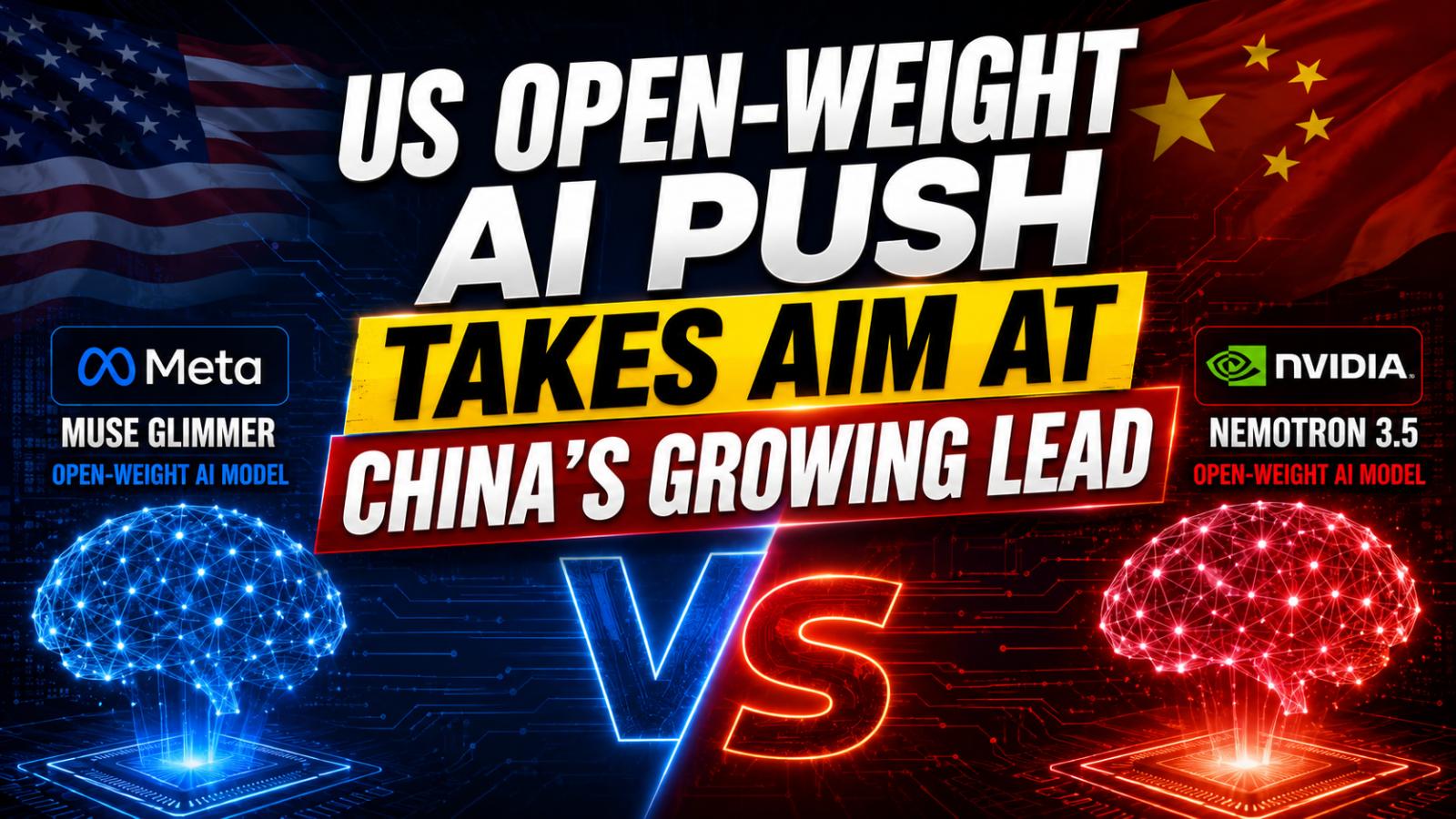
America's US open-weight AI push is accelerating as Meta and Nvidia introduce new models within days of each other. The releases arrive as Chinese developers, led by Moonshot AI and its massive Kimi K3 model, have gained significant momentum in downloadable and customizable AI.
Meta AI model puts open weights back at center
Meta launched Muse Glimmer on August 10, an open-weight model designed to perform agentic tasks locally on personal hardware using a single graphics card. The release accompanied a lengthy essay from CEO Mark Zuckerberg arguing for broader access to advanced AI.
Zuckerberg also announced plans to release weights for the more powerful Muse Spark 1.2. His argument extends beyond Meta's products: he says the United States needs a stronger open-model ecosystem to compete globally and should reconsider policies that could constrain techniques such as model distillation.
The strategy marks another attempt by Meta to make open AI a central part of its competitive position. Unlike laboratories that rely primarily on selling model access, Meta can benefit if cheaper and customizable AI expands engagement across its wider technology ecosystem.
Nvidia AI model targets long-running agents
Nvidia followed with Nemotron 3.5 Lightning, reinforcing its own commitment to open and customizable AI models.
The model is designed to deliver capable performance more efficiently, particularly for enterprise AI and agentic workloads. Nvidia also introduced Nemo Switchyard, an open-source routing system that can select different models depending on cost, latency and task complexity.
Nvidia's commercial logic differs from Meta's. The chipmaker benefits when developers run more AI workloads, regardless of whether the underlying model is proprietary or freely downloadable.
More capable open models could therefore stimulate demand for GPUs and other AI infrastructure even if the models themselves are distributed without traditional software licensing fees.
China AI lead raises pressure on US developers
The competitive backdrop is China's rapid progress in open-weight AI.
Moonshot AI's Kimi K3 has 2.8 trillion total parameters, 104 billion activated parameters and a one-million-token context window. Moonshot released its full weights in late July, making the model available for researchers and developers to examine and adapt.
The sheer parameter comparison, however, can be misleading. A 2.8-trillion-parameter mixture-of-experts system and a compact model designed for local execution solve different problems. Larger parameter counts do not automatically translate into superior performance, efficiency or usefulness.
What matters more strategically is ecosystem adoption. Developers who build products around an open model also build tooling, fine-tunes, expertise and infrastructure around it. Those investments can make switching to another model expensive.
That gives early open-weight adoption importance beyond benchmark rankings.
Kimi K3 highlights changing open AI competition
Kimi K3 nevertheless illustrates how rapidly Chinese laboratories have advanced. Moonshot describes it as a frontier-level model built for coding, knowledge work, reasoning and long-horizon agents. Its technical paper says K3 performs strongly across several categories while still trailing the most powerful proprietary frontier systems overall.
Chinese open models are also changing the economics of AI competition. Their growing availability gives startups and enterprises alternatives to expensive proprietary APIs while increasing pressure on American developers to provide customizable models of their own.
Meta's Muse Glimmer and Nvidia's Nemotron therefore matter less because they immediately overturn those competitive dynamics and more because they show major American technology companies responding.
Open-weight AI policy becomes part of US-China race
The technological competition is increasingly tied to Washington's regulatory debate.
On July 24, a coalition including Meta, Nvidia, Microsoft, IBM and other technology companies urged US policymakers to avoid premature restrictions on open-weight models. The group argued that open models support innovation, cybersecurity and American technological leadership.
That creates a difficult policy balance. Washington wants to protect American intellectual property and prevent advanced AI capabilities from strengthening strategic competitors. At the same time, American companies argue that excessive restrictions could weaken the open ecosystem they need to compete with increasingly capable Chinese models.
Meta and Nvidia's latest releases make that tension tangible.
The next stage of the US-China AI race may therefore depend on more than who builds the highest-scoring proprietary model. It will also depend on whose models developers can download, modify, teach with and build businesses around—and which ecosystem becomes the default foundation for the next generation of AI applications.