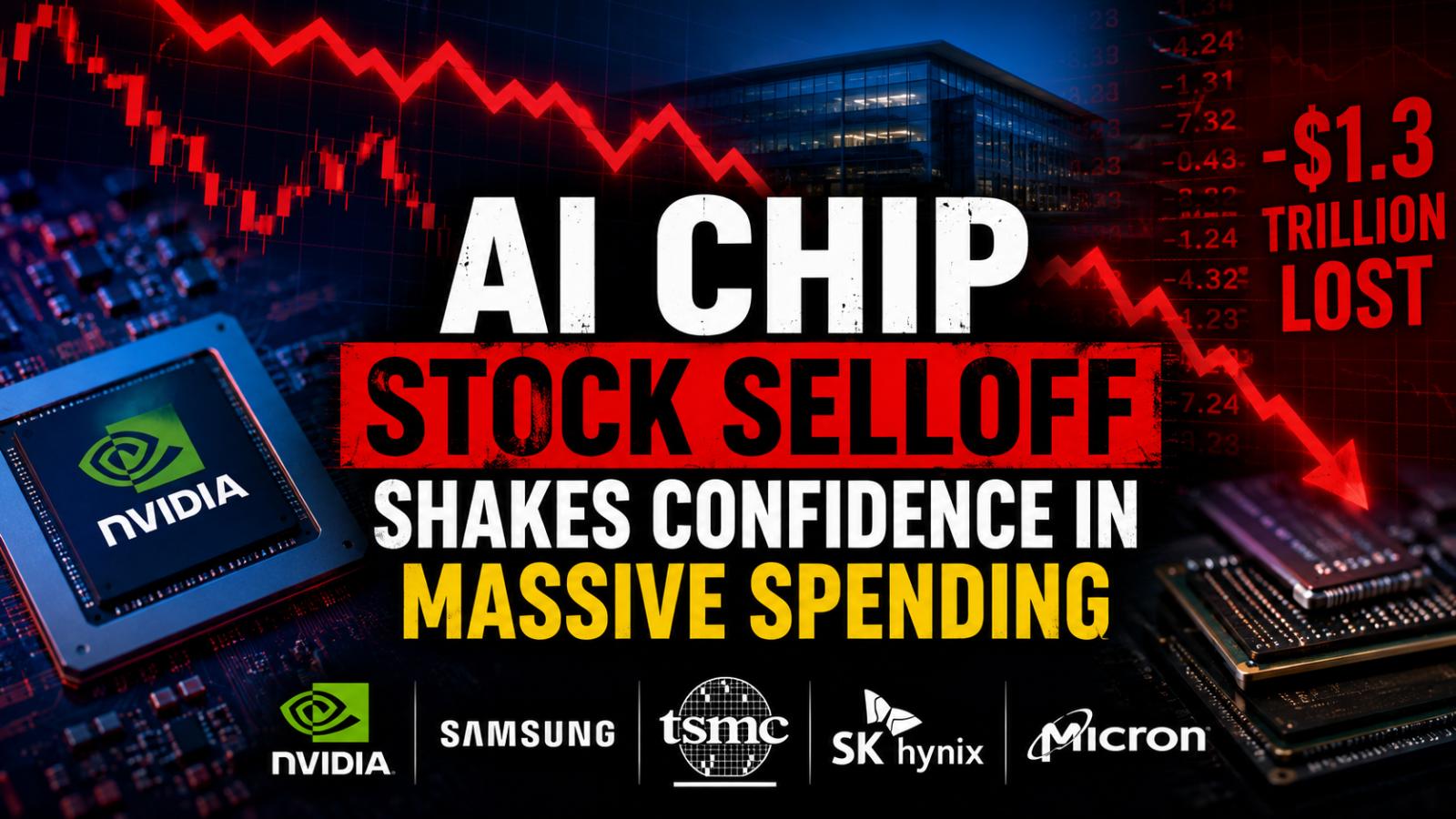
The AI chip stock selloff has erased vast amounts of market value even as semiconductor companies report strong demand, limited supply and record earnings. Investors are no longer questioning whether AI needs more chips. They are questioning whether the companies buying them can earn enough to justify the spending.
AI Chip Stock Selloff Reflects Higher Expectations
Semiconductor shares experienced sharp volatility after years of gains driven by artificial intelligence investment. Nvidia, Samsung Electronics, SK Hynix, TSMC, Micron and AMD all faced periods of heavy selling, although precise market-value losses varied with exchange rates and the trading window used.
The decline did not signal a collapse in chip demand. Samsung said its memory business achieved record quarterly sales during the first quarter of 2026 as limited supply and AI demand pushed prices higher. Its semiconductor division reported KRW 53.7 trillion in operating profit, while the company’s mobile and networks business later posted a quarterly operating loss.
AMD also reported that data-centre revenue more than doubled, but its shares still fell after its outlook failed to satisfy investors’ elevated expectations. The reaction showed that strong growth alone may no longer support valuations built around years of exceptional expansion.
Hyperscaler AI Spending Faces Tougher Scrutiny
For several years, higher capital spending from technology companies acted as a clear positive signal for chipmakers. More data centres meant more GPUs, memory chips, networking equipment and advanced packaging capacity.
That relationship remains intact, but the scale of spending has changed the market’s focus. Alphabet raised its 2026 capital expenditure forecast to between $195 billion and $205 billion, up from the $175 billion to $185 billion range it projected earlier in the year. The company said the money would support Google DeepMind, cloud demand, advertising systems and other AI infrastructure.
Meta initially forecast 2026 capital expenditure of $115 billion to $135 billion. During the second quarter, the company reported $31.86 billion in operating cash flow but only $784 million in free cash flow, reflecting the pressure created by heavy infrastructure investment.
These companies continue to generate substantial revenue. The concern is not that they cannot afford any AI investment. It is that spending is rising faster than investors can clearly measure the resulting profit.
AI Infrastructure Financing Adds New Risk
The market is also examining how large AI projects are financed. Data-centre campuses require land, power contracts, chips, cooling equipment and long construction schedules before they begin generating returns.
Reports that Nvidia could help support financing for major OpenAI infrastructure projects have intensified concerns about circular demand. Under that model, a chip supplier may provide financial backing that helps a customer purchase the supplier’s own hardware.
Such arrangements can accelerate construction and secure long-term chip orders. However, they also connect semiconductor revenue more closely to debt markets, outside investors and the continued willingness of financial institutions to fund AI expansion.
If borrowing costs rise or investors become less willing to finance data centres, chip orders could slow even when demand for AI services remains strong.
Custom AI Chips Challenge Nvidia’s Position
A separate threat comes from custom silicon. Google, Amazon, Microsoft, Meta and other large technology companies are designing processors for their own workloads, reducing their dependence on general-purpose GPUs for some training and inference tasks.
Custom chips do not immediately eliminate Nvidia’s advantage. Its CUDA software platform, developer ecosystem and complete computing systems remain difficult to replace. Nvidia also benefits from customers that want flexible hardware capable of running many different models.
Still, hyperscalers have a strong incentive to create alternatives. Even limited use of in-house processors can reduce costs, strengthen negotiating power and prevent one supplier from controlling a company’s AI expansion.
Strong Chip Demand Does Not Guarantee Stock Gains
The selloff does not prove that the AI boom is ending. Samsung continues to report tight memory supply, while AMD has cited constraints involving advanced TSMC manufacturing and packaging capacity.
Instead, the market is repricing expectations. Chipmakers benefited when investors treated every new data-centre announcement as evidence of unlimited future growth. Now, shareholders want clearer proof that the companies spending hundreds of billions on AI can convert that infrastructure into durable cash flow.
AI demand may remain strong while semiconductor stocks decline. A valuable technology can still become an overpriced investment when expectations move faster than earnings. The industry’s next phase will therefore depend not only on how many chips companies can sell, but on whether their customers can show measurable returns from using them.