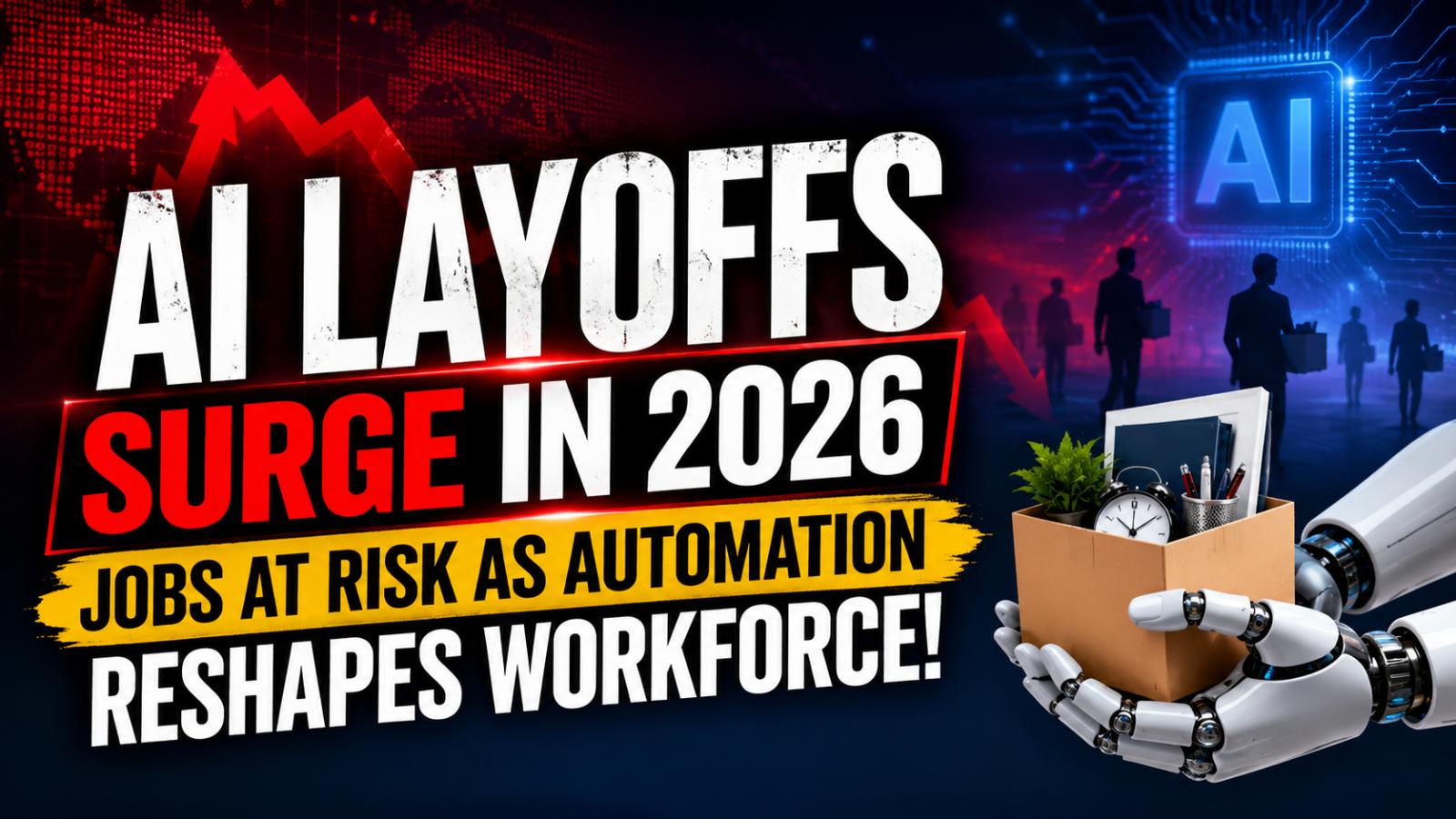
AI layoffs in 2026 are no longer just a prediction about the future of work. Companies are increasingly linking workforce reductions to automation and artificial intelligence, while technology firms remain at the center of the cuts. Yet the data also show that AI is reshaping jobs in more complex ways than simply replacing workers.
US AI job cuts rise sharply in 2026
The latest figures from Challenger, Gray & Christmas show a much larger AI-related layoff total than some earlier estimates. Through July 2026, US employers announced 477,033 job cuts, with artificial intelligence cited in 112,713 of them, or about 24% of the total. AI was the leading stated reason for cuts for a fifth consecutive month in July. Since Challenger began tracking AI separately in 2023, it has been cited in 184,538 announced job cuts.
Those figures matter because they show how quickly AI has moved into corporate restructuring decisions. However, the data should not be interpreted as proof that every affected position was directly replaced by an AI system. Challenger itself distinguishes between layoffs explicitly attributed to AI and broader technological updates where the role of AI may be less clear.
Tech AI layoffs remain heavily concentrated
Technology has emerged as the main center of workforce reductions. Through July, the sector announced 149,023 cuts, up 67% from the same period in 2025 and representing roughly 31% of all announced US job cuts. Transportation, healthcare, services and government also reported significant reductions, but tech remained far ahead.
That concentration supports the argument that AI adoption is playing an important role in restructuring knowledge-based work. Still, broader economic pressures cannot be ignored. Market conditions, business closures, restructuring and contract losses also accounted for substantial numbers of layoffs in 2026.
Salesforce AI highlights changing support work
Customer support is one of the clearest areas where AI agents can absorb repetitive, text-heavy tasks. Salesforce has heavily promoted an operating model in which employees work alongside AI agents, reflecting a broader move toward automated customer service and sales workflows.
Earlier comments from Salesforce CEO Marc Benioff about reducing the company’s support workforce from roughly 9,000 to about 5,000 became a prominent example of this shift. That reduction was discussed in 2025, not as a newly completed August 2026 layoff, so presenting it as a fresh 2026 event would be misleading.
AI skill risk creates a different employment divide
Gallup research adds an important complication. Among workers who had been laid off, 62% were people who used AI once a year or less, compared with 50% among currently employed workers. In technology roles, workers using AI less than monthly were three times as likely to have been laid off as workers using it at least monthly.
That does not prove that avoiding AI causes layoffs. Gallup explicitly notes that differences in job type, skills and exposure may explain part of the relationship. More importantly, only 1% of laid-off workers surveyed by Gallup personally identified AI or automation as the primary reason for losing their job.
AI hiring slowdown may be the bigger story
Layoffs capture only positions that already existed. The harder effect to measure is hiring that never happens because companies expect smaller teams to produce more with AI. Entry-level coding, testing, support and administrative jobs may be particularly exposed because these roles often contain structured and repetitive tasks.
The picture is therefore more nuanced than saying AI is simply destroying employment. Challenger reported that employers announced 107,500 hiring plans through July, 25% more than during the same period in 2025. The evidence points toward a labor market being reorganized rather than universally dismantled, with growing pressure on workers and companies to adapt to AI-assisted workflows.