











AI Chip Stock Selloff Tests Faith in Massive Data Centre Spending
The AI chip stock selloff has erased vast amounts of market value even as semiconductor companies report strong demand, limited supply and record earnings. Investors are no longer questioning whether AI needs more chips. They are questioning whether the companies buying them can earn enough to justify the spending. AI Chip Stock Selloff Reflects Higher Expectations Semiconductor shares experienced sharp volatility after years of gains dr
AI Chip Stock Selloff Tests Faith in Massive Data Centre Spending
The AI chip stock selloff has erased vast amounts of market value even as semiconductor companies report strong demand, limited supply and record earnings. Investors are no longer questioning whether AI needs more chips. They are questioning whether the companies buying them can earn enough to justify the spending. AI Chip Stock Selloff Reflects Higher Expectations Semiconductor shares experienced sharp volatility after years of gains dr
Sanae Takaichi Unveils ¥370 Trillion AI Growth Strategy
Japanese Prime Minister Sanae Takaichi has unveiled a ¥370 trillion investment strategy targeting artificial intelligence, semiconductors, quantum technology and energy by 2040. The ambitious plan aims to strengthen Japan's economic competitiveness, reduce reliance on China and accelerate long-term industrial growth, but it has also raised concerns about fiscal sustainability and rising government debt.
Sanae Takaichi Unveils ¥370 Trillion AI Growth Strategy
Japanese Prime Minister Sanae Takaichi has unveiled a ¥370 trillion investment strategy targeting artificial intelligence, semiconductors, quantum technology and energy by 2040. The ambitious plan aims to strengthen Japan's economic competitiveness, reduce reliance on China and accelerate long-term industrial growth, but it has also raised concerns about fiscal sustainability and rising government debt.

China EUV prototype intensifies global AI chip race
China’s reported progress in extreme ultraviolet lithography has intensified the global race for advanced AI chips. Although its prototype cannot yet manufacture usable semiconductors, the project highlights why India must invest in chip equipment, research and skilled manufacturing. China EUV prototype reaches an important stage China has reportedly assembled an indigenous extreme ultraviolet lithography pro
China EUV prototype intensifies global AI chip race
China’s reported progress in extreme ultraviolet lithography has intensified the global race for advanced AI chips. Although its prototype cannot yet manufacture usable semiconductors, the project highlights why India must invest in chip equipment, research and skilled manufacturing. China EUV prototype reaches an important stage China has reportedly assembled an indigenous extreme ultraviolet lithography pro
India-Japan summit signals strategic shift beyond China
India-Japan summit reflects a broader strategic shift The India-Japan summit has drawn attention beyond New Delhi and Tokyo because its outcomes point to a wider realignment in Asia’s economic and security order. Japan’s plan to invest more than $61 billion in India over the next decade is the headline, but the deeper issue is why Tokyo is seeking stronger options outside China. Prime Minister Sanae Takai
India-Japan summit signals strategic shift beyond China
India-Japan summit reflects a broader strategic shift The India-Japan summit has drawn attention beyond New Delhi and Tokyo because its outcomes point to a wider realignment in Asia’s economic and security order. Japan’s plan to invest more than $61 billion in India over the next decade is the headline, but the deeper issue is why Tokyo is seeking stronger options outside China. Prime Minister Sanae Takai

India Japan economic ties shift toward supply chain resilience
India and Japan are steadily moving their partnership beyond routine trade discussions into a broader realignment shaped by global risk and industrial restructuring. What looks like increased investment flows is actually part of a deeper repositioning of how both countries want to secure long-term economic stability in an uncertain global environment. Investment growth driven by risk recalibration Japanese companies are expanding their footprint in India not only for growth but also to reduce exposure to concentrated supply networks in East Asia. Rising geopolitical friction and periodic trade restrictions have forced firms to reconsider how dependent they are on single-country manufacturing systems. India is increasingly viewed as a viable diversification hub due to its scale, labor availability, and expanding industrial base. Supply chain restructuring becomes the core driver The most significant shift is happening in supply chains rather than headline investment figures. Japanese manufacturers are gradually redesigning sourcing and production models to reduce vulnerabilities in electronics, automotive components, and precision engineering. India fits into this transition as an alternative production and assembly base, especially for sectors where demand is growing but diversification is still limited. Technology and industrial cooperation deepen Cooperation is also expanding into advanced sectors such as semiconductors, digital systems, and artificial intelligence. These areas are no longer treated as purely commercial exchanges but as strategic capabilities. Both countries are aligning on technology resilience, where production continuity and security of supply matter as much as cost efficiency. Rare earths and critical materials gain importance Another emerging focus is critical minerals and rare earth supply chains. These materials are essential for electronics, renewable energy systems, and defence manufacturing. Dependence on concentrated suppliers has pushed both India and Japan to explore alternative sourcing strategies and joint development frameworks to reduce long-term risk. Financial flows signal long-term positioning Japanese capital inflows into Indian financial institutions and industrial projects suggest more than short-term investment interest. Financial participation typically indicates long-term confidence in policy stability and market expansion. However, the real test will be whether this capital flow expands into deeper manufacturing integration rather than remaining portfolio-based exposure. Economic security becomes the defining theme At the core of this evolving relationship is economic security. Trade decisions are increasingly shaped by geopolitical uncertainty rather than pure cost advantage. This marks a shift from efficiency-driven globalization to resilience-driven partnerships, where countries prioritize stability over optimization. A cautious but strategic realignment The India–Japan partnership is gradually becoming a case study in how middle and advanced economies adjust to global fragmentation. While the direction is clear—greater cooperation in technology, investment, and supply chains—the pace will depend on regulatory alignment, infrastructure readiness, and how effectively both sides manage external geopolitical pressures.
India Japan economic ties shift toward supply chain resilience
India and Japan are steadily moving their partnership beyond routine trade discussions into a broader realignment shaped by global risk and industrial restructuring. What looks like increased investment flows is actually part of a deeper repositioning of how both countries want to secure long-term economic stability in an uncertain global environment. Investment growth driven by risk recalibration Japanese companies are expanding their footprint in India not only for growth but also to reduce exposure to concentrated supply networks in East Asia. Rising geopolitical friction and periodic trade restrictions have forced firms to reconsider how dependent they are on single-country manufacturing systems. India is increasingly viewed as a viable diversification hub due to its scale, labor availability, and expanding industrial base. Supply chain restructuring becomes the core driver The most significant shift is happening in supply chains rather than headline investment figures. Japanese manufacturers are gradually redesigning sourcing and production models to reduce vulnerabilities in electronics, automotive components, and precision engineering. India fits into this transition as an alternative production and assembly base, especially for sectors where demand is growing but diversification is still limited. Technology and industrial cooperation deepen Cooperation is also expanding into advanced sectors such as semiconductors, digital systems, and artificial intelligence. These areas are no longer treated as purely commercial exchanges but as strategic capabilities. Both countries are aligning on technology resilience, where production continuity and security of supply matter as much as cost efficiency. Rare earths and critical materials gain importance Another emerging focus is critical minerals and rare earth supply chains. These materials are essential for electronics, renewable energy systems, and defence manufacturing. Dependence on concentrated suppliers has pushed both India and Japan to explore alternative sourcing strategies and joint development frameworks to reduce long-term risk. Financial flows signal long-term positioning Japanese capital inflows into Indian financial institutions and industrial projects suggest more than short-term investment interest. Financial participation typically indicates long-term confidence in policy stability and market expansion. However, the real test will be whether this capital flow expands into deeper manufacturing integration rather than remaining portfolio-based exposure. Economic security becomes the defining theme At the core of this evolving relationship is economic security. Trade decisions are increasingly shaped by geopolitical uncertainty rather than pure cost advantage. This marks a shift from efficiency-driven globalization to resilience-driven partnerships, where countries prioritize stability over optimization. A cautious but strategic realignment The India–Japan partnership is gradually becoming a case study in how middle and advanced economies adjust to global fragmentation. While the direction is clear—greater cooperation in technology, investment, and supply chains—the pace will depend on regulatory alignment, infrastructure readiness, and how effectively both sides manage external geopolitical pressures.

India Japan summit 2026 boosts FOIP rare earth strategy
The India Japan Summit 2026 is emerging as more than diplomatic engagement, shifting toward a structured economic alignment under the Free and Open Indo-Pacific (FOIP) framework. Japan is positioning India as a long-term partner in building alternative production networks outside China’s dominant supply ecosystem. The focus is no longer symbolic cooperation but measurable industrial integration across energy, technology, and critical materials. Rare Earth Dependency and Strategic Diversification A major driver of the summit is global concern over rare earth concentration in China. These materials are essential for electric vehicles, defence systems, and semiconductor manufacturing. Japan has been actively seeking diversification, and India is being viewed as a viable partner due to its untapped mineral reserves and growing extraction capability. However, this shift is not immediate. India still faces infrastructure gaps in refining and processing, which limits its ability to fully replace existing supply chains. The partnership therefore focuses on joint development rather than replacement. Northeast India as an Emerging Industrial Bridge Northeast India is increasingly being integrated into strategic planning as a logistics and manufacturing connector between South Asia and Southeast Asia. Its geographical position near the Bay of Bengal makes it relevant for regional trade routes, especially under Japan-backed connectivity initiatives. The long-term expectation is the development of corridors linking manufacturing zones, ports, and resource hubs. But execution remains a challenge due to terrain, infrastructure bottlenecks, and slow industrial scaling. EV Batteries and Semiconductor Collaboration Expands The summit is expected to accelerate cooperation in electric mobility and chip production. Japan’s technology strength in precision manufacturing complements India’s expanding industrial base and domestic demand growth. Instead of simple export-import trade, both countries are moving toward localized production ecosystems. This includes battery supply chains, semiconductor assembly, and joint research in advanced materials. The real shift here is from consumption-driven trade to production-sharing models. Investment Flow and Industrial Integration Japanese investment in India continues to grow steadily, with a strong presence in automobiles, electronics, and infrastructure. The partnership now appears to be entering a deeper phase where investment is tied to strategic supply chain redesign rather than isolated projects. This creates a long-term dependency loop where both economies benefit from shared manufacturing ecosystems, but also become more structurally linked to global market fluctuations. Strategic Outcome: A Competing Supply Chain Bloc The broader outcome of the India Japan Summit 2026 is the gradual formation of an alternative industrial network in Asia. It does not replace existing systems overnight but creates parallel pathways in critical sectors like energy storage, semiconductors, and defence manufacturing. The key question going forward is execution speed. Policy alignment is strong, but infrastructure readiness and capital deployment will decide how quickly this partnership moves from strategy to reality.
India Japan summit 2026 boosts FOIP rare earth strategy
The India Japan Summit 2026 is emerging as more than diplomatic engagement, shifting toward a structured economic alignment under the Free and Open Indo-Pacific (FOIP) framework. Japan is positioning India as a long-term partner in building alternative production networks outside China’s dominant supply ecosystem. The focus is no longer symbolic cooperation but measurable industrial integration across energy, technology, and critical materials. Rare Earth Dependency and Strategic Diversification A major driver of the summit is global concern over rare earth concentration in China. These materials are essential for electric vehicles, defence systems, and semiconductor manufacturing. Japan has been actively seeking diversification, and India is being viewed as a viable partner due to its untapped mineral reserves and growing extraction capability. However, this shift is not immediate. India still faces infrastructure gaps in refining and processing, which limits its ability to fully replace existing supply chains. The partnership therefore focuses on joint development rather than replacement. Northeast India as an Emerging Industrial Bridge Northeast India is increasingly being integrated into strategic planning as a logistics and manufacturing connector between South Asia and Southeast Asia. Its geographical position near the Bay of Bengal makes it relevant for regional trade routes, especially under Japan-backed connectivity initiatives. The long-term expectation is the development of corridors linking manufacturing zones, ports, and resource hubs. But execution remains a challenge due to terrain, infrastructure bottlenecks, and slow industrial scaling. EV Batteries and Semiconductor Collaboration Expands The summit is expected to accelerate cooperation in electric mobility and chip production. Japan’s technology strength in precision manufacturing complements India’s expanding industrial base and domestic demand growth. Instead of simple export-import trade, both countries are moving toward localized production ecosystems. This includes battery supply chains, semiconductor assembly, and joint research in advanced materials. The real shift here is from consumption-driven trade to production-sharing models. Investment Flow and Industrial Integration Japanese investment in India continues to grow steadily, with a strong presence in automobiles, electronics, and infrastructure. The partnership now appears to be entering a deeper phase where investment is tied to strategic supply chain redesign rather than isolated projects. This creates a long-term dependency loop where both economies benefit from shared manufacturing ecosystems, but also become more structurally linked to global market fluctuations. Strategic Outcome: A Competing Supply Chain Bloc The broader outcome of the India Japan Summit 2026 is the gradual formation of an alternative industrial network in Asia. It does not replace existing systems overnight but creates parallel pathways in critical sectors like energy storage, semiconductors, and defence manufacturing. The key question going forward is execution speed. Policy alignment is strong, but infrastructure readiness and capital deployment will decide how quickly this partnership moves from strategy to reality.

India Japan summit to review 10-year joint vision roadmap cooperation
India-Japan Summit to Review Long-Term Strategic Roadmap India is set to host Japanese Prime Minister Sanae Takaichi from July 1 to 3 for the 16th India-Japan Annual Summit, where both sides are expected to review progress under the Japan-India Joint Vision for the Next Decade. The framework, signed in Tokyo in August 2025, outlines a long-term roadmap aimed at streng
India Japan summit to review 10-year joint vision roadmap cooperation
India-Japan Summit to Review Long-Term Strategic Roadmap India is set to host Japanese Prime Minister Sanae Takaichi from July 1 to 3 for the 16th India-Japan Annual Summit, where both sides are expected to review progress under the Japan-India Joint Vision for the Next Decade. The framework, signed in Tokyo in August 2025, outlines a long-term roadmap aimed at streng
US official calls India indispensable in global tech race
India positioned as key global technology partner A senior United States official has described India as an indispensable partner in the global technology landscape, highlighting its unique ability to match China’s scale of engineering talent. The remarks were made at the IX US-India Strategic Partnership Forum Leadership Summit 2026 and reflect Washington’s growing reliance on New Delhi in critical emerging technologies.
US official calls India indispensable in global tech race
India positioned as key global technology partner A senior United States official has described India as an indispensable partner in the global technology landscape, highlighting its unique ability to match China’s scale of engineering talent. The remarks were made at the IX US-India Strategic Partnership Forum Leadership Summit 2026 and reflect Washington’s growing reliance on New Delhi in critical emerging technologies.
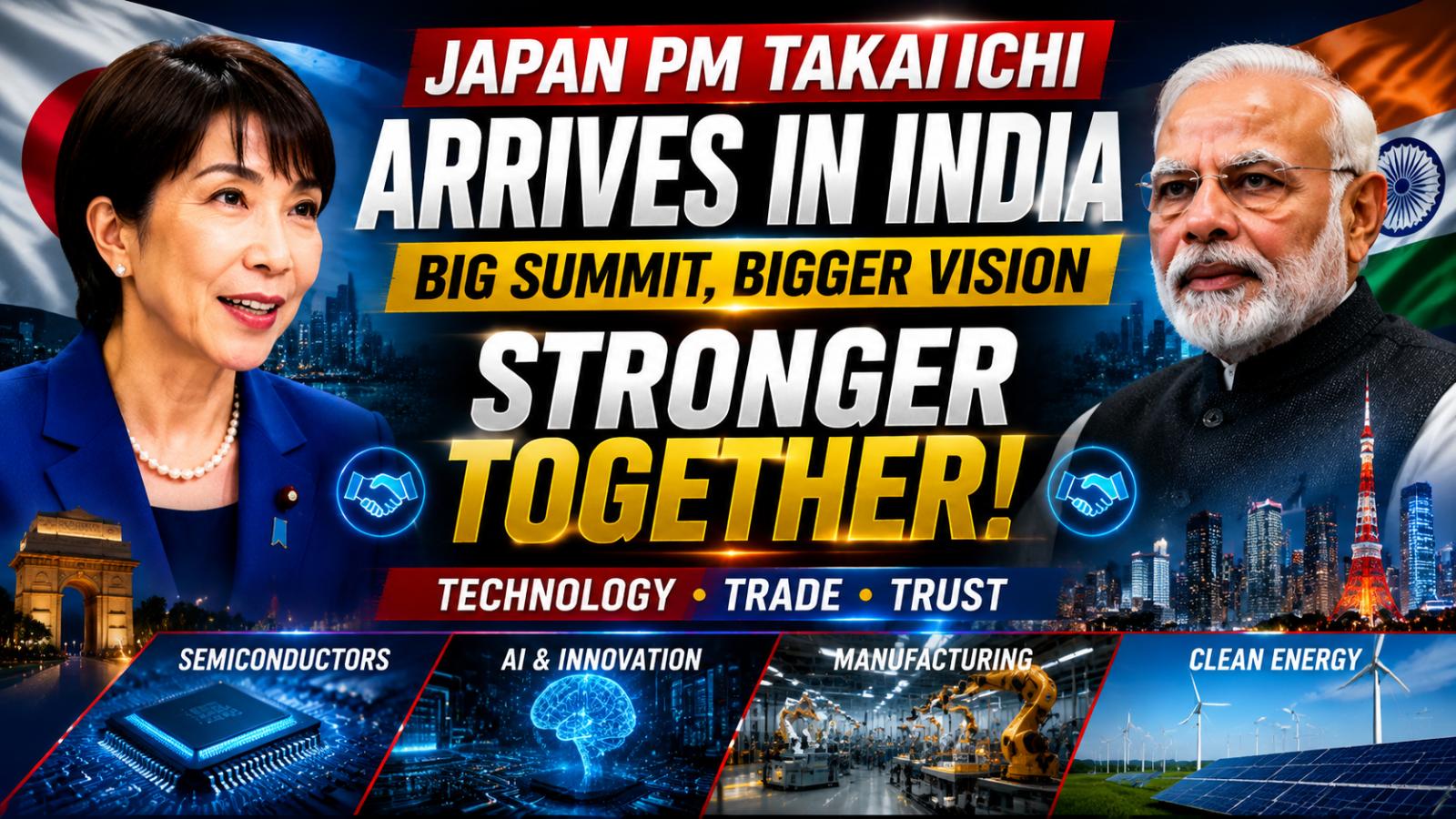
Japan PM Sanae Takaichi to visit India for key summit with Modi
High-level diplomatic engagement in New Delhi Japanese Prime Minister Sanae Takaichi will arrive in India on July 1,2026 for the 16th India-Japan Annual Summit at the invitation of Prime Minister Narendra Modi. The visit marks her first official trip to India since taking office in 2025 and comes at a time when both nations are seeking to strengthen strategic and economic alignment in a rapidly changing global environment.
Japan PM Sanae Takaichi to visit India for key summit with Modi
High-level diplomatic engagement in New Delhi Japanese Prime Minister Sanae Takaichi will arrive in India on July 1,2026 for the 16th India-Japan Annual Summit at the invitation of Prime Minister Narendra Modi. The visit marks her first official trip to India since taking office in 2025 and comes at a time when both nations are seeking to strengthen strategic and economic alignment in a rapidly changing global environment.

AI Lock-In Explained: Why Innovation Slows in Artificial Intelligence Systems
Innovation often slows not because better ideas are unavailable, but because existing systems become too expensive and complex to replace. Once infrastructure, capital, regulation, and industry habits align around a dominant technology, switching to alternatives becomes increasingly difficult—even when better options begin to emerge. This pattern is already visible in artificial intelligence today and has repeated across multiple technological revolutions. AI Infrastructu
AI Lock-In Explained: Why Innovation Slows in Artificial Intelligence Systems
Innovation often slows not because better ideas are unavailable, but because existing systems become too expensive and complex to replace. Once infrastructure, capital, regulation, and industry habits align around a dominant technology, switching to alternatives becomes increasingly difficult—even when better options begin to emerge. This pattern is already visible in artificial intelligence today and has repeated across multiple technological revolutions. AI Infrastructu

Takaichi visit signals deeper Japan India strategic cooperation
The visit of Sanae Takaichi to New Delhi marks a renewed phase in relations between Japan and India. Her meeting with
Takaichi visit signals deeper Japan India strategic cooperation
The visit of Sanae Takaichi to New Delhi marks a renewed phase in relations between Japan and India. Her meeting with
Nvidia vs AMD AI Chip Race: What It Means for AI Stocks
The race to power artificial intelligence is no longer only about software. It is increasingly a battle over chips, data centers and the hardware needed to train and run advanced AI models. Nvidia remains the dominant name in AI computing, but AMD is pushing harder into the market with new data center accelerators. The competition is also creating space for newer players such as Cerebras Systems, which has drawn attention after its market debut as an AI chip company.
Nvidia vs AMD AI Chip Race: What It Means for AI Stocks
The race to power artificial intelligence is no longer only about software. It is increasingly a battle over chips, data centers and the hardware needed to train and run advanced AI models. Nvidia remains the dominant name in AI computing, but AMD is pushing harder into the market with new data center accelerators. The competition is also creating space for newer players such as Cerebras Systems, which has drawn attention after its market debut as an AI chip company.
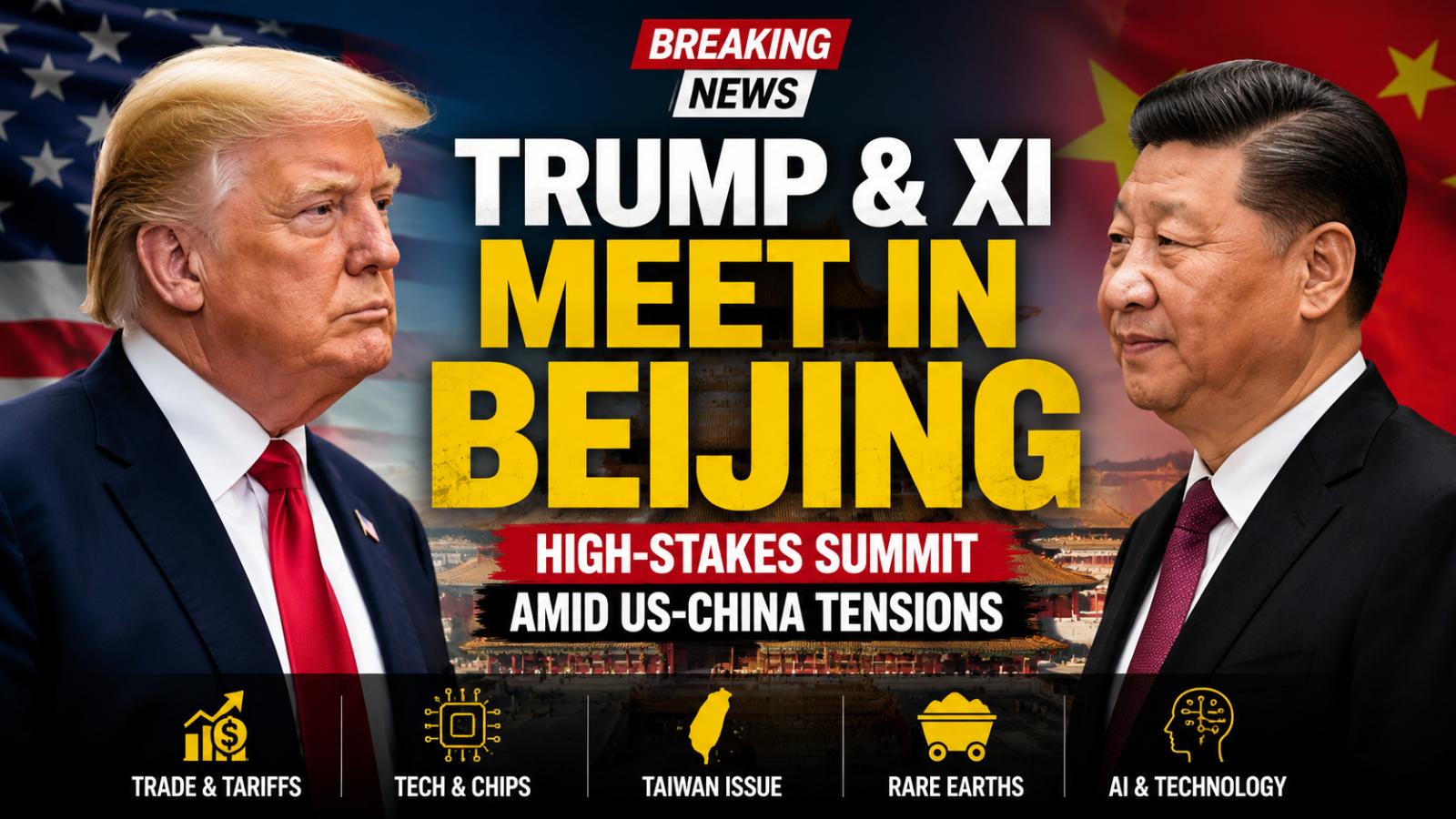
Trump and Xi Meet in Beijing Amid Rising US-China Trade Tensions
US President Donald Trump and Chinese President Xi Jinping are meeting in Beijing amid renewed efforts to prevent escalating tensions between the world’s two largest economies. The summit follows months of friction over tariffs, semiconductors, artificial intelligence, supply chains, and Taiwan, all of which have intensified competition between Washington and Beijing despite a temporary stabilisation agreement reached during the APEC summit in Busan, South Korea, in October 2025.
Trump and Xi Meet in Beijing Amid Rising US-China Trade Tensions
US President Donald Trump and Chinese President Xi Jinping are meeting in Beijing amid renewed efforts to prevent escalating tensions between the world’s two largest economies. The summit follows months of friction over tariffs, semiconductors, artificial intelligence, supply chains, and Taiwan, all of which have intensified competition between Washington and Beijing despite a temporary stabilisation agreement reached during the APEC summit in Busan, South Korea, in October 2025.
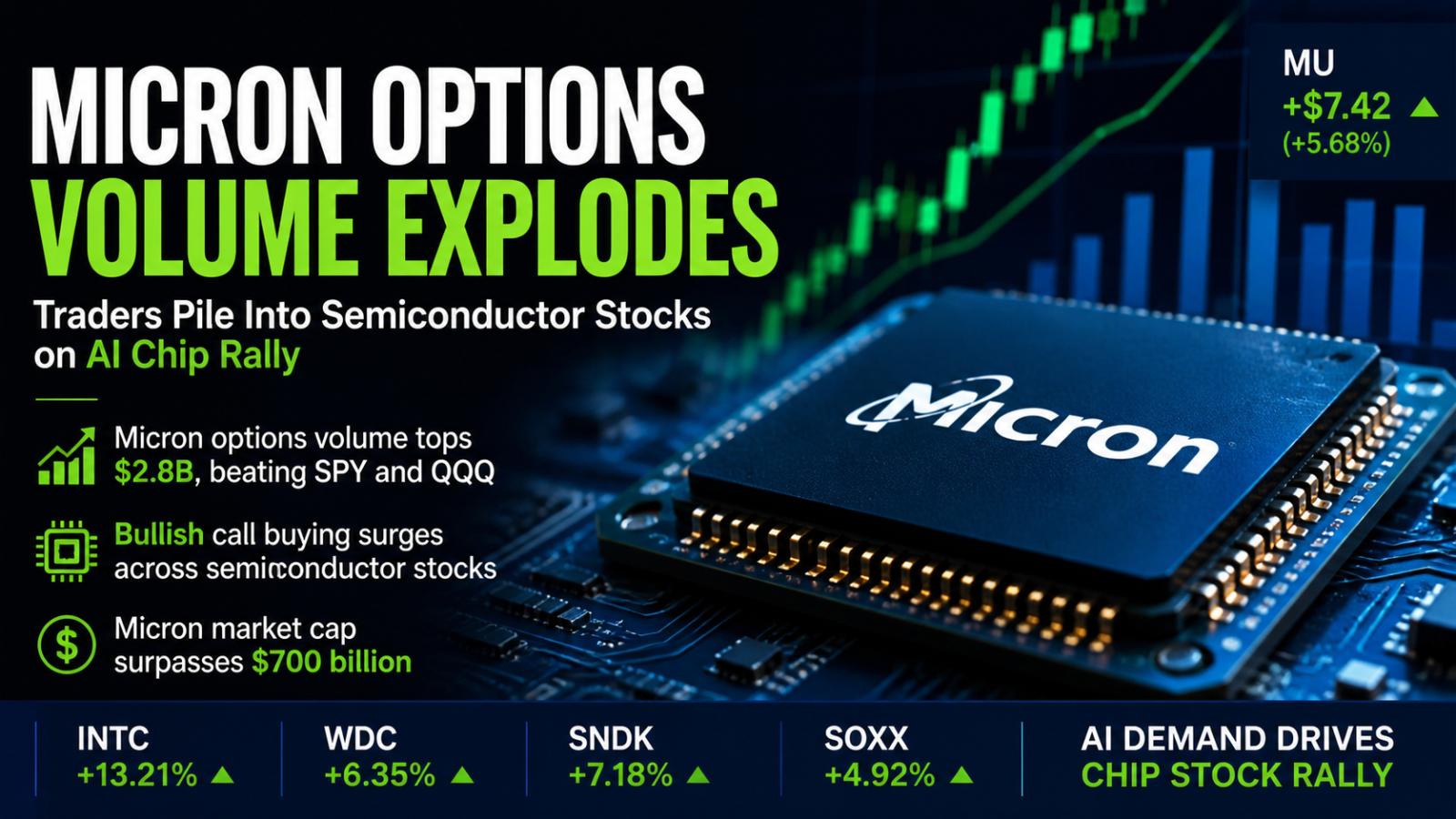
Micron Options Boom: AI Chip Rally Pulls Traders Into Semis
Micron Options Volume Explodes as AI Chip Rally Heats Up Micron options volume surged Tuesday as traders piled into semiconductor stocks, betting the AI chip rally still has room to run despite stretched valuations and rising volatility. By midday Chicago time, options tied to Micron Technology had drawn more than $2.8 billion in premium activity, outpacing major index ETF flows and putting MU stock at the center of Wall Street’s latest AI trade.
Micron Options Boom: AI Chip Rally Pulls Traders Into Semis
Micron Options Volume Explodes as AI Chip Rally Heats Up Micron options volume surged Tuesday as traders piled into semiconductor stocks, betting the AI chip rally still has room to run despite stretched valuations and rising volatility. By midday Chicago time, options tied to Micron Technology had drawn more than $2.8 billion in premium activity, outpacing major index ETF flows and putting MU stock at the center of Wall Street’s latest AI trade.
AI spending surge could top $1 trillion by 2027, analysts say
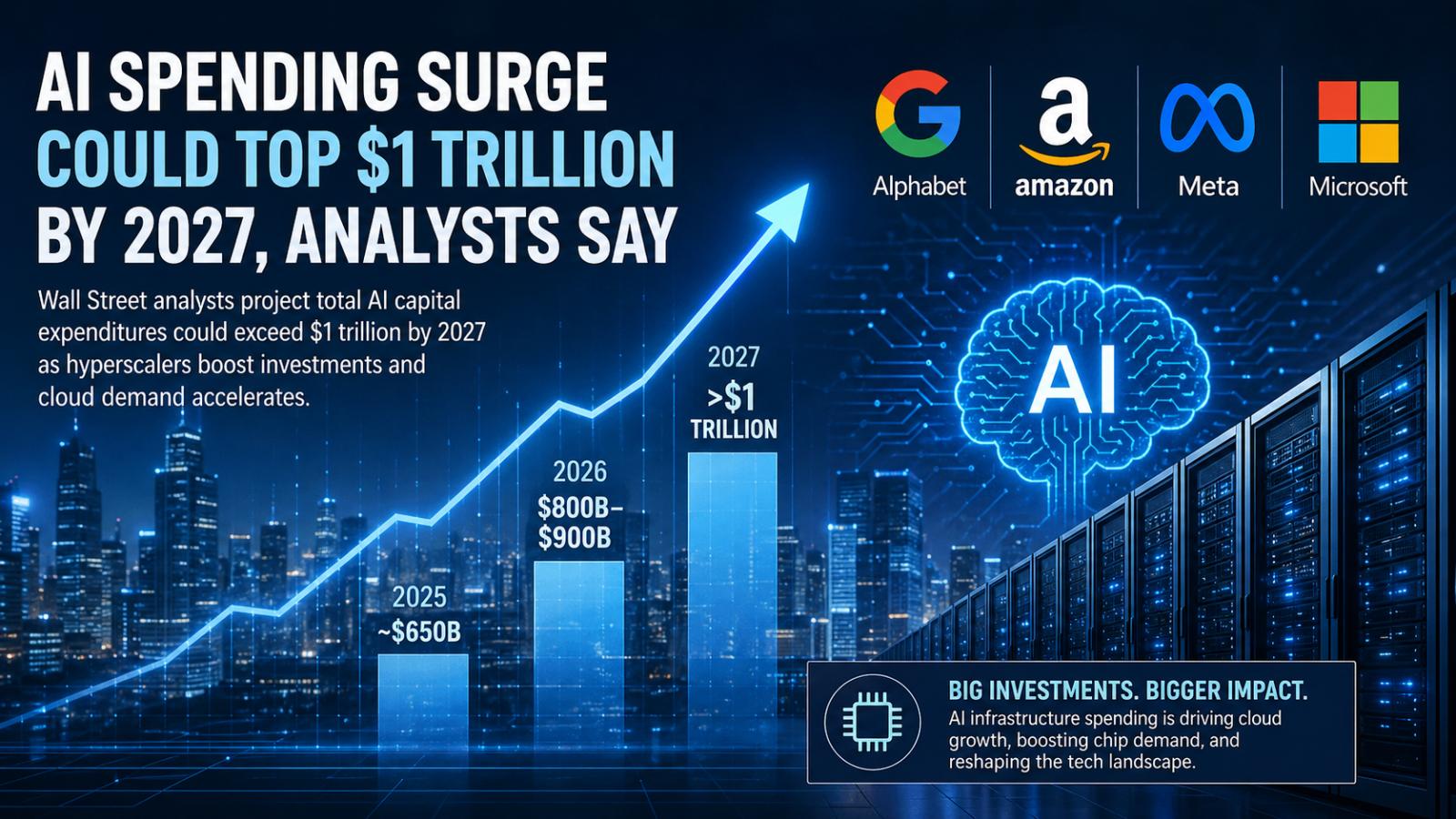
Wall Street analysts project AI spending could exceed $1 trillion by 2027 as major tech firms boost investments. Strong cloud demand and rising revenues support growth, though investor concerns remain over returns and rising infrastructure costs AI spending surge could top $1 trillion by 2027, analysts say is increasingly shaping expectations across the technology sector, as Wall Street analysts project unprecedented capital expenditures driven by artificial intelligence demand. Following recent tech earnings announcements on Wednesday, analysts at firms including Evercore and Bank of America estimate total AI-related capital spending could surpass $1 trillion by 2027, with 2026 projections already rising to between $800 billion and $900 billion. The surge reflects aggressive investment strategies by major technology companies, including Alphabet, Amazon, Meta, and Microsoft. According to analyst estimates, projected capital spending for 2026 includes approximately $200 billion from Amazon, $190 billion from Microsoft, $185 billion from Alphabet, and $135 billion from Meta, reflecting broad increases across the sector. Executives continue to signal confidence in long-term AI investments despite investor concerns about the scale of spending. Amazon CEO Andy Jassy emphasized the company’s commitment to infrastructure expansion, citing strong long-term returns. Similarly, Alphabet reported significant growth in its cloud segment, with revenue increasing sharply year over year, reinforcing expectations that AI-driven services are becoming a major revenue driver. Analysts note that while capital expenditures continue to rise, early signs of return on investment are emerging. Strong cloud demand, expanding contract backlogs, and increasing enterprise adoption of AI tools are contributing to revenue growth. Alphabet, in particular, has seen substantial backlog expansion tied to its cloud platform, with a large portion expected to convert into revenue over the next two years. However, not all companies are receiving equal investor confidence. Meta’s increased spending plans have raised concerns about near-term returns, particularly as its free cash flow has declined significantly compared to the previous year. CEO Mark Zuckerberg acknowledged higher infrastructure costs, including rising component prices, while maintaining confidence in the long-term value of AI investments. The rapid expansion of AI infrastructure is also benefiting semiconductor manufacturers and hardware suppliers. Companies such as Intel are seeing increased demand as AI workloads require a broader range of computing hardware beyond graphics processors. Analysts highlight growing demand for specialized chips and custom silicon solutions, suggesting that AI development could drive sustained growth across the semiconductor industry. Overall, analysts expect improving revenue and cash flow trends across the sector by 2026, supporting continued investment. While skepticism remains about the pace and scale of spending, the combination of strong demand, expanding cloud services, and technological advancements indicates that the AI-driven capital expenditure cycle is likely to continue shaping the global technology landscape.
AI spending surge could top $1 trillion by 2027, analysts say
Wall Street analysts project AI spending could exceed $1 trillion by 2027 as major tech firms boost investments. Strong cloud demand and rising revenues support growth, though investor concerns remain over returns and rising infrastructure costs AI spending surge could top $1 trillion by 2027, analysts say is increasingly shaping expectations across the technology sector, as Wall Street analysts project unprecedented capital expenditures driven by artificial intelligence demand. Following recent tech earnings announcements on Wednesday, analysts at firms including Evercore and Bank of America estimate total AI-related capital spending could surpass $1 trillion by 2027, with 2026 projections already rising to between $800 billion and $900 billion. The surge reflects aggressive investment strategies by major technology companies, including Alphabet, Amazon, Meta, and Microsoft. According to analyst estimates, projected capital spending for 2026 includes approximately $200 billion from Amazon, $190 billion from Microsoft, $185 billion from Alphabet, and $135 billion from Meta, reflecting broad increases across the sector. Executives continue to signal confidence in long-term AI investments despite investor concerns about the scale of spending. Amazon CEO Andy Jassy emphasized the company’s commitment to infrastructure expansion, citing strong long-term returns. Similarly, Alphabet reported significant growth in its cloud segment, with revenue increasing sharply year over year, reinforcing expectations that AI-driven services are becoming a major revenue driver. Analysts note that while capital expenditures continue to rise, early signs of return on investment are emerging. Strong cloud demand, expanding contract backlogs, and increasing enterprise adoption of AI tools are contributing to revenue growth. Alphabet, in particular, has seen substantial backlog expansion tied to its cloud platform, with a large portion expected to convert into revenue over the next two years. However, not all companies are receiving equal investor confidence. Meta’s increased spending plans have raised concerns about near-term returns, particularly as its free cash flow has declined significantly compared to the previous year. CEO Mark Zuckerberg acknowledged higher infrastructure costs, including rising component prices, while maintaining confidence in the long-term value of AI investments. The rapid expansion of AI infrastructure is also benefiting semiconductor manufacturers and hardware suppliers. Companies such as Intel are seeing increased demand as AI workloads require a broader range of computing hardware beyond graphics processors. Analysts highlight growing demand for specialized chips and custom silicon solutions, suggesting that AI development could drive sustained growth across the semiconductor industry. Overall, analysts expect improving revenue and cash flow trends across the sector by 2026, supporting continued investment. While skepticism remains about the pace and scale of spending, the combination of strong demand, expanding cloud services, and technological advancements indicates that the AI-driven capital expenditure cycle is likely to continue shaping the global technology landscape.

Nvidia stock hits record high, pushes market cap above $5 trillion
Shares of Nvidia hit a record $208.27 on Friday, April 24, 2026, pushing its value past $5 trillion amid strong AI demand. Gains followed upbeat results from Intel, lifting chipmakers broadly, even as Alphabet
Nvidia stock hits record high, pushes market cap above $5 trillion
Shares of Nvidia hit a record $208.27 on Friday, April 24, 2026, pushing its value past $5 trillion amid strong AI demand. Gains followed upbeat results from Intel, lifting chipmakers broadly, even as Alphabet
Nvidia shares dip as uncertainty clouds potential OpenAI investment plans
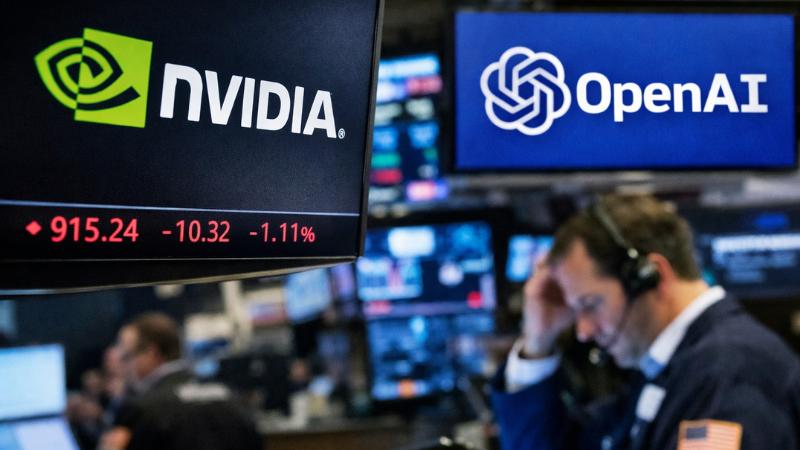
Nvidia shares declined on Monday as uncertainty surrounding the chipmaker’s potential investment in OpenAI weighed on investor sentiment. The stock slipped in early trading after reports suggested that previously announced plans involving a massive financial commitment to the artificial intelligence company may not yet be finalized. The market reaction underscored growing sensitivity around large-scale AI investments and the evolving relationships among major technology players. T
Nvidia shares dip as uncertainty clouds potential OpenAI investment plans
Nvidia shares declined on Monday as uncertainty surrounding the chipmaker’s potential investment in OpenAI weighed on investor sentiment. The stock slipped in early trading after reports suggested that previously announced plans involving a massive financial commitment to the artificial intelligence company may not yet be finalized. The market reaction underscored growing sensitivity around large-scale AI investments and the evolving relationships among major technology players. T
Sergio Gor assumes charge as US ambassador to India, outlines trade talks and Pax Silica invite
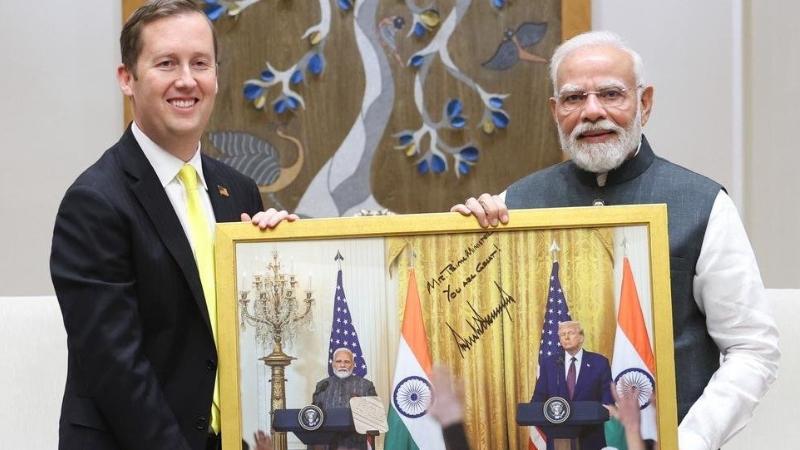
Sergio Gor formally assumed charge as the United States Ambassador to India on Monday, marking the beginning of a new diplomatic chapter between the two countries. Speaking shortly after taking office, Gor described the relationship between India and the United States as the most consequential global partnership of the century, underlining its growing importance across economic, strategic, and technological domains. He confirmed that fresh trade negotiations between the two sides are schedule
Sergio Gor assumes charge as US ambassador to India, outlines trade talks and Pax Silica invite
Sergio Gor formally assumed charge as the United States Ambassador to India on Monday, marking the beginning of a new diplomatic chapter between the two countries. Speaking shortly after taking office, Gor described the relationship between India and the United States as the most consequential global partnership of the century, underlining its growing importance across economic, strategic, and technological domains. He confirmed that fresh trade negotiations between the two sides are schedule
US-China chip war deepens in 2025 as export controls reshape global semiconductor industry
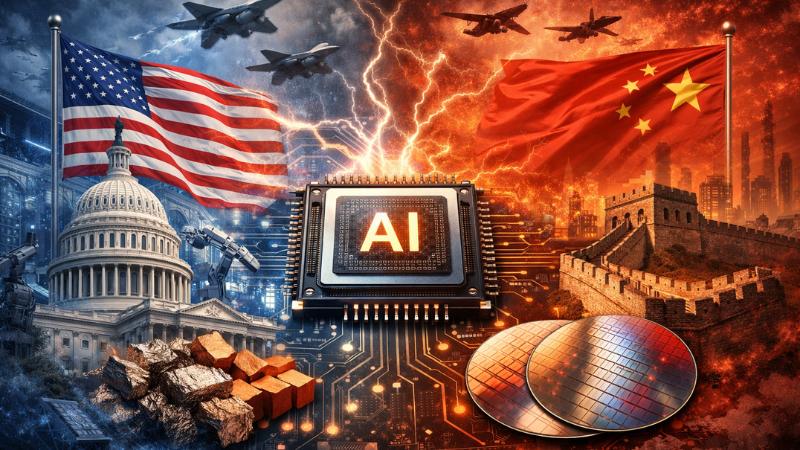
The strategic rivalry between the United States and China in the semiconductor sector continued to intensify throughout 2025, with export controls remaining a central instrument in what has come to be known as the global chip war. The dispute, rooted in concerns over national security, technological leadership and economic influence, significantly affected the semiconductor industry, global supply chains and investment decisions during the year. At the start of 2025, the United States maintained restrictions on the export of advanced artificial intelligence chips and related technologies to China. These controls were designed to limit Beijing’s access to cutting-edge computing capabilities that could be applied to military and surveillance technologies. US officials defended the measures as necessary to protect national security interests, but the restrictions had immediate commercial consequences for American chipmakers with strong exposure to the Chinese market. Companies producing high-performance AI chips, including industry leaders such as Nvidia, reported revenue pressures linked to reduced access to Chinese customers. The curbs also led to higher compliance costs and uncertainty over long-term market strategies. Industry executives warned that prolonged restrictions could weaken the global competitiveness of US firms while accelerating China’s efforts to develop independent semiconductor capabilities. Policy signals shifted after Donald Trump assumed the US presidency in January. His administration moved to ease certain export controls on advanced AI chips for what were described as approved customers in China. Under the revised framework, sales of Nvidia’s H200 chip were permitted, subject to conditions that included profit-sharing arrangements with the US government. The adjustments were widely interpreted as an attempt to balance national security concerns with the commercial interests of American technology companies. China responded to the US measures by criticising what it described as discriminatory semiconductor policies and urging Washington to reverse the controls. Beijing argued that the restrictions were disrupting global supply chains and undermining fair competition in the semiconductor industry. At the same time, Chinese authorities accelerated domestic initiatives aimed at strengthening the country’s chip manufacturing ecosystem and reducing reliance on foreign suppliers. As part of its response, China imposed export controls on several rare earth elements, materials that are essential for semiconductor production and advanced electronics. China holds a dominant position in the global rare earth supply, making these measures a powerful lever in the broader technology competition. The restrictions heightened concerns among manufacturers worldwide about material availability and supply chain resilience. The prolonged US-China chip war had ripple effects across global markets. American and allied semiconductor firms experienced volatility in revenues and share prices as companies reassessed exposure to geopolitical risk. Investment patterns shifted as manufacturers sought to diversify production and sourcing to reduce dependence on any single market. Chinese technology firms increasingly turned to domestic suppliers, accelerating efforts to replace restricted foreign components with locally developed alternatives. In parallel, the United States expanded its focus on strengthening domestic semiconductor production through subsidy programmes under the CHIPS Act. The initiative supported the construction of new fabrication plants and aimed to secure long-term technological leadership by rebuilding advanced manufacturing capacity within the country. By late 2025, both Washington and Beijing took limited steps to ease tensions, agreeing to suspend certain rare earth export controls. While the move signalled a willingness to manage escalation, the underlying competition in advanced chip technologies remained unresolved. The year underscored how deeply the semiconductor rivalry has become embedded in global trade, industrial policy and national security calculations, with lasting implications for the future of the technology sector.
US-China chip war deepens in 2025 as export controls reshape global semiconductor industry
The strategic rivalry between the United States and China in the semiconductor sector continued to intensify throughout 2025, with export controls remaining a central instrument in what has come to be known as the global chip war. The dispute, rooted in concerns over national security, technological leadership and economic influence, significantly affected the semiconductor industry, global supply chains and investment decisions during the year. At the start of 2025, the United States maintained restrictions on the export of advanced artificial intelligence chips and related technologies to China. These controls were designed to limit Beijing’s access to cutting-edge computing capabilities that could be applied to military and surveillance technologies. US officials defended the measures as necessary to protect national security interests, but the restrictions had immediate commercial consequences for American chipmakers with strong exposure to the Chinese market. Companies producing high-performance AI chips, including industry leaders such as Nvidia, reported revenue pressures linked to reduced access to Chinese customers. The curbs also led to higher compliance costs and uncertainty over long-term market strategies. Industry executives warned that prolonged restrictions could weaken the global competitiveness of US firms while accelerating China’s efforts to develop independent semiconductor capabilities. Policy signals shifted after Donald Trump assumed the US presidency in January. His administration moved to ease certain export controls on advanced AI chips for what were described as approved customers in China. Under the revised framework, sales of Nvidia’s H200 chip were permitted, subject to conditions that included profit-sharing arrangements with the US government. The adjustments were widely interpreted as an attempt to balance national security concerns with the commercial interests of American technology companies. China responded to the US measures by criticising what it described as discriminatory semiconductor policies and urging Washington to reverse the controls. Beijing argued that the restrictions were disrupting global supply chains and undermining fair competition in the semiconductor industry. At the same time, Chinese authorities accelerated domestic initiatives aimed at strengthening the country’s chip manufacturing ecosystem and reducing reliance on foreign suppliers. As part of its response, China imposed export controls on several rare earth elements, materials that are essential for semiconductor production and advanced electronics. China holds a dominant position in the global rare earth supply, making these measures a powerful lever in the broader technology competition. The restrictions heightened concerns among manufacturers worldwide about material availability and supply chain resilience. The prolonged US-China chip war had ripple effects across global markets. American and allied semiconductor firms experienced volatility in revenues and share prices as companies reassessed exposure to geopolitical risk. Investment patterns shifted as manufacturers sought to diversify production and sourcing to reduce dependence on any single market. Chinese technology firms increasingly turned to domestic suppliers, accelerating efforts to replace restricted foreign components with locally developed alternatives. In parallel, the United States expanded its focus on strengthening domestic semiconductor production through subsidy programmes under the CHIPS Act. The initiative supported the construction of new fabrication plants and aimed to secure long-term technological leadership by rebuilding advanced manufacturing capacity within the country. By late 2025, both Washington and Beijing took limited steps to ease tensions, agreeing to suspend certain rare earth export controls. While the move signalled a willingness to manage escalation, the underlying competition in advanced chip technologies remained unresolved. The year underscored how deeply the semiconductor rivalry has become embedded in global trade, industrial policy and national security calculations, with lasting implications for the future of the technology sector.

Intel In Talks With Apple For Strategic Investment Amid Global Chip Race
Intel Corp. is reportedly in preliminary talks with Apple Inc. over a potential investment, according to Bloomberg. The chipmaker, which has struggled in recent years against rivals AMD and Nvidia, is seeking new partnerships to strengthen its global position. While the discussions are still in early stages and no agreement is confirmed, the possibility of Apple joining Intel’s revival plan has already stirred investor interest.
Intel In Talks With Apple For Strategic Investment Amid Global Chip Race
Intel Corp. is reportedly in preliminary talks with Apple Inc. over a potential investment, according to Bloomberg. The chipmaker, which has struggled in recent years against rivals AMD and Nvidia, is seeking new partnerships to strengthen its global position. While the discussions are still in early stages and no agreement is confirmed, the possibility of Apple joining Intel’s revival plan has already stirred investor interest.










