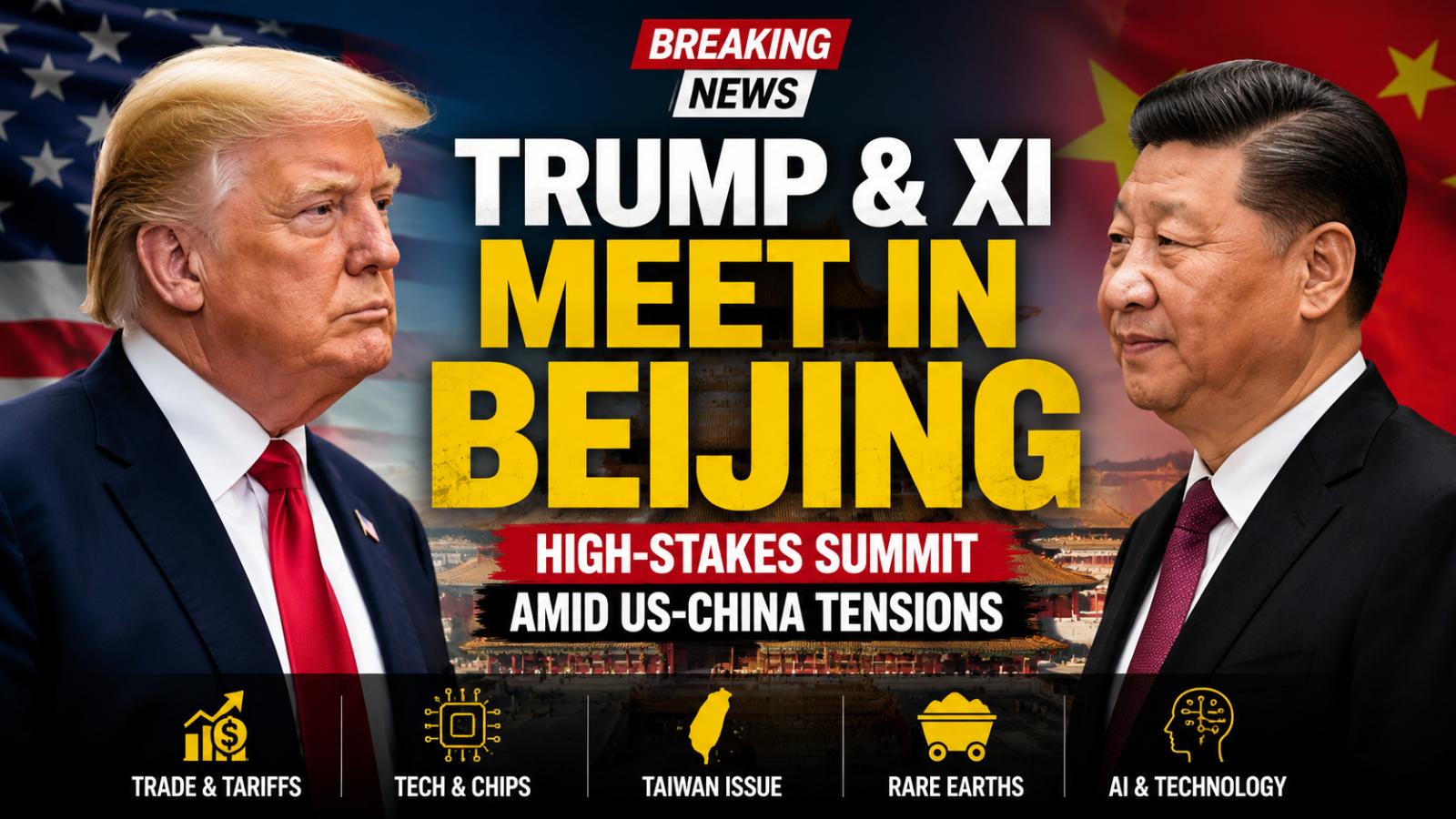
US President Donald Trump and Chinese President Xi Jinping are meeting in Beijing amid renewed efforts to prevent escalating tensions between the world’s two largest economies. The summit follows months of friction over tariffs, semiconductors, artificial intelligence, supply chains, and Taiwan, all of which have intensified competition between Washington and Beijing despite a temporary stabilisation agreement reached during the APEC summit in Busan, South Korea, in October 2025.
The Busan meeting marked the first face-to-face interaction between Trump and Xi in six years and helped slow a growing economic confrontation that had unsettled global markets. At the time, both countries agreed to pause additional tariff measures and continue discussions involving trade controls, fentanyl cooperation, and rare earth exports. China also indicated willingness to increase purchases of American agricultural goods, while the United States softened pressure on certain Chinese imports. However, the broader strategic disagreements between the two nations remained unresolved.
Since the Busan summit, both governments have continued to clash over advanced technology and economic security. Washington has maintained restrictions on semiconductor exports and artificial intelligence technologies, arguing that the measures are necessary to protect national security interests. Beijing has responded by highlighting its influence over rare earth minerals, which remain critical for American defence systems and technology manufacturing. The ongoing dispute has reinforced concerns over global supply chain dependence and technological competition.
Taiwan remains another major source of tension ahead of the summit. China has repeatedly criticised US military support and weapons sales to Taiwan, while Washington maintains that its approach is intended to preserve regional stability. The issue continues to shape diplomatic discussions between both sides as concerns grow over security in the Indo-Pacific region.
Trade negotiations are expected to dominate the talks. Trump continues to advocate for what his administration describes as fair trade practices, including expanded Chinese purchases of American soybeans, poultry, beef, and Boeing aircraft. China, meanwhile, is seeking relief from export controls affecting semiconductors and other advanced technologies. Discussions are also expected to include cybersecurity, artificial intelligence competition, and broader economic cooperation.
The geopolitical environment surrounding the meeting has also shifted significantly since Busan. Tensions in the Middle East and concerns involving Iranian oil exports have added another layer to US-China relations. Analysts believe both leaders are approaching the summit with a focus on avoiding further escalation while protecting their respective strategic and economic interests.
Rather than producing a major breakthrough, the Beijing summit is widely viewed as an effort to preserve stability, extend the tariff truce, and prevent the relationship from sliding back into a deeper economic confrontation.