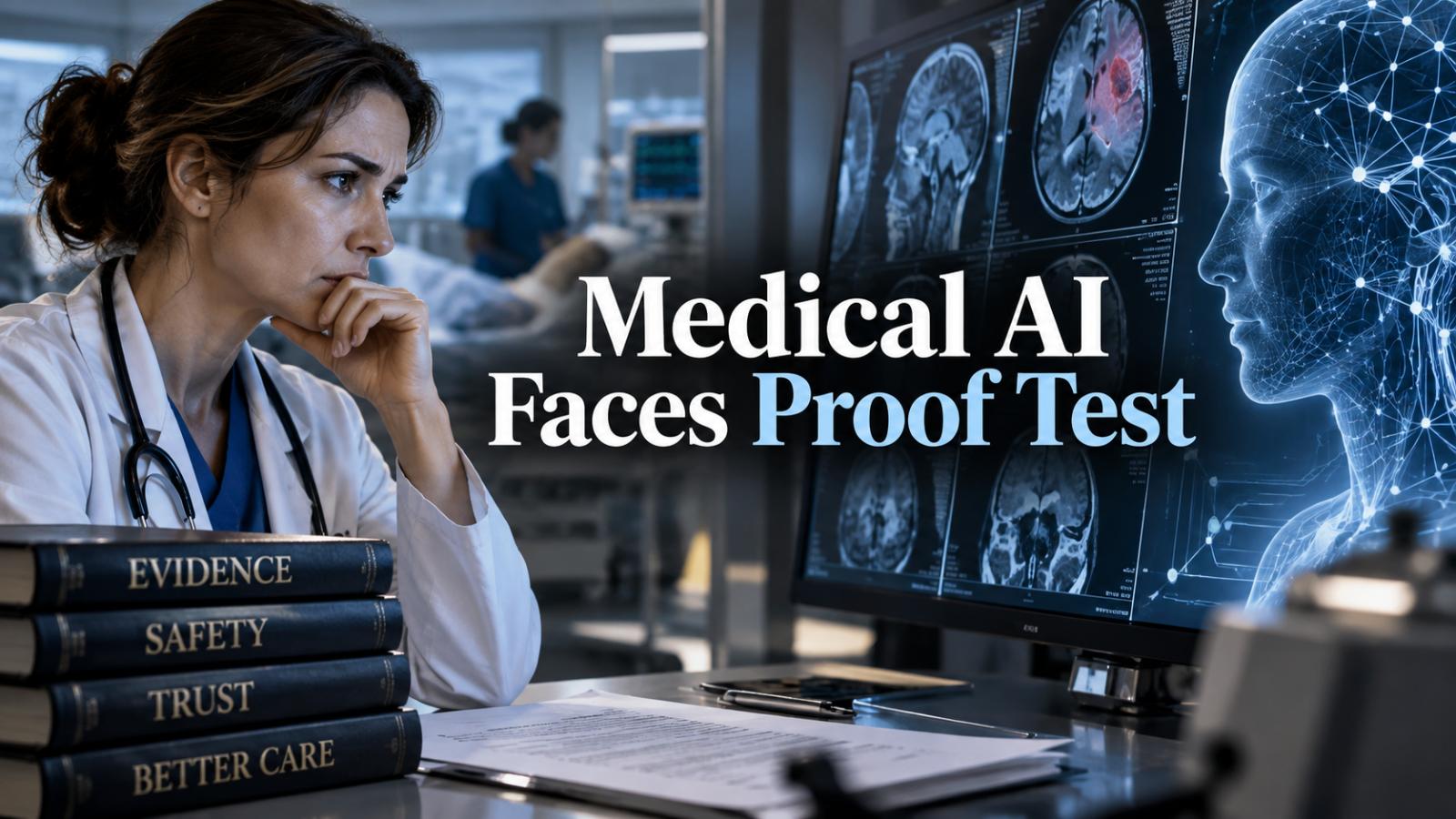
Medical AI is gaining ground in radiology, documentation and diagnostics, but clinicians are demanding stronger proof before trusting it with treatment or clinical decisions. New surveys show concern about deskilling, hallucinations and weak governance even as AI use rises sharply in healthcare.
Medical AI evidence gap slows wider clinical adoption
AI has already established a meaningful role in areas where performance can be tested against measurable outcomes, particularly medical imaging. The harder question is whether newer tools that suggest treatments, summarize patient information or support clinical decisions can show the same level of real-world reliability.
Recent reporting on healthcare AI highlights a persistent gap between laboratory performance and evidence that systems improve patient outcomes in routine clinical settings. Some medical AI products have reached hospitals without the kind of rigorous real-world trials clinicians expect from other medical technologies.
That helps explain why clinician caution is growing as vendors move beyond radiology. Doctors are not necessarily rejecting AI; they are asking whether a tool has been validated in the population, hospital and workflow where it will actually be used.
Deskilling and hallucinations worry clinicians
The 2026 Future Ready Healthcare Survey from Wolters Kluwer and Ipsos found that 74% of clinicians were concerned that overreliance on AI could cause clinical “deskilling.” The same share identified hallucinations — confident but false or fabricated AI outputs — as a major concern.
Those risks can reinforce each other. If clinicians rely heavily on automated recommendations, their own diagnostic or reasoning skills could weaken over time. That becomes particularly dangerous when a system produces convincing but incorrect information.
The survey also found that 77% of clinicians take additional steps to verify AI-generated information, often by checking trusted medical databases or source links.
Doctors are adopting AI despite their caution
The debate is not simply about resistance to technology. AI adoption among physicians is already widespread. Doximity’s 2026 report found that 94% of surveyed US physicians were either using AI or interested in using it, while 54% said they already used AI in clinical practice.
The American Medical Association has also reported rising physician adoption and growing confidence in selected AI applications.
The stronger case for AI remains in areas where benefits are easier to demonstrate, including reducing administrative work, assisting with documentation, identifying potential abnormalities and helping clinicians retrieve information more efficiently.
AI governance may determine which tools win trust
Hospitals now face a practical challenge: deciding which systems deserve deployment and how those systems should be monitored after adoption.
Governance matters because AI performance can vary across patient groups, locations and workflows. Healthcare organizations need processes for validation, human oversight, error reporting, security and continuous monitoring instead of assuming that a vendor benchmark will translate directly into clinical benefit.
Wolters Kluwer’s findings show that clinicians want transparent sources and stronger safeguards around AI-assisted decisions. Many doctors also want citations and supporting evidence displayed directly within their workflow.
The opportunity for medical AI remains substantial, but adoption beyond diagnostics will depend increasingly on proof rather than promises. Vendors that can demonstrate real-world effectiveness, explain how their systems reach conclusions and support human oversight are more likely to earn clinician trust.