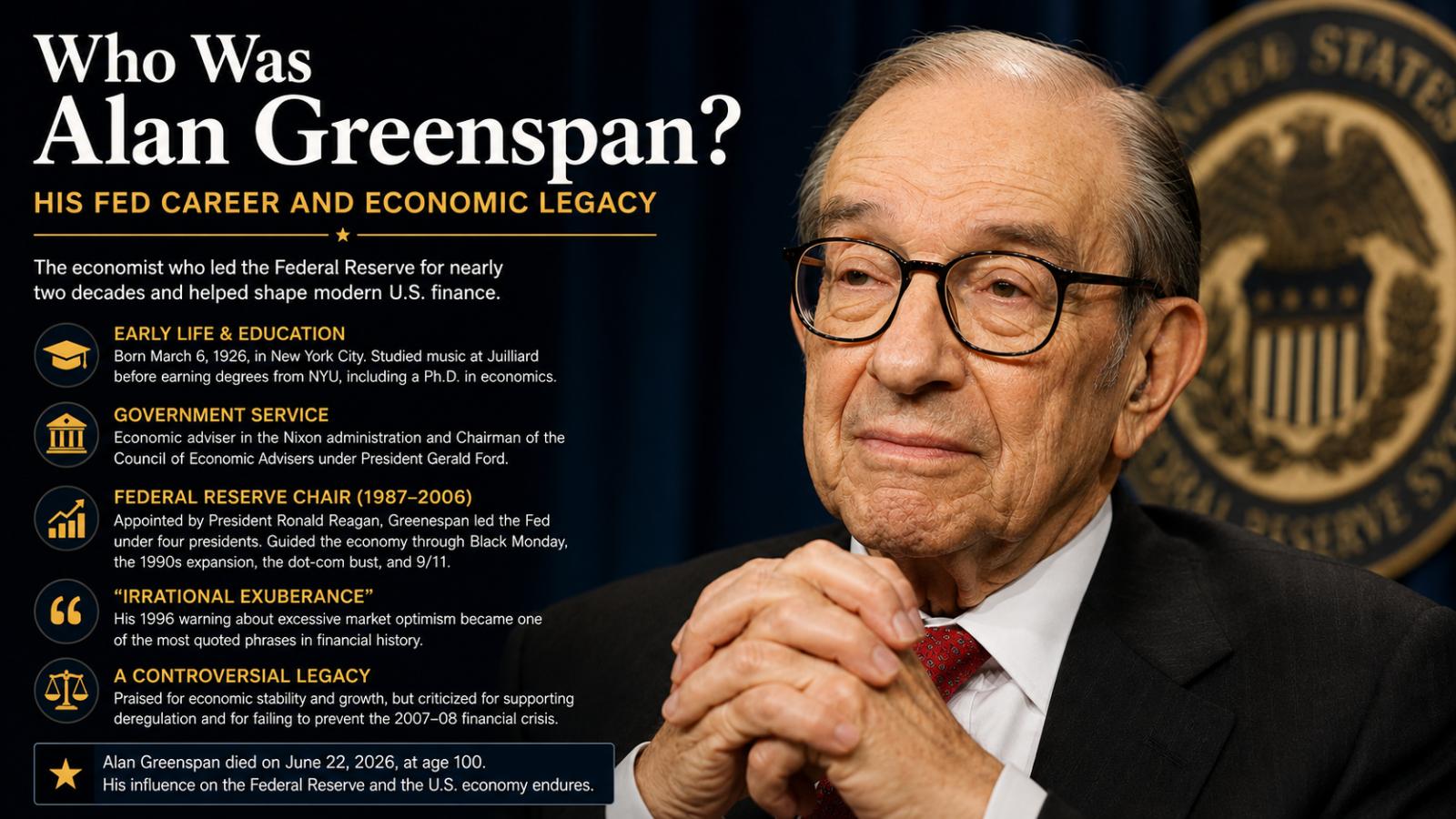
Who was Alan Greenspan? He was one of the most influential—and disputed—central bankers in modern U.S. history, leading the Federal Reserve from 1987 to 2006.
Greenspan died on Monday, June 22, 2026, at age 100. His death renewed attention on a career that spanned Wall Street, presidential administrations and nearly two decades at the center of U.S. monetary policy.
Who Was Alan Greenspan?
Born on March 6, 1926, in New York City, Greenspan first pursued music. He studied at the Juilliard School and played saxophone and clarinet in a jazz band before turning to economics.
He earned bachelor’s and master’s degrees from New York University and later completed a doctorate there. He built his reputation through economic consulting and served as chairman of the Council of Economic Advisers under President Gerald Ford from 1974 to 1977.
From Black Monday to the 1990s Boom
President Ronald Reagan appointed Greenspan as Federal Reserve chair in 1987. Weeks after he took office, the October 19 stock market crash sent the Dow Jones Industrial Average down more than 22%. The Fed responded by assuring markets that liquidity would remain available.
Greenspan later guided monetary policy through the 1990s expansion, the dot-com boom and bust, and the economic disruption after the September 11, 2001, attacks. His influence became so extensive that admirers called him “the maestro.”
In a 1996 speech, he questioned whether “irrational exuberance” was pushing asset prices too high, a phrase that became closely associated with speculative bubbles.
Why Greenspan’s Legacy Remains Contested
Greenspan favored market competition and limited regulation, views shaped partly by his association with writer Ayn Rand. After the 2007–08 financial crisis, critics argued that the Fed failed to restrain risky mortgage lending and that his support for deregulation weakened safeguards.
The Financial Crisis Inquiry Commission later identified reliance on self-regulation and regulatory failures as contributors to the collapse. In 2008 congressional testimony, Greenspan acknowledged that the crisis exposed a flaw in his assumptions about how financial institutions managed risk.
Greenspan remains important because debates surrounding his record—interest rates, asset bubbles, deregulation and central-bank intervention—continue to shape how Americans judge the Federal Reserve.
Related: Alan Greenspan, former Federal Reserve chair, dies at 100.