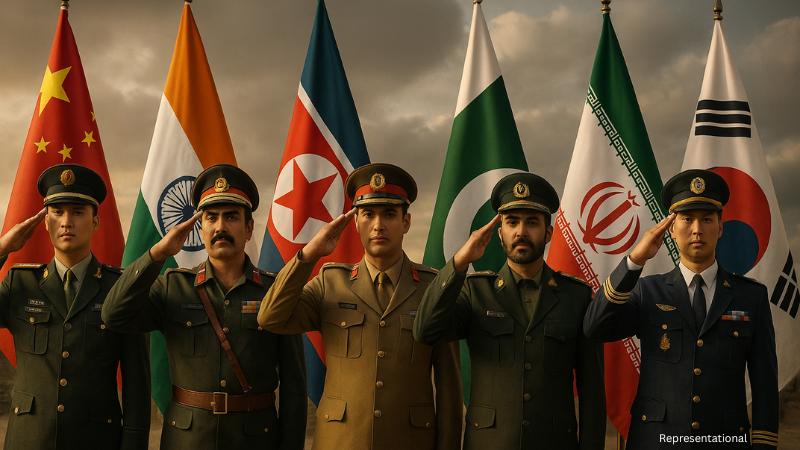
China continues to stand at the top with the largest single military in terms of active personnel. The People’s Liberation Army maintains a strength of around 20,35,000 active service members, the highest globally for 2025. This extraordinary number is not only a measure of its potential for land operations but also reflects the reserves and paramilitary groups that exist beyond the active roster. The scale of China’s army underlines its long-term strategy of being able to sustain large deployments while projecting influence across Asia and beyond.
India ranks second in Asia and also globally, with about 14,55,550 active personnel. Its military structure is a combination of a large standing army, strong paramilitary forces, and an organized reserve system. This vast force demonstrates India’s position as a major power with security demands spanning from its contested borders to its maritime domain. The scale of India’s manpower highlights the continuing need for readiness across multiple fronts and the importance of its armed forces in maintaining regional stability.
North Korea, often seen through the lens of its nuclear capabilities, also remains one of the largest armies by manpower. With 13,20,000 active personnel, the Korean People’s Army is among the biggest in the world. Despite much of its equipment being outdated compared to regional rivals, the raw manpower provides Pyongyang with a formidable conventional force backed by reserve and militia systems. This capacity ensures that North Korea continues to influence the regional balance through its ability to mobilize significant numbers in any conflict scenario.
Pakistan follows with an active personnel strength of approximately 6,54,000. While smaller than its immediate neighbor India, Pakistan maintains a balanced force that combines its army, air force, and paramilitary structures. The size of this force plays a key role in South Asia’s security dynamics and reflects Islamabad’s ongoing strategic calculations in maintaining deterrence and readiness.
Iran also figures prominently with about 6,10,000 active personnel. This count includes its conventional armed forces, while its paramilitary wing, most notably the Islamic Revolutionary Guard Corps, adds an additional layer of manpower that is often not included in the standard figures. Iran’s military numbers emphasize the country’s approach to blending conventional capacity with unconventional forces to maintain influence across the region and project strength beyond its borders.
South Korea completes the top group with nearly 6,00,000 active personnel. Historically among Asia’s largest armies, South Korea has seen a reduction of around 20 percent in its troop numbers since 2019, largely due to demographic changes and shorter terms of service. Despite this decline, its army remains one of the most capable in the region, supported by modern technology and robust defense ties with global partners.
Taken together, these figures demonstrate that Asia is not just home to economic powerhouses but also to military giants whose presence reshapes the strategic environment. The Global Firepower Index for 2025 underscores that military strength in Asia is a defining factor of global security. Whether it is China’s unmatched numbers, India’s multi-front readiness, North Korea’s mass mobilization, Pakistan’s regional balance, Iran’s layered force structure, or South Korea’s technologically advanced army, the continent remains the epicenter of military manpower. The balance of power in Asia continues to be written not only in boardrooms and diplomatic summits but also in the scale and readiness of millions of soldiers across its vast lands.