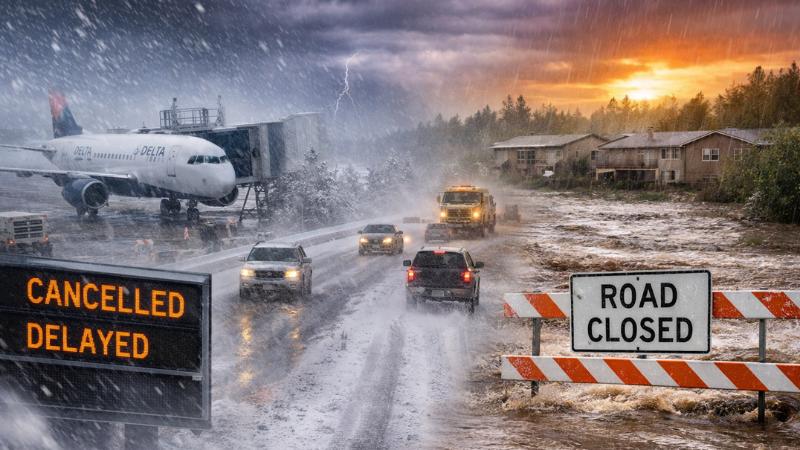
Severe weather conditions continued to affect large portions of the United States over the holiday weekend, with approximately 72 million people remaining under wind alerts across the High Plains, Rocky Mountains and the Northeast. Powerful wind gusts and winter storms disrupted travel by air and road, prompting safety warnings from federal and state agencies as conditions evolved across multiple regions.
The most intense winds were reported across the High Plains, where gusts reached between 90 and 100 miles per hour. These conditions raised concerns over fire danger through Friday night before gradually easing overnight. Forecasters indicated that calmer weather was expected to settle in over the weekend, bringing some relief after a prolonged period of hazardous conditions.
In Montana, snow showers combined with reduced visibility and strong winds created dangerous travel conditions on highways and rural roads. Weather officials warned drivers to use extreme caution, citing rapidly changing conditions and blowing snow that made travel unpredictable in several areas. State authorities continued to monitor impacts as winter weather persisted.
Colorado also faced significant disruptions, with snowfall totals ranging from four to eight inches in parts of the state. Wind gusts approaching 50 miles per hour compounded the situation, making travel especially difficult in mountainous regions and along exposed roadways. These conditions led to delays at airports and increased risks for motorists traveling through higher elevations.
The Northeast experienced strong winds throughout Friday, with gusts ranging from 50 to 60 miles per hour before gradually weakening overnight. Rainfall that had impacted much of the region began tapering off, though lake-effect snow showers were expected to linger into the early part of the weekend. Officials cautioned that slick roads and reduced visibility could continue to pose hazards despite improving conditions.
Air travel nationwide saw widespread disruptions. As of Saturday afternoon, more than 3,000 flights within, into and departing the United States were delayed, while 217 flights were canceled. Hartsfield-Jackson Atlanta International Airport accounted for the largest share of delays, reporting more than 223 delayed flights and 24 cancellations. In Colorado, Aspen/Pitkin County Airport experienced ground delays of nearly two hours due to low ceilings and adverse weather, according to federal aviation authorities.
Beyond the central and eastern regions, an active storm pattern persisted along the West Coast. Roughly 16 million people across California, Oregon and Washington remained under flood alerts as successive storm systems moved through the area. Scattered rain and snow showers continued across the Pacific Northwest, while steadier rainfall developed over northern California and Oregon.
Heavier downpours were forecast from Sunday into Monday, significantly increasing the risk of flash flooding. Rainfall totals across California were expected to range from two to six inches through the end of the week, with localized amounts between six and twelve inches possible in parts of the northern Sierra Nevada. Officials warned that numerous flash flooding events could affect streams, rivers and low-lying areas.
Authorities also raised concerns about debris flows in or near recently burned areas, where saturated soils could give way under heavy rain. Urban and surrounding regions including Seattle, Napa, Fresno and Sacramento were among the areas identified as vulnerable. In the mountains, the same system was expected to deliver heavy snowfall, with accumulations of three to eight feet possible in parts of the Sierra Nevada and Cascade Range. Strong winds accompanying the snow could create near-impossible driving conditions over some mountain passes.
The National Weather Service urged residents to remain alert, avoid rivers and creeks, and plan ahead for travel disruptions, particularly during the early to middle part of the holiday week. With storms expected to continue affecting multiple regions, officials emphasized preparedness and caution as weather conditions remained dynamic nationwide.