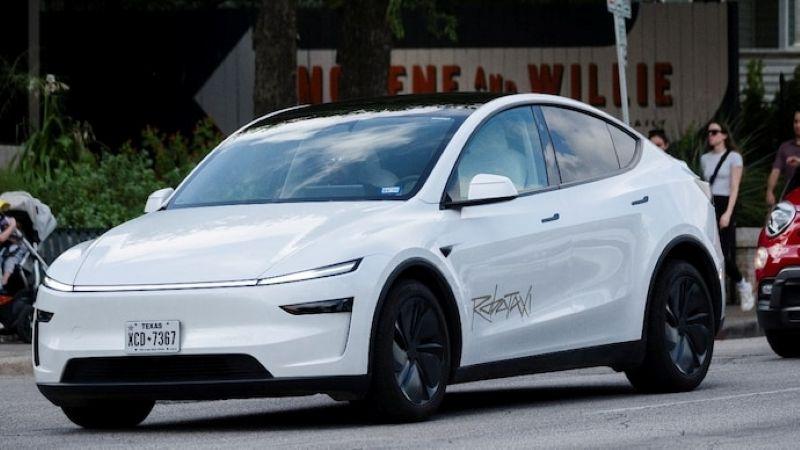
Driverless cars are moving from concept to reality in many parts of the world. Autonomous cab services are already operating in select cities, and companies across the globe are investing heavily in self-driving technology.
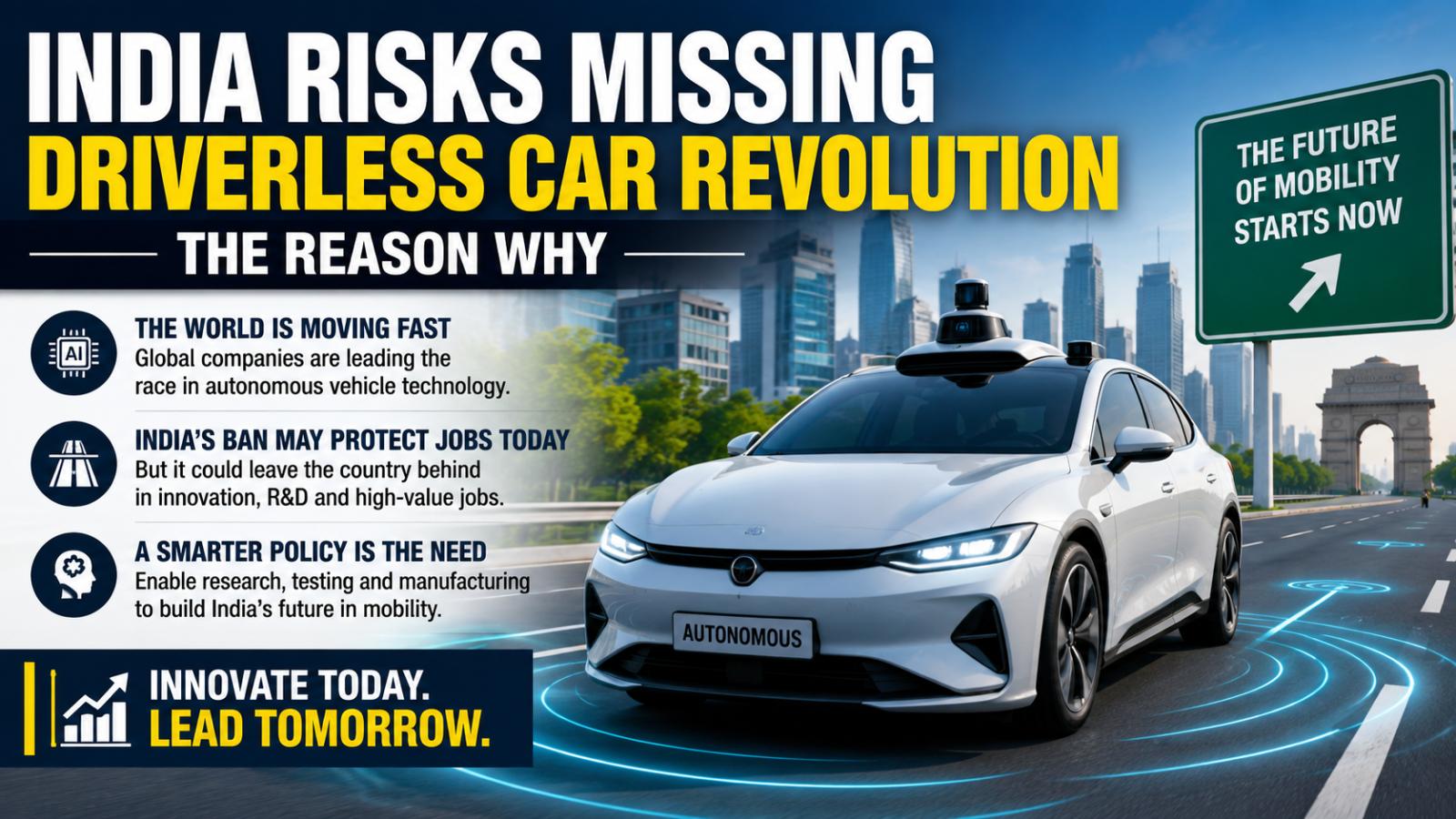
India, however, risks missing out on this fast-growing revolution if it continues to take a rigid stand against driverless vehicles.
The concern is understandable. India has millions of people whose livelihoods depend on driving. A sudden entry of fully driverless cars could create fear around job losses. But completely blocking the sector may not be the right answer.
India needs to separate two things clearly: allowing driverless cars on public roads for commercial use, and allowing research, development, testing, and manufacturing in controlled environments.
Why India’s Current Stand Could Hurt Innovation
India has taken a cautious approach toward driverless cars mainly because of employment concerns. The fear is that autonomous vehicles could replace drivers and affect jobs in transport, taxi services, trucking, logistics, and delivery.
But banning or discouraging the entire sector could leave India behind in a major global technology shift.
Autonomous vehicles are not just about cars. The real value lies in software, sensors, cameras, radar, mapping systems, artificial intelligence, data processing, cybersecurity, and vehicle-control technology.
Countries and companies that build these systems will control a large part of the future mobility economy.
India already has strong talent in software, engineering, automotive components, and electronics. But without policy support, Indian companies may miss the chance to enter the autonomous vehicle ecosystem early.
India Can Become a Strong R&D Hub
Indian roads are complex, unpredictable, and crowded. Many see this as a barrier to driverless cars. But it can also become India’s biggest advantage.
If autonomous systems can be developed to handle Indian traffic conditions, they may become strong enough to work in many other global markets.
Several Indian companies, colleges, and startups have already started working on autonomous mobility. Some are testing self-driving systems for mines, industrial zones, campuses, IT parks, and controlled environments. Others are building autopilot systems, autonomous shuttles, and self-driving vehicle prototypes suited for Indian conditions.
This shows that India has the talent. What is missing is a clear national framework.
Benefits Beyond Passenger Cars
Driverless vehicle technology can help several sectors beyond urban taxi services.
It can be useful in mining operations, ports and freight corridors, warehouses and factories, airports and industrial parks, agriculture, defence, logistics, and long-distance transport.
These areas can adopt autonomous systems without immediately affecting public road traffic or regular taxi drivers.
This is where India should begin.
A strong autonomous vehicle ecosystem can attract high-quality foreign investment, create advanced engineering jobs, support university research, and push Indian companies into high-value technology manufacturing.
India has already missed early opportunities in semiconductors and electric vehicle batteries. Waiting too long on autonomous systems could repeat the same mistake.
A Practical Policy Path for India
India does not need to allow robotaxis everywhere immediately. That would be unrealistic and risky.
A better approach would be phased and controlled.
First, the government should allow large-scale research, prototyping, and testing in closed environments such as mines, ports, warehouses, airports, industrial campuses, and technology parks.
Second, India should build safety rules, insurance systems, cybersecurity standards, mapping infrastructure, data-reporting requirements, and road-quality benchmarks.
Third, limited public-road testing can be allowed in controlled zones such as freight corridors, highways, ports, and smart mobility zones.
Finally, broader commercial use should be considered only after enough safety data is available. Any future rollout should be gradual, location-specific, and supported by worker reskilling programs.
Protect Jobs Without Blocking the Future
India’s goal should not be to replace drivers overnight. The goal should be to prepare for the future without sacrificing today’s workers.
A blanket ban may protect jobs temporarily, but it can also stop Indian companies, engineers, and researchers from participating in one of the biggest mobility revolutions of this century.
The smarter option is to allow innovation while controlling deployment.
India should protect livelihoods, but it should not close the door on research, manufacturing, software development, and global technology opportunities.
Driverless cars may not be ready for Indian roads today. But India must be ready for the driverless future.