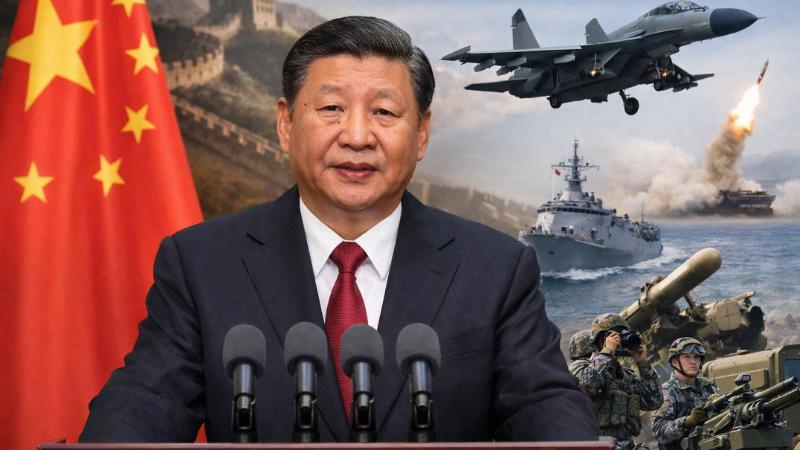
Chinese President Xi Jinping used his annual New Year’s Eve address to reaffirm Beijing’s long-standing position on Taiwan, declaring that reunification with the self-governing island was inevitable. Speaking in Beijing on Wednesday, Xi said that bringing Taiwan under China’s control was “a trend of the times” that could not be stopped, reiterating a pledge that has become a central pillar of his leadership.
The speech came just one day after the conclusion of large-scale Chinese military drills conducted around Taiwan, exercises that further heightened tensions across the Taiwan Strait. China claims Taiwan as part of its territory and has repeatedly stated that it reserves the right to use force if peaceful reunification efforts fail. Taiwan rejects Beijing’s claims and maintains its own democratic government, military, and political system.
Xi’s televised address was closely watched not only for its references to Taiwan, but also for its broader messaging on China’s strategic priorities. Alongside his remarks on reunification, he praised advances in artificial intelligence, semiconductor development, aerospace exploration, and military technology, while urging renewed efforts to strengthen economic growth at a time of mounting domestic and international challenges.
Earlier in the week, China’s People’s Liberation Army carried out live-fire drills on Monday and Tuesday in waters and airspace surrounding Taiwan. The exercises, known as “Justice Mission 2025,” involved coordinated operations by the navy, air force, rocket force, and coast guard. According to official statements, the drills simulated a blockade of key ports and aimed to test joint combat readiness across multiple branches of the military.
The maneuvers marked one of the most expansive military operations near Taiwan in more than a year. At least 89 Chinese military aircraft were reported to have taken part, the highest number recorded over such a short period since similar exercises last year. Analysts noted that the drills moved closer to Taiwan’s main island than previous operations, underlining growing confidence in the PLA’s operational reach.
Chinese commentators linked the timing of the drills to a recent decision by the United States to approve a major arms package for Taiwan, valued at roughly $11 billion. Beijing has consistently opposed such sales, arguing that they undermine regional stability and violate understandings between China and the United States. American officials, meanwhile, say the weapons are intended to help Taiwan maintain a credible defensive capability.
In his speech, Xi also sought to project an image of China as an engaged global actor. He said the country had “embraced the world with open arms,” pointing to several international gatherings hosted by Beijing over the past year. Among them was the Shanghai Cooperation Organization summit held in August in the northern port city of Tianjin, which brought together leaders from across Eurasia and highlighted China’s efforts to deepen ties beyond Western alliances.
The broadcast of the address was interspersed with images from a massive military parade held in September to mark the 80th anniversary of the end of the Second World War. The event showcased advanced weapons systems and was widely interpreted as a demonstration of China’s growing military power. Xi was shown standing alongside visiting foreign leaders, reinforcing a message of strategic alignment at a time of shifting global power balances.
Historical memory also featured prominently in Xi’s remarks. He referenced Taiwan Retrocession Day, a memorial observance introduced in 2025 to mark the end of Japanese colonial rule over Taiwan in 1945. While the date has long been commemorated on the mainland, it has taken on renewed political significance amid competing narratives between Beijing and Taipei over wartime history and national identity.
The legacy of the Second World War has become an increasingly prominent theme in political discourse on both sides of the strait this year. China has emphasized its role in defeating Japanese forces, arguing that its contribution has been underestimated internationally. In Taiwan, political leaders have drawn parallels between the island’s current security concerns and the experiences of European democracies facing authoritarian expansion in the 1930s.
Beyond geopolitics, Xi devoted part of his address to China’s technological and cultural achievements. He highlighted progress in robotics and space exploration, including the Tianwen-2 mission aimed at studying comets, and cited the global popularity of Chinese-made video games and animated films as signs of growing cultural influence.
Economic performance remains a critical concern for Beijing. Earlier on Wednesday, Xi told senior Communist Party officials that China was on track to meet its annual growth target of around 5 percent. However, policymakers continue to face headwinds from slowing domestic demand, property sector stress, and ongoing trade and technology disputes with Washington.
As China navigates these pressures, Xi’s New Year’s message underscored a dual focus on national strength and strategic resolve. By pairing renewed rhetoric on Taiwan with assertions of military readiness, technological progress, and economic ambition, the speech offered a clear signal of Beijing’s priorities as it enters the new year amid intensifying global scrutiny.