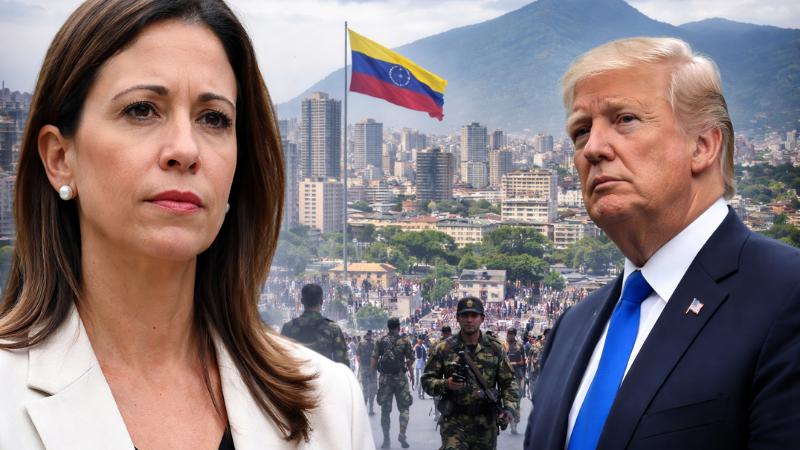
María Corina Machado, long regarded as the most prominent figure in Venezuela’s opposition movement, has emerged as the principal political casualty of Donald Trump’s latest moves on Venezuela. Despite her vocal alignment with Trump and public support for his hardline stance against Nicolás Maduro, Machado now finds herself sidelined as Washington recalibrates its approach to the crisis-ridden nation.
Trump has publicly claimed that the United States will effectively “run” Venezuela, yet there has been no deployment of American troops on the ground. Power within the country remains firmly in the hands of Maduro loyalists, with Venezuelan security forces continuing to patrol the streets. Following a ruling by the Supreme Court, Vice President Delcy Rodríguez has assumed the role of acting president, reinforcing the continuity of the existing power structure. In this rapidly evolving political landscape, Machado’s absence from decision-making has become increasingly conspicuous.
Machado’s current whereabouts remain undisclosed. After spending more than a year in hiding inside Venezuela, she was evacuated in a clandestine operation reportedly led by Bryan Stern, a former US Special Forces veteran and founder of the Grey Bull Rescue Foundation. Despite being under a government-imposed travel ban, she first moved to a coastal fishing village before traveling through the Caribbean, including a reported stop in Curaçao, and then onward to Europe.
She surfaced briefly in Oslo, where she arrived on December 10 to receive the 2025 Nobel Peace Prize, an honor accepted hours earlier by her daughter on her behalf. Norwegian authorities later indicated that Machado had left the country and traveled to another undisclosed location to receive medical treatment for injuries sustained during her escape from Venezuela.
Politically, her isolation is striking given her unwavering support for Trump over the past year. Machado repeatedly praised him as a “champion of freedom” and echoed his administration’s rhetoric, describing the Maduro government as a “narco-terrorist cartel.” She publicly argued that Venezuela had already been “invaded” through the presence of foreign agents and criminal networks, including drug cartels and militant groups, which she said had transformed the country into a hub for organized crime in the Americas.
As events unfolded, Machado initially appeared optimistic. In a message posted on social media, she declared that the opposition was prepared to assert its mandate and take power, asserting that Maduro now faced international justice for crimes committed against Venezuelans and foreign citizens alike. She framed recent US actions as the fulfillment of long-standing promises to uphold the rule of law.
That optimism quickly faded. Within hours, Trump publicly dismissed the possibility of working with Machado, stating that they had not spoken and questioning her ability to lead. While describing her as a “very nice woman,” he said she lacked both respect and support within Venezuela, making any transition under her leadership unlikely.
According to individuals close to Machado, Trump’s remarks left her shocked and deeply disappointed. Reports suggest that Trump’s decision to distance himself from her was influenced by her acceptance of the Nobel Peace Prize, an accolade he has long coveted. One White House official reportedly characterized the acceptance as an unforgivable misstep, despite Machado later dedicating the award to Trump.
In the wake of her marginalization, Machado has urged Venezuelans to rally behind Edmundo González, who replaced her as the opposition’s presidential candidate in the 2024 election and was widely viewed as the legitimate winner. González, however, has since fled to Spain, further weakening the opposition’s position inside the country.
Trump has stated that Secretary of State Marco Rubio and Defense Secretary Pete Hegseth would oversee Venezuela’s future, though it remains unclear how such authority could be exercised without a physical presence or local backing. While Trump has not ruled out sending US troops to Caracas, such a move could provoke backlash domestically, making cooperation with figures inside the existing regime a more likely path.
For Machado, the situation underscores a harsh political reality. After years of resistance, sacrifice, and international advocacy, she now stands excluded from the very transition she championed. Although some of her allies still hope that the Trump administration may eventually include opposition figures in negotiations, her diminished role highlights the unpredictable costs of aligning too closely with external power in a deeply fractured political struggle.