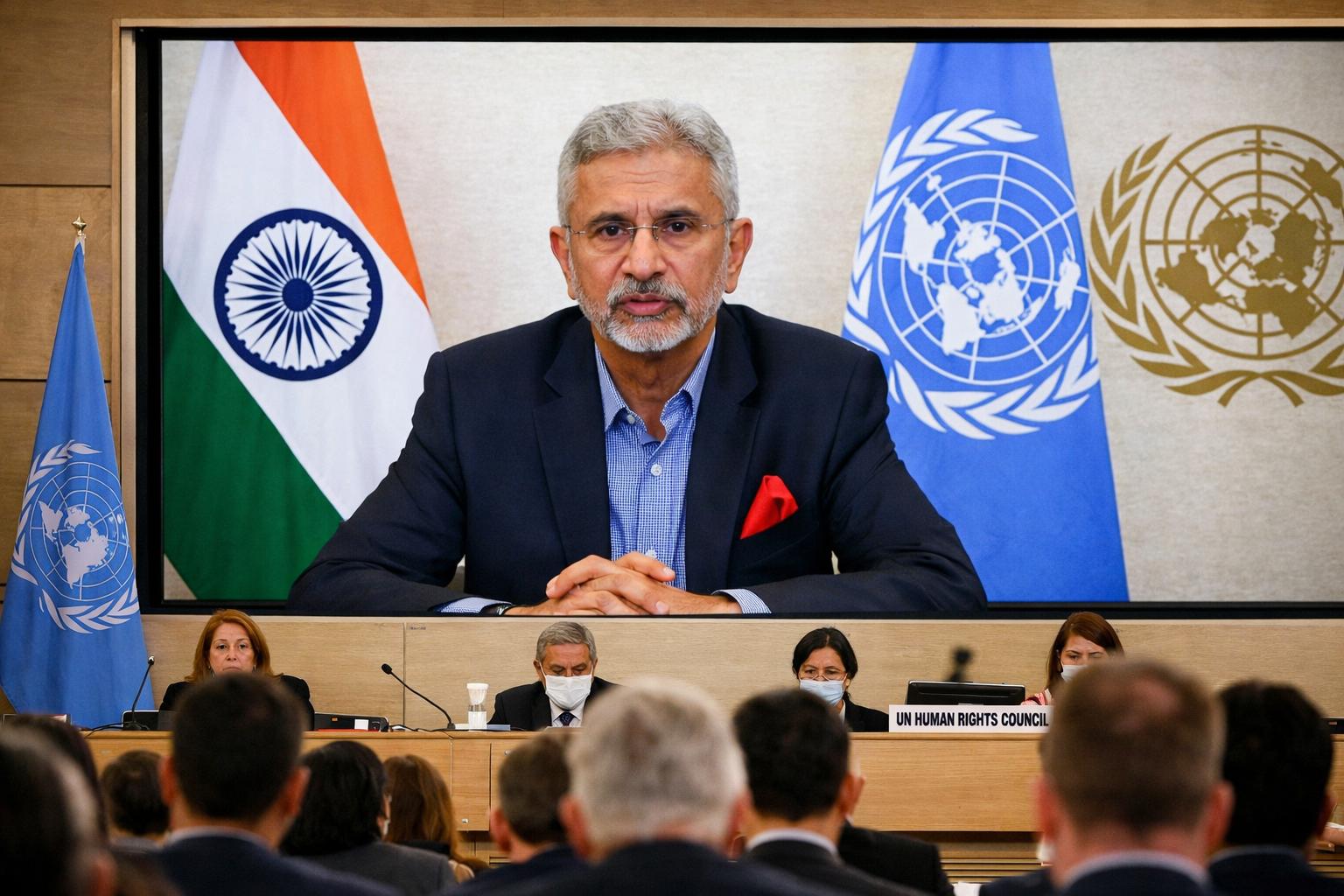
India remains steadfast in its fight against terrorism in all its forms, External Affairs Minister S. Jaishankar said while addressing the High-Level Segment of the 61st session of the United Nations Human Rights Council virtually on Wednesday. He asserted that attacks on innocent civilians can never be justified under any circumstances and called for a unified global response rooted in a zero tolerance approach to terrorism.
Speaking at the UNHRC session, Jaishankar urged the United Nations system and member states to take a firm and consistent stand against terrorist acts, describing terrorism as one of the gravest violations of human rights. He stressed that confronting the threat requires collective determination and sustained international cooperation, particularly at a time when the world is facing heightened conflict, polarisation and uncertainty.
The minister said India’s approach to global challenges is guided by efforts to build common ground rather than deepen divisions. He reiterated New Delhi’s consistent emphasis on dialogue over confrontation, consensus over division and human-centric development over narrow national interests. According to Jaishankar, instability in any region and the marginalisation of communities ultimately undermine human rights protections everywhere.
Outlining India’s engagement with the Human Rights Council, he noted that rights are best advanced through dialogue, capacity building and genuine partnerships rather than politicisation or selective standards. He argued that durable solutions emerge when nations work collaboratively and respect diverse contexts while upholding universal principles.
Jaishankar also highlighted India’s expanding humanitarian aid and development partnerships. He said the country’s outreach, including disaster relief, vaccine supplies during the pandemic, food assistance and capacity-building initiatives, has been driven by empathy and solidarity. Emphasising India’s civilisational ethos of Vasudhaiva Kutumbakam, he said the principle of viewing the world as one family continues to shape its foreign policy and development cooperation.
Addressing broader global challenges, the minister pointed to the compounded effects of the pandemic, climate change, geopolitical tensions and economic stress. These pressures, he said, have deepened inequities, disrupted education, strained food and fuel security and increased debt burdens for vulnerable nations. Such setbacks, he warned, threaten progress toward the Sustainable Development Goals and erode the broader promise of human rights.
Jaishankar further underlined India’s investments in strengthening human capacities through large-scale initiatives and Digital Public Infrastructure. He said the country’s technology platforms have enabled hundreds of millions of people to access welfare benefits, financial services and public schemes with enhanced transparency and reduced leakage. India has shared its Digital Public Infrastructure model as a global public good, he added, reinforcing the idea that technology should serve as a force multiplier for human rights and inclusive development rather than create new fault lines.
Reaffirming India’s commitment at the UNHRC, Jaishankar said that in an era marked by uncertainty and division, collective action grounded in dialogue, equity and zero tolerance for terrorism remains essential to safeguarding global security and advancing human rights worldwide.