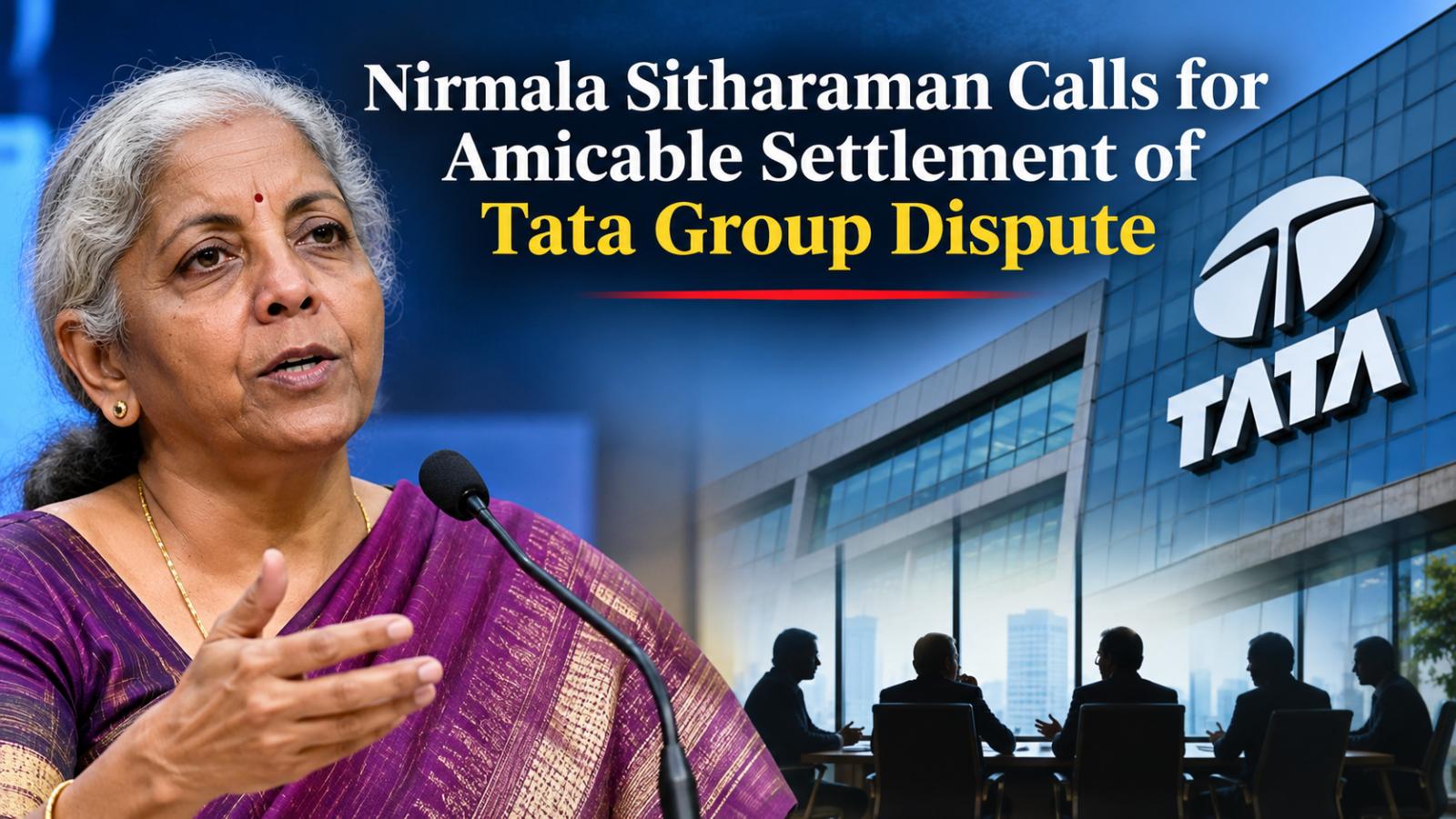
Union Finance Minister Nirmala Sitharaman has urged the leadership of the Tata Group to resolve its growing internal differences through discussions and mutual understanding rather than relying on government intervention. Her remarks come as disagreements over the future of Tata Sons, the group's holding company, continue to raise questions about corporate governance and leadership decisions.
Speaking at the Financial Express Leadership Awards in Mumbai on November 2, 2026, Sitharaman described the Tata Group as an important pillar of the Indian economy. She stressed that an organization with such a long business legacy should handle internal disagreements responsibly and avoid allowing them to become prolonged public disputes.
The Finance Minister acknowledged the contribution of the Parsi community in building the Tata Group into a globally recognized business organization. She emphasized that protecting the group's reputation requires mature leadership, cooperation and a willingness to find common ground.
When asked whether the government should intervene or help bring the opposing sides together, Sitharaman declined to make any immediate commitment. She indicated that even serious disagreements should first be addressed by the parties involved.
Tata Sons listing and RBI listing rules deepen disagreement
The ongoing Tata Group dispute largely revolves around the proposed stock market listing of Tata Sons and differences over the authority of its board and majority shareholder.
Tata Trusts holds approximately 66 percent of Tata Sons, while the Shapoorji Pallonji Group owns around 18.4 percent. The latter has been seeking ways to unlock the value of its investment, making the listing proposal particularly significant.
The disagreement intensified during the September 17, 2026, board meeting, when directors approved a fresh five-year term for Tata Sons Chairman N Chandrasekaran and decided to move forward with plans for a public listing.
However, Tata Trusts Chairman Noel Tata reportedly opposed these decisions, bringing differences between the board and the group's controlling shareholder into sharper focus.
Regulatory requirements have further complicated the situation. The Reserve Bank of India classified Tata Sons as an upper-layer non-banking financial company, a category subject to stricter regulatory obligations, including listing requirements.
Although Tata Sons repaid substantial debt in 2024 and sought deregistration, the listing question remained unresolved.
To address the situation, Tata Trusts proposed restructuring measures intended to change the holding company's regulatory classification and potentially eliminate the need for a public listing.
These developments have created uncertainty over the company's future structure and how major decisions should be made.
Tata Trusts governance and Noel Tata dispute raise concerns
Beyond the listing issue, disagreements involving Tata Trusts governance have added another layer of complexity to the situation.
Trustees Venu Srinivasan and Vijay Singh have approached the Maharashtra Charity Commissioner, seeking an examination of matters involving the administration of Sir Dorabji Tata Trust.
Former trustee Mehli Mistry has also raised concerns regarding governance practices, trustee compensation and potential conflicts of interest. Tata Trusts has challenged his legal standing to pursue those objections.
Meanwhile, Noel Tata has reportedly questioned the process followed during Chandrasekaran's reappointment and requested recordings and additional information related to the September 17 board meeting.
The next Tata Sons board meeting, scheduled for November 26, 2026, is expected to be an important development as directors consider restructuring proposals, shareholder concerns and the company's long-term direction.
The dispute has attracted attention because Tata Group companies operate across major sectors of the Indian economy, including technology, automobiles, steel, aviation and consumer businesses.
While disagreements over ownership and decision-making are not unusual in large business organizations, the Tata Group's longstanding reputation makes the current developments particularly significant.
Sitharaman's remarks reflect a preference for internal dialogue over immediate government involvement. Her appeal places responsibility on the group's leadership to find a practical resolution while respecting regulatory requirements and shareholder interests.
With important decisions approaching, the focus remains on whether the parties can overcome their differences and protect the institutional stability and business legacy of one of India's most respected conglomerates.