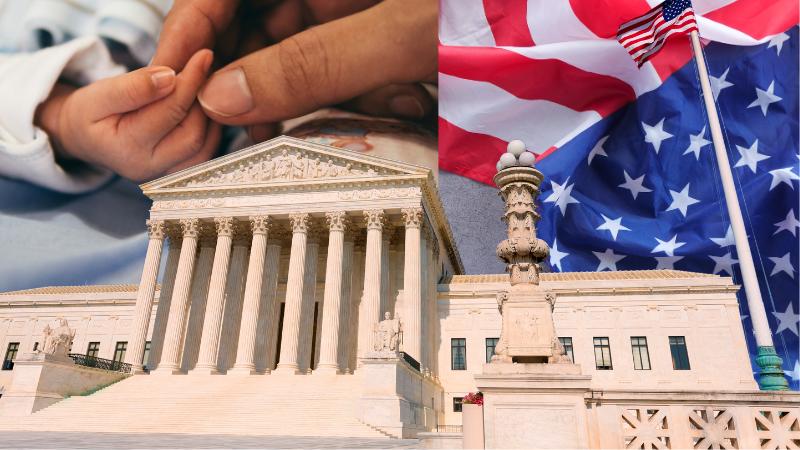
The United States Supreme Court on Thursday appeared divided as it considered two major legal questions: the fate of former President Donald Trump’s executive order seeking to end birthright citizenship, and the broader judicial practice of nationwide injunctions that lower courts have used to block such policies. Although none of the justices openly supported the constitutionality of Trump’s controversial order—which attempts to deny citizenship to certain individuals born in the United States—several conservative members of the bench expressed deep concern about the increasing use of nationwide injunctions to block federal policies.
For more than two hours, the justices engaged in pointed debate, not only about the legal merits of Trump’s immigration order but also about whether lower courts should possess the authority to halt federal policies across the entire country. Chief Justice John Roberts and Justice Brett Kavanaugh both emphasized the urgency of reviewing the executive order’s validity, but also conveyed skepticism about allowing district judges to impose remedies that have sweeping nationwide effects. The discussion reflected broader anxieties among conservative justices about judicial overreach and the growing frequency with which individual judges block federal initiatives in their entirety.
Justice Brett Kavanaugh took a leading role in suggesting an alternative legal pathway: allowing challenges to such executive orders through class-action lawsuits rather than through universal injunctions. He argued that class actions would still provide meaningful relief while forcing courts to narrowly tailor who is protected, based on clearly defined legal criteria. While this method would present additional procedural hurdles for challengers, such as immigrant rights groups, it would avoid what conservatives perceive as overly broad judicial remedies.
However, the proposal to limit judicial remedies did not go unchallenged. Liberal justices raised critical concerns about the real-world implications of removing the power of district courts to issue nationwide injunctions. Justice Ketanji Brown Jackson confronted Solicitor General John Sauer—who was defending Trump’s executive order—on the notion that every individual affected by an illegal policy should be forced to file a personal lawsuit for relief. Jackson warned that such a restrictive interpretation would essentially transform the justice system into a race against governmental overreach, undermining public trust and accessibility.
At the center of the legal debate is Trump’s executive order, which purports to deny automatic citizenship to some children born in the U.S., directly contradicting the 14th Amendment of the Constitution. The amendment, ratified in 1868, guarantees citizenship to all individuals born on American soil regardless of their parents’ immigration status. Legal experts broadly agree that this long-standing interpretation forms a foundational part of American civil rights law. Despite that, the Trump administration pushed the executive order in 2019 as part of a broader agenda to reduce birthright citizenship, which has historically protected millions of U.S.-born children of immigrants.
Multiple district court judges quickly blocked the order from taking effect using nationwide injunctions, prompting criticism from the Trump administration and many conservative legal scholars. These broad orders have been used to stop various federal actions, from changes in immigration policy to the suspension of diversity training and reallocation of federal funds. Conservative justices on the court expressed frustration at what they described as judicial activism and an imbalance of power that allows a single judge to affect national policy with immediate effect.
Justice Samuel Alito articulated a recurring concern by suggesting that the judiciary is vulnerable to a form of egotism, where individual judges believe their interpretation is correct and impose sweeping remedies without restraint. He noted that there are nearly 700 district judges in the United States, and if each had the power to block national policies independently, it could lead to chaos and legal inconsistency across jurisdictions. That sentiment found sympathy among other conservative justices, who worry that unchecked judicial authority could undermine the structure of federal governance.
Still, liberal members of the court emphasized the importance of ensuring that the executive branch cannot enforce policies that courts have deemed unlawful, particularly against vulnerable populations. Without nationwide injunctions, they argued, individuals in different regions might be treated inconsistently under the same federal law, creating confusion and potential injustice. They also expressed concern that limiting court powers could embolden future administrations to act beyond their legal limits, knowing that enforcement could proceed unchecked in certain jurisdictions.
At the conclusion of the hearing, the Supreme Court appeared poised to strike a delicate balance. While there is little support among the justices for upholding Trump’s birthright citizenship order, there seems to be a strong interest in re-evaluating how and when nationwide injunctions should be used. A final decision could have far-reaching implications, not only for immigration law but also for the broader separation of powers and the role of the judiciary in checking executive action. The court is expected to issue its ruling in the coming months, which will likely influence the legal landscape around presidential authority and judicial restraint for years to come.