The issue came to the forefront after talks in Washington between Greenland’s Foreign Minister Vivian Motzfeldt, Denmark’s Foreign Minister Lars Lokke Rasmussen, US Vice President JD Vance, and Secretary of State Marco Rubio. According to officials familiar with the discussions, the meeting concluded without progress and highlighted what was described as a fundamental disagreement between the parties on Greenland’s future and its relationship with the United States.
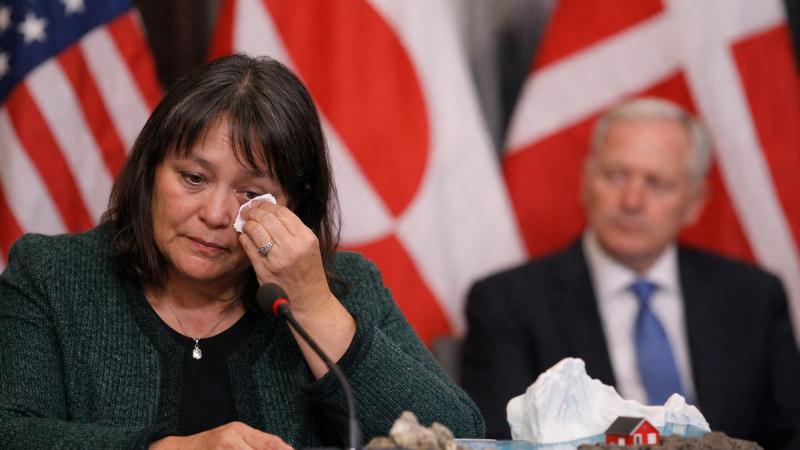
Speaking after the meeting, Motzfeldt described the heavy burden placed on Greenland’s small foreign affairs administration, noting that officials have been working under extreme pressure in recent days. She said the combination of constant diplomatic preparation, public statements from US leaders, and growing international attention had created an unusually intense situation for a territory with limited administrative resources. During the interview, she became visibly emotional, pausing as she acknowledged how difficult the past days had been for both herself and her colleagues.
Despite the strain, Motzfeldt stressed that Greenland’s government remains focused on safeguarding the security and well-being of its population. She said the administration was determined to ensure that Greenlanders continue to feel safe and able to live securely, adding that every effort is being made to defend the island’s autonomy and political stability. Her remarks reflected a broader concern within Greenland that external pressure could undermine the principles of self-government and consent that underpin its relationship with Denmark.
From Washington, the White House sought to downplay European responses, stating that the presence or potential deployment of European troops in Greenland would not alter President Trump’s position. The administration reiterated that such developments had no bearing on the president’s stated objective regarding the Arctic territory, reinforcing the perception that the United States remains firm in its strategic interest in Greenland.
Denmark responded forcefully, rejecting any suggestion that Greenland could be acquired by another state. Danish officials said the idea was unacceptable and ran directly counter to international law, established norms of sovereignty, and the wishes of both Denmark and Greenland. They emphasized that Greenland’s status is not open to negotiation and warned that continued rhetoric on the issue risks damaging diplomatic relations.
Concerns have also been voiced elsewhere in Europe. Polish Prime Minister Donald Tusk warned that any attempt by one Nato member to take over part of another member’s territory would have severe political consequences. He said such an action would strike at the heart of Nato solidarity, which has long served as a cornerstone of collective security and a deterrent against aggression. According to Tusk, undermining these principles would represent a profound crisis for the alliance and the broader international order.
As diplomatic tensions continue, the situation underscores the growing strategic importance of the Arctic, where issues of security, resources, and geopolitical influence are increasingly intersecting. For Greenland, the challenge remains balancing its autonomy and the protection of its people amid mounting pressure from global powers and an uncertain diplomatic landscape.