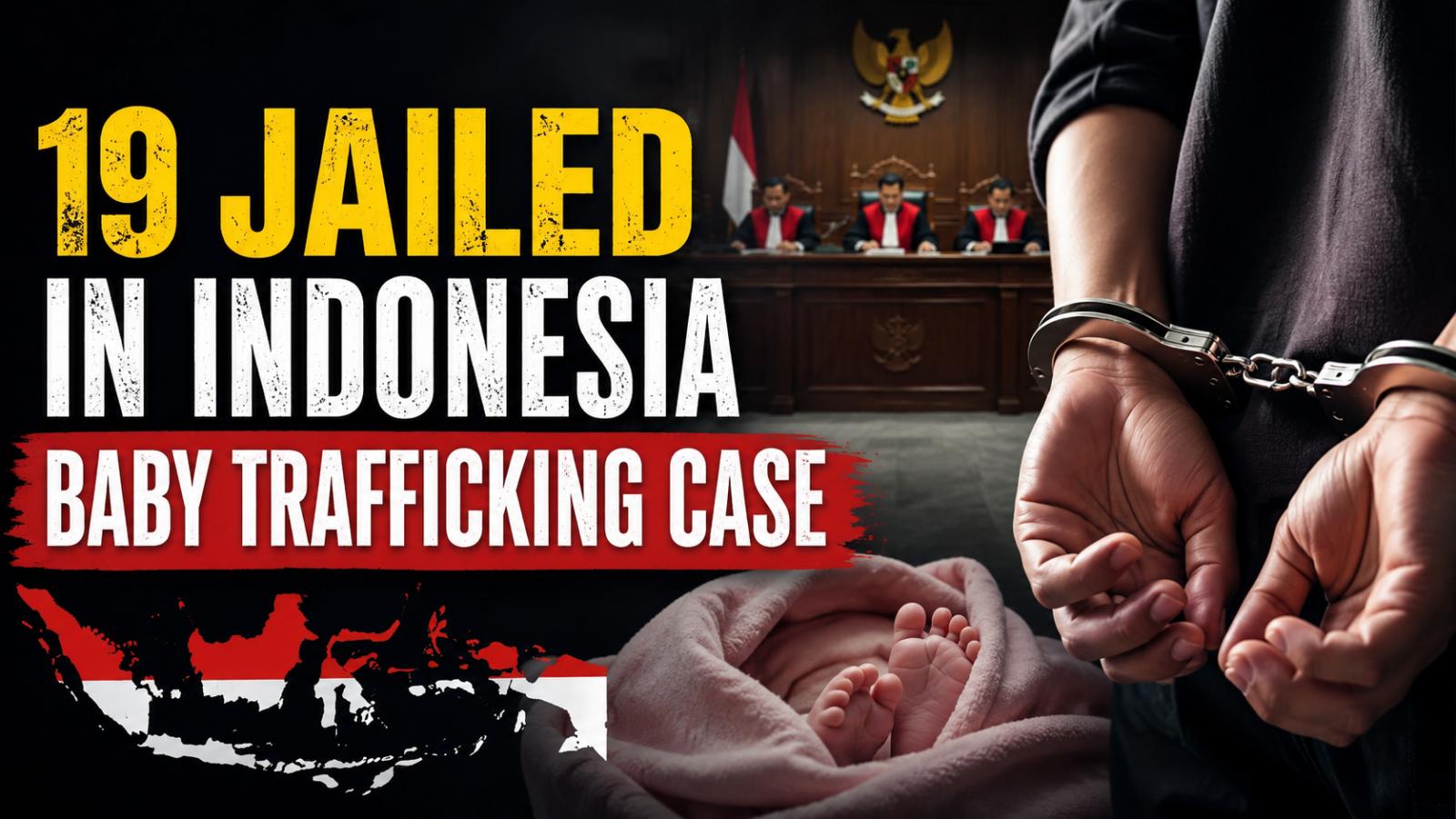
An Indonesian court has sentenced 19 people to prison for their roles in an Indonesia baby trafficking operation that moved infants through several cities and sold some to adoptive families in Singapore. The Bandung City District Court imposed terms ranging from three years and four months to seven years after finding all defendants guilty of human trafficking. The convictions were delivered on Tuesday, July 21, 2026.
Court
Judge Gatot Ardian Agustriono said the group had recruited, sheltered, transferred and received babies for exploitation. Proceedings showed that the syndicate handled at least 34 infants between 2022 and 2025. Prosecutors had sought prison terms of up to 10 years for five defendants, but the court imposed lower sentences after reviewing each person’s role.
Lie Siu Luan, 70, also known as Popo, received the longest sentence of seven years. The court identified her as the leader who recruited participants and supervised domestic and cross-border operations. Astri Fitrinika, who recruited babies, and Lai Siu Ha, who prepared false birth certificates and family registration documents, each received six years and seven months.
Singapore
Investigators said the network moved babies from parts of West Java to Depok before transferring them to a house in Pontianak, West Kalimantan. Appointed caregivers looked after the infants there. Some babies were later transported through Jakarta and taken to Singapore under the appearance of legal adoption.
Court evidence indicated that babies sent to Singapore could be sold for up to S$18,000, or approximately US$14,000, each. At least 12 trafficked children are believed to remain in Singapore. The Indonesian National Police said it had worked with the Singapore Police Force to investigate the international route and identify people involved outside Indonesia.
Sentences
Djaka Hamdani Hutabarat, the only male defendant, and his wife, Elin Marlina, were sentenced to six years and seven months for acting as intermediaries. Six other defendants who posed as biological mothers or babysitters received prison terms of three years and four months each.
The penalties drew attention because prosecutors requested tougher punishment for several senior members. However, the ruling still represents a major conviction in a serious cross-border infant-trafficking case involving 18 women and one man.
Network
The case exposed how trafficking groups can exploit adoption procedures, financially vulnerable families and falsified civil records. Recruiters sourced babies, intermediaries moved them between cities, caregivers housed them and document handlers created records designed to make the transfers appear legitimate.
Authorities now face the harder task of locating the remaining children, confirming their identities and deciding whether they can be safely reunited with their biological families. Stronger checks on birth registration, adoption documents and cross-border travel could help prevent similar networks from operating again.