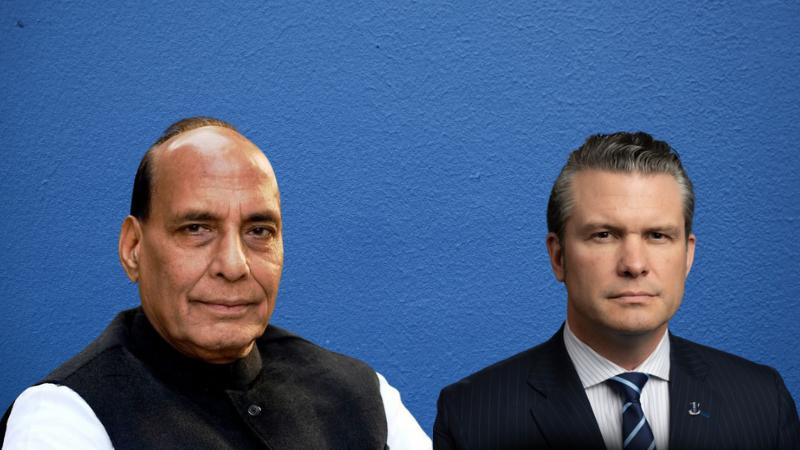
India and the United States have agreed to finalize a new 10-year defence partnership framework aimed at deepening strategic and military cooperation between the two countries. The agreement is expected to be signed later this year when India's Defence Minister Rajnath Singh meets with US Secretary of Defence Pete Hegseth, according to a Pentagon spokesperson.
The decision to move forward with the long-term framework was made during a recent phone call between Singh and Hegseth. During their conversation, the two leaders reviewed the growing defence relationship and reaffirmed their commitment to enhancing cooperation in key areas such as defence trade, technology transfer, and joint production. Colonel Chris Devine, a senior spokesperson for the US Department of Defence, confirmed the discussions and said that Hegseth emphasized India’s role as a key strategic defence partner in South Asia.
The new framework builds upon the progress made under the joint statement released by President Donald Trump and Prime Minister Narendra Modi in February 2025, which outlined shared goals for defence collaboration, regional stability, and technological innovation. The renewed agreement is expected to include provisions for expanding defence industrial cooperation, finalizing major US defence sales to India, and enhancing co-production of military systems.
In addition to Singh’s conversation with Hegseth, the US Secretary of Defence also met with India’s External Affairs Minister S Jaishankar at the Pentagon. Their meeting covered a wide range of issues including regional security in the Indo-Pacific, the evolving defence partnership, and progress in high-end technological collaboration. The two leaders expressed mutual interest in strengthening interoperability between their armed forces and supporting emerging defence tech sectors in both countries.
One of the major points of discussion was the upcoming INDUS-X Summit, a bilateral initiative focused on promoting joint defence innovation and accelerating startup ecosystems between the two countries. They also welcomed the formal launch of the Autonomous Systems Industry Alliance, or ASIA, which aims to bring together private sector players to boost collaboration in drone and autonomous system technologies.
According to US officials, the new defence framework will formalize many of these efforts and pave the way for more ambitious cooperation over the next decade. Hegseth noted that the United States is encouraged by how successfully American defence systems have been integrated into India’s military operations. He added that Washington is committed to supporting New Delhi through increased defence exports, supply chain cooperation, and collaborative research and development.
Speaking after his meeting, Jaishankar reaffirmed India’s strategic commitment to the US and emphasized that the defence relationship goes beyond shared interests. He stated that it is rooted in a growing alignment of capabilities and responsibilities, especially in a region as critical as the Indo-Pacific. He stressed the need for deeper cooperation to ensure regional security, maintain freedom of navigation, and support a rules-based international order.
The two sides also agreed to participate in the upcoming India-US Defence Acceleration Ecosystem Summit, which is expected to bring together defence industry stakeholders, policymakers, and innovation leaders. The goal is to accelerate joint projects, enable greater public-private partnerships, and foster a resilient industrial base that benefits both nations.
While no specific date has been announced for the signing of the 10-year framework, officials on both sides indicated that preparations are well underway. The agreement is expected to be one of the most comprehensive bilateral defence plans signed in recent years and is being viewed as a significant step in shaping a stronger strategic future for India and the United States.
As tensions persist in the Indo-Pacific region and global security dynamics evolve, the growing partnership between India and the US is increasingly seen as a stabilizing force. With this new framework, both countries aim to reinforce their defence ties, align strategic objectives, and promote a shared vision for peace, innovation, and cooperation in the region.