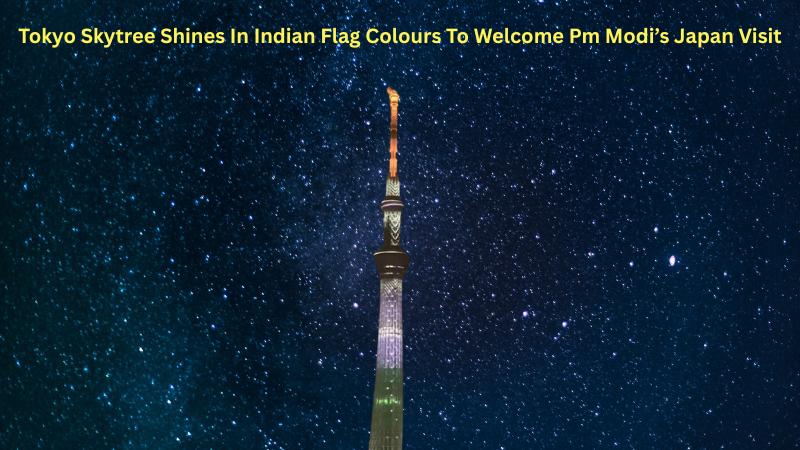
The Tokyo Skytree, the tallest tower in Japan and one of the most iconic landmarks of the country, was illuminated in the colours of the Indian national flag to mark the visit of Prime Minister Narendra Modi to Tokyo on Friday, August 29. The tricolour lighting served as a symbolic gesture reflecting the warmth of the relationship between India and Japan. Modi is in Japan for a two-day visit to participate in the 15th Annual India-Japan Summit, which was hosted by Japanese Prime Minister Shigeru Ishiba. The vibrant visuals of the Skytree highlighted the significance of this diplomatic engagement, showing how cultural symbolism plays an important role in strengthening ties between nations.
Prime Minister Modi was officially welcomed by his Japanese counterpart Shigeru Ishiba, and the two leaders held a bilateral meeting followed by a joint press briefing. Discussions centered around deepening cooperation in defence, space, investments, economic growth, and advanced technologies. The dialogue between the two countries demonstrated the breadth and depth of their partnership, which has steadily grown over the past decade.
One of the major areas of cooperation highlighted during the summit was defence collaboration. India and Japan announced that they will jointly work on the development of the Unified Complex Radio Antenna, also known as UNICORN, designed for the Indian Navy. This marks another milestone in their security partnership, which has expanded significantly in recent years in response to the evolving regional security landscape.
Space exploration was another area of strong cooperation. India’s ISRO and Japan’s JAXA are already working together on the LUPEX mission, which aims to explore the moon’s south pole. The collaboration in lunar research showcases how both countries are combining their technological expertise to achieve ambitious goals in space science, with the potential for discoveries that will contribute to global scientific progress.
Economic ties formed another pillar of the discussions. Japan has set an ambitious target of investing 10 trillion yen in India over the next decade. This investment commitment spans multiple sectors, including infrastructure, manufacturing, technology, and green energy. Such long-term investment goals highlight Japan’s confidence in India’s economic potential and its role as a major partner in Asia’s growth story.
Beyond formal diplomatic talks, Prime Minister Modi also engaged in parliamentary and cultural exchanges during his visit. He held a meeting with Speaker Fukushiro Nukaga and a group of Japanese parliamentarians, where discussions focused on strengthening parliamentary ties, fostering human resource development, and boosting cultural exchanges. Modi emphasized the role of cooperation in emerging areas such as artificial intelligence, science, technology, mobility, and healthcare, underlining the multidimensional nature of the India-Japan partnership.
The Indian community in Japan also played an important role during Modi’s visit. Meeting members of the diaspora, the Prime Minister praised their contributions in building bridges between India and Japan. The Indian community has long served as a cultural link, enhancing mutual understanding and ensuring that people-to-people relations remain strong. Modi’s recognition of their role reflects how diaspora communities are integral to foreign relations, often supporting and amplifying the work done at the government level.
Cultural symbolism was at the heart of this visit as well. The lighting of the Tokyo Skytree in the Indian tricolour was not only a tribute to India but also a reflection of how the Japan-India partnership is being celebrated publicly. Such gestures go a long way in demonstrating goodwill and strengthening the bonds of friendship beyond political agreements.
India and Japan had elevated their ties to a Special Strategic and Global Partnership a decade ago, a designation that underscores the depth of their relationship. This year’s summit further reinforced that bond, highlighting a shared vision for peace, stability, and development in the Indo-Pacific region and beyond. Defence and space cooperation, large-scale investments, parliamentary dialogue, and cultural engagement all reflect the comprehensive and enduring nature of this relationship.
Prime Minister Modi’s two-day visit is therefore seen as an important step in advancing the bilateral agenda between India and Japan. With the focus on cutting-edge technologies, economic growth, and cultural exchanges, both nations reaffirmed their commitment to shaping a future that is not only beneficial to them individually but also contributes to regional and global progress. The lighting of the Tokyo Skytree in Indian colours will remain a striking image symbolizing this enduring friendship and the bright prospects that lie ahead for India and Japan’s partnership.