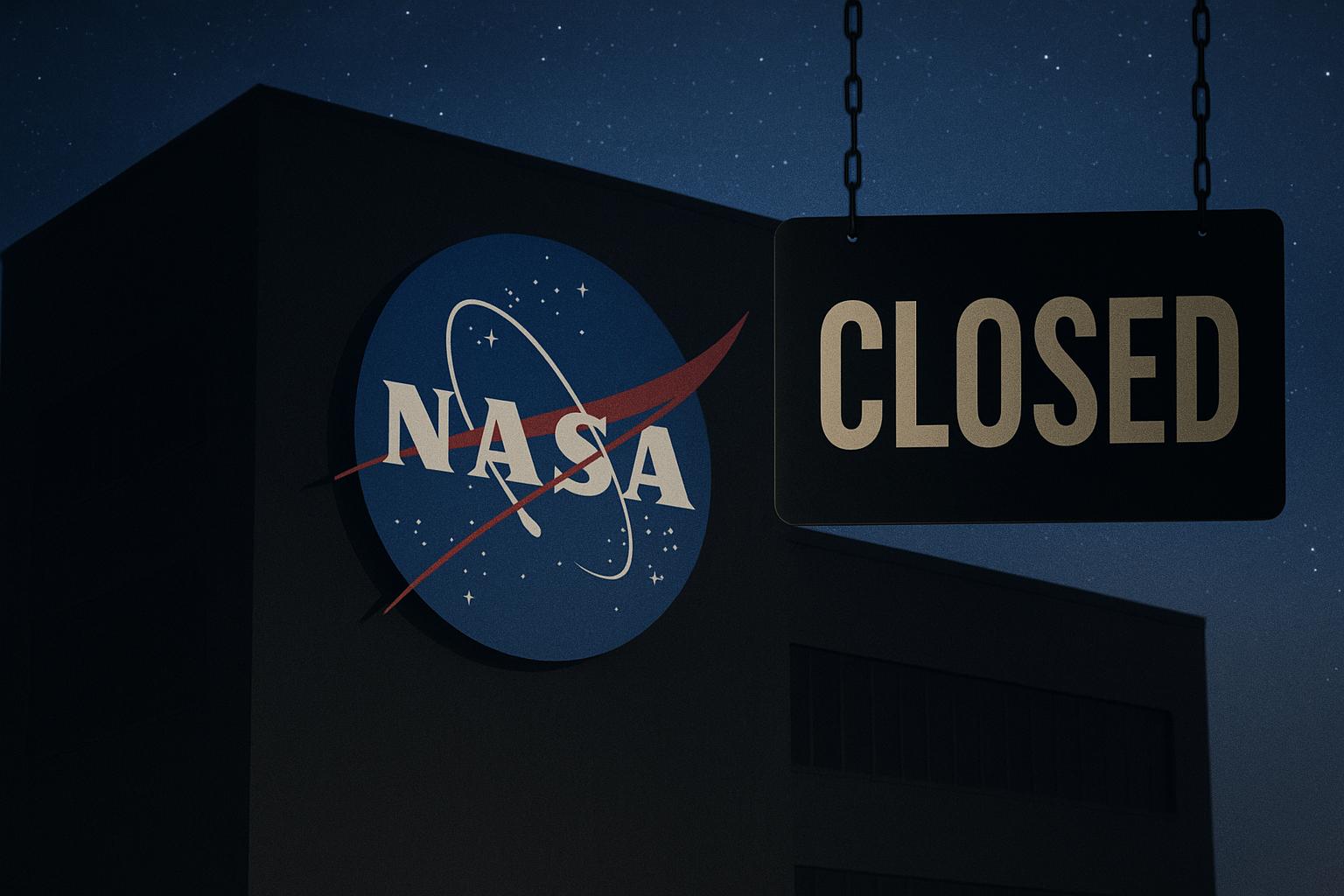
Nasa has announced that it is suspending most of its operations after the United States entered a government shutdown on October 1, 2025, following Congress’s failure to pass a budget or temporary funding measure. A notice on the agency’s website declared that it is “closed until further notice,” with only a limited workforce continuing essential tasks.
The shutdown, the first in nearly six years, has led to thousands of federal employees being furloughed across multiple government agencies. For Nasa, the impact is especially significant as it halts a wide range of activities, from space research to public communications. Social media channels have gone silent, public updates about missions are paused, and outreach programs are on hold until funding is restored.
Despite this broad suspension, a small number of critical functions remain active. Astronauts aboard the International Space Station continue to be monitored, spacecraft exploring the solar system are still being operated, and planetary defense systems that track asteroids are running with reduced staffing. These tasks are deemed vital to safety and cannot be interrupted even during a government funding lapse.
The disruption, however, threatens to derail some of Nasa’s most ambitious projects. Preparations for upcoming launches under the Artemis program, which aims to return humans to the Moon, could face delays. Work toward future Mars missions is also likely to be slowed as scientific and engineering schedules are disrupted. Each day of delay risks pushing back key milestones, undermining the momentum needed to achieve long-term exploration goals.
Research projects supported by Nasa funding have been suspended, affecting universities and scientific institutions that rely heavily on the agency’s grants. The pause also impacts contractors who support Nasa’s programs, many of whom could face serious disruptions if the shutdown continues for an extended period. Such breaks in continuity make it harder to manage complex projects and maintain partnerships essential to advancing space science.
This is not the first time Nasa has faced such challenges. Previous shutdowns, including the 2018–2019 closure, caused significant setbacks to ongoing missions and created uncertainty for the workforce. Recurring interruptions disrupt planning and make it increasingly difficult for Nasa to maintain steady progress on its bold ambitions, including lunar exploration and deep-space missions.
The current funding lapse comes at a crucial time for the agency. Nasa has invested heavily in the Artemis program, a centerpiece of America’s return to crewed lunar missions, while also laying groundwork for Mars exploration. Each delay caused by political deadlock in Washington directly impacts the pace at which these historic missions can move forward.
While critical safety functions remain intact, the broader silence from Nasa is a stark reminder of how political stalemates affect science and exploration. Astronauts and spacecraft remain under watch, but thousands of employees and researchers are left waiting for the green light to resume work. Until a resolution is reached, Nasa’s operations remain paused, its communications silent, and its future goals at risk of further delay.
For now, the shutdown highlights how fragile progress in space exploration can be when tied to political negotiations. The closure of Nasa underscores the cost of inaction, leaving vital missions in limbo and reminding the world that even the pursuit of the stars can be grounded by earthly disputes.