Four emerging humanoid robotics companies — Unitree, Galbot, Noetix, and MagicLab — presented their latest machines during the high-profile broadcast, an event often compared in cultural impact to the Super Bowl in the United States. The appearance of multiple robotics firms on prime-time television reflects the growing importance China places on AI-driven automation and next-generation manufacturing capabilities.
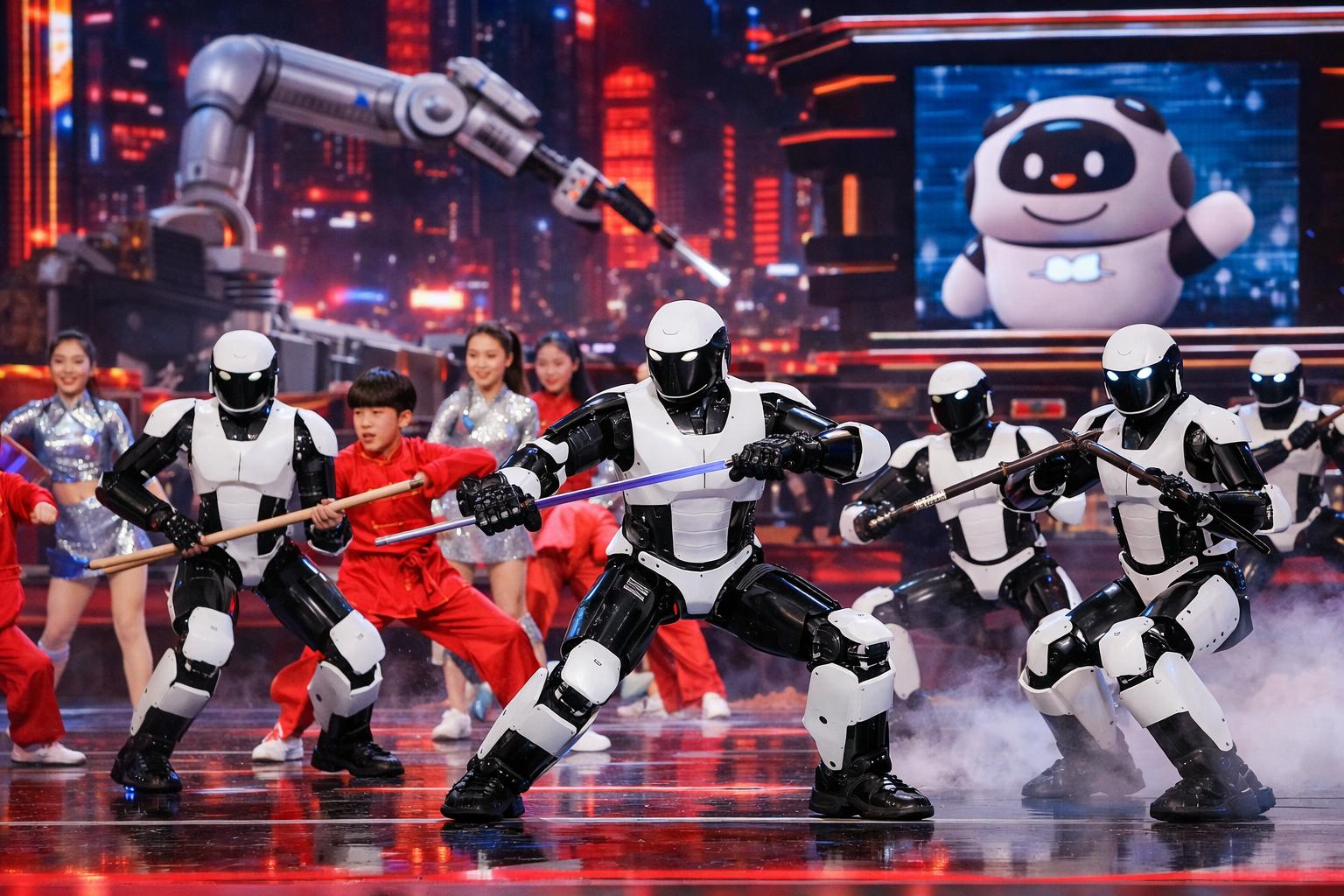
The gala’s opening segments prominently featured humanoid machines performing alongside human actors. In one extended martial arts demonstration, more than a dozen Unitree robots executed complex choreographed fight routines using swords, poles, and nunchucks while performing in close proximity to child performers. The sequence included movements inspired by China’s traditional “drunken boxing” style, highlighting advances in balance control, multi-robot coordination, and fault recovery systems that allow robots to regain stability after falls.
Artificial intelligence also played a visible role in the program. ByteDance’s chatbot Doubao appeared in the opening sketch, while Noetix robots participated in a comedy segment with human actors. MagicLab machines later joined performers in a synchronized dance during the musical number “We Are Made in China,” reinforcing the event’s focus on domestic technological capability.
Interest in China’s robotics sector has intensified as companies such as AgiBot and Unitree prepare for potential robotIPO activity this year. At the same time, several domestic AI firms released new frontier models during the Lunar New Year holiday period, signaling heightened competition in embodied AI and smart manufacturing.
The previous year’s gala had already drawn widespread attention after featuring 16 full-sized Unitree humanoids performing a coordinated dance routine. Weeks later, the company’s founder met President Xi Jinping at a major technology symposium, highlighting the sector’s rising political visibility. Over the past year, Xi has reportedly met multiple robotics entrepreneurs, placing the industry on similar footing with electric vehicle and semiconductor priorities.
Analysts say the gala has long functioned as a platform for signaling national technology goals. Georg Stieler, Asia managing director at a technology consultancy, noted that companies featured on the broadcast often gain increased investor interest, government support, and market access. He added that the rapid improvement in robot motion control suggests firms like Unitree are making significant progress in developing the AI “brains” required for real-world industrial deployment.
Behind the spectacle of kung-fu demonstrations and choreographed performances, China is positioning robotics and AI at the center of its AI+manufacturing strategy. Policymakers are betting that automation and intelligent machines will help offset economic pressures from the country’s aging workforce while strengthening its global manufacturing position.
Beijing-based analyst Poe Zhao said humanoid platforms effectively combine several of China’s core strengths, including hardware supply chains, AI capability, and large-scale manufacturing experience. In an emerging market, Zhao noted, public attention itself becomes a strategic asset.
Market data underscores China’s early lead. Research firm Omdia estimates the country accounted for roughly 90 percent of the approximately 13,000 humanoid robots shipped globally last year, far ahead of international competitors including Tesla’s Optimus program. Morgan Stanley projects China’s shipments could exceed 28,000 units this year.
Tesla CEO Elon Musk recently acknowledged the growing challenge from Chinese firms as the company pivots toward embodied AI. He warned that many observers underestimate the pace and scale of China’s technological progress, signaling that global competition in humanoid robotics is likely to intensify in the coming years.