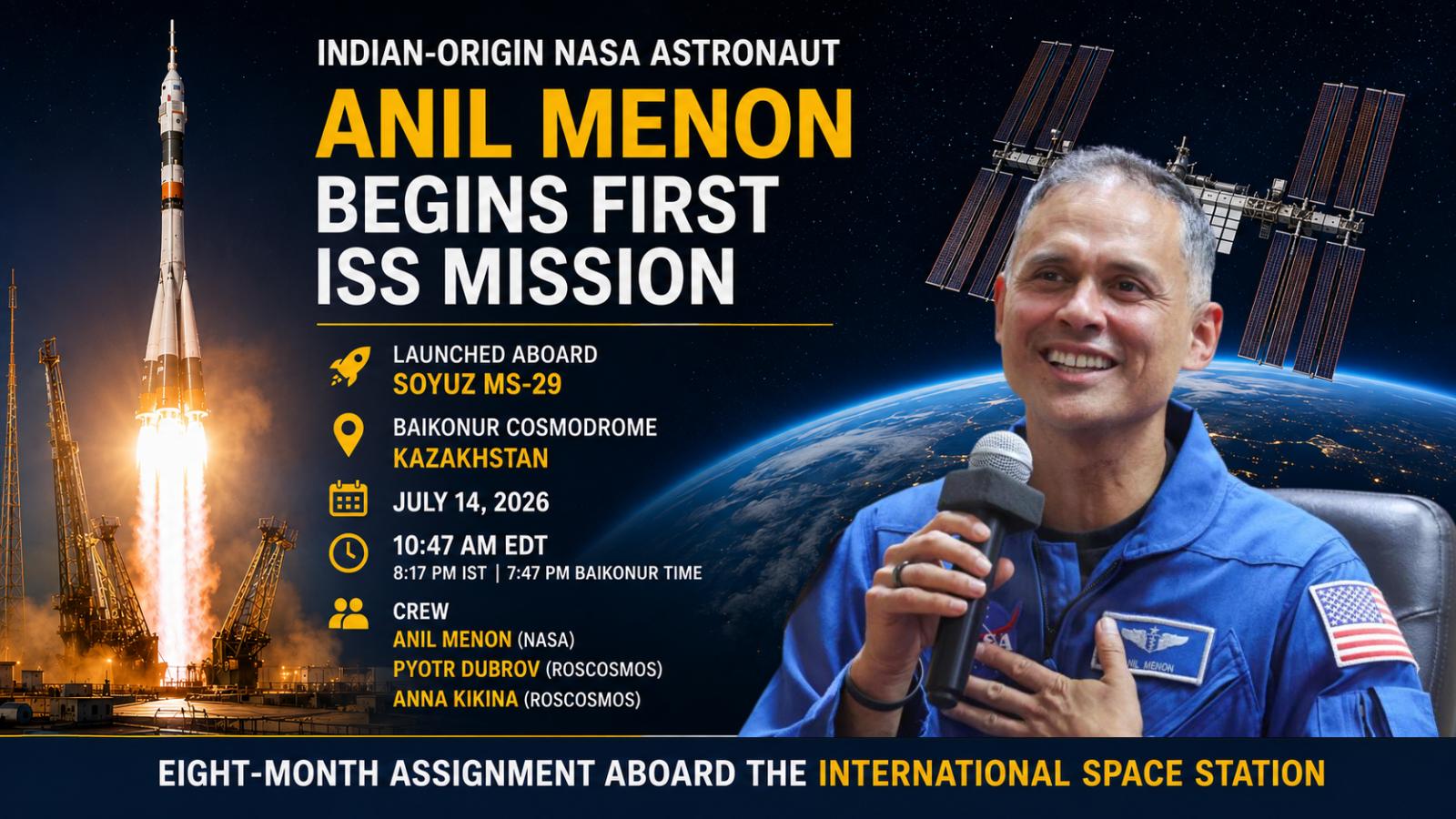
The Anil Menon ISS mission began Tuesday, July 14, 2026, when the NASA astronaut launched aboard Soyuz MS-29 from Kazakhstan with cosmonauts Pyotr Dubrov and Anna Kikina for an eight-month Expeditions 74 and 75 assignment.
Indian-origin NASA astronaut Anil Menon began his first spaceflight on Tuesday, July 14, 2026, launching aboard Russia’s Soyuz MS-29 spacecraft for an eight-month assignment at the International Space Station.
The spacecraft lifted off from the Baikonur Cosmodrome in Kazakhstan at 7:47 PM local time. The launch occurred at 10:47 AM EDT in the United States and 8:17 PM IST in India. NASA confirmed that the spacecraft successfully reached Earth orbit following liftoff.
Soyuz MS-29 Launches Three-Person Crew
Menon traveled with Roscosmos cosmonauts Pyotr Dubrov and Anna Kikina. The three-person crew began a two-orbit journey lasting approximately three hours before the spacecraft’s planned arrival at the station.
Soyuz MS-29 was scheduled to dock automatically with the Russian Prichal module at 1:56 PM EDT on Tuesday, July 14, 2026. NASA began its live rendezvous and docking coverage at 1:10 PM EDT.
Anil Menon Begins First Spaceflight
The mission marks Menon’s first journey into space after NASA selected him as an astronaut in 2021. He is a physician, mechanical engineer and colonel in the United States Space Force.
Menon was born and raised in Minneapolis and is of Indian and Ukrainian heritage. He previously supported International Space Station missions as a NASA flight surgeon.
Crew to Join Expeditions 74 and 75
After entering the station, Menon, Dubrov and Kikina were set to join the Expedition 74 crew. They are expected to remain aboard the orbiting laboratory for about eight months as members of Expeditions 74 and 75 before returning to Earth in spring 2027.
The station’s multinational crew includes personnel representing NASA, the European Space Agency and Roscosmos.
Eight-Month ISS Mission Focus
During his assignment, Menon is expected to participate in scientific investigations and technology demonstrations supporting future human missions and research benefiting life on Earth.
NASA said his planned work includes studies of astronaut veins, blood flow and blood composition in microgravity. He is also expected to help test the production of intravenous fluids using drinking water available aboard the station.
Following docking and hatch opening, the Soyuz crew will begin station operations alongside the astronauts and cosmonauts already aboard. NASA and Roscosmos will continue monitoring the spacecraft’s arrival and the crew’s transition into their long-duration orbital assignment.