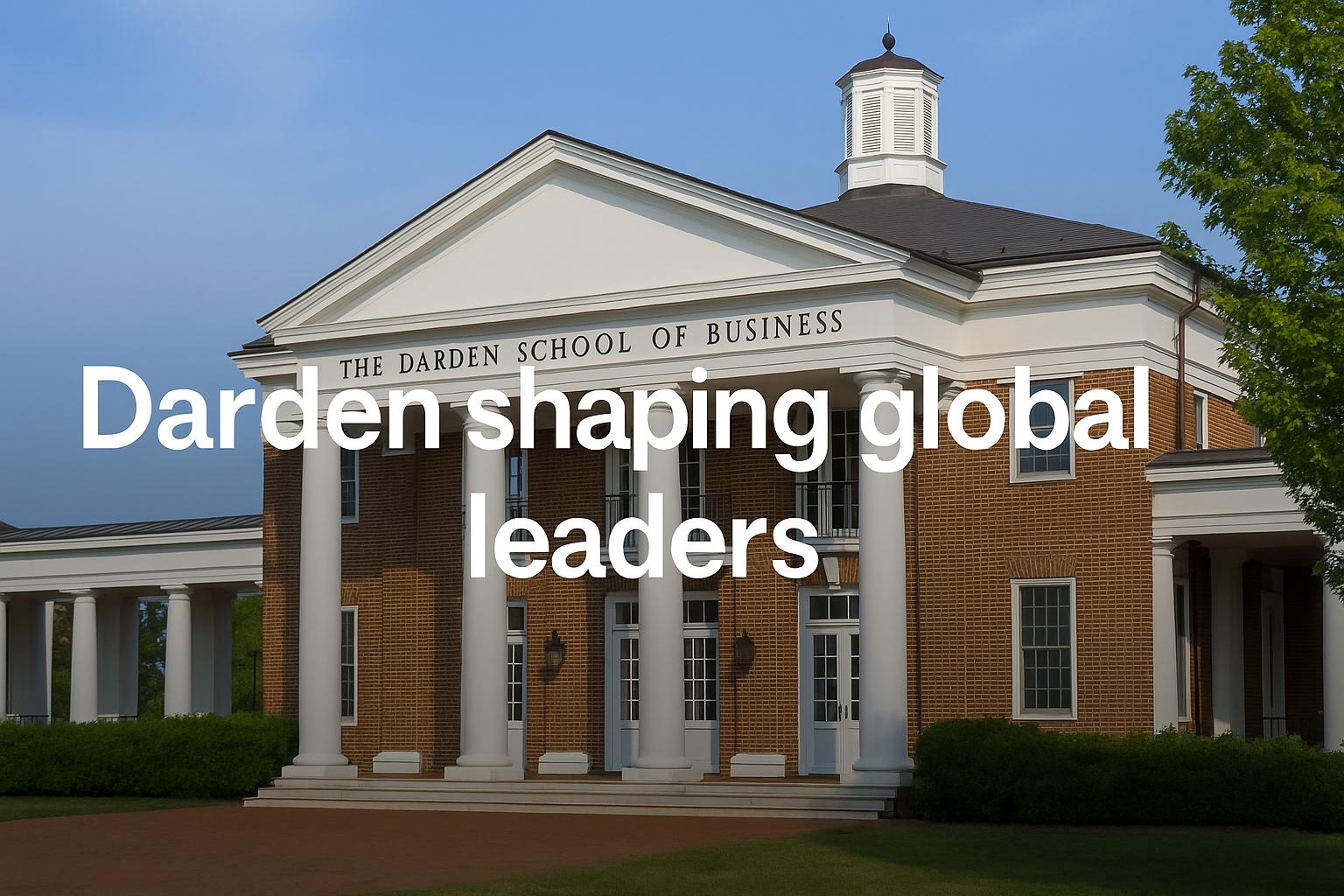
Ranked among the world’s top public institutions, the Darden School of Business at the University of Virginia has gained recognition for shaping students into leaders who can thrive in rapidly evolving global markets. With students from across the world joining its programs, Indian students in particular are increasingly enrolling with a clear aim: to sharpen their leadership and entrepreneurial skills while learning how to apply technical expertise in international business contexts.
Professor Doug Thomas, Academic Director of the Sands Institute for Lifelong Learning at Darden, explains that modern business education cannot remain confined to narrow specialization. According to him, a leader who only understands one dimension, such as operations or finance, without linking it to strategy, people, and supply chain management, will eventually face failure. The approach at Darden emphasizes an interconnected model of decision-making, where students learn to view challenges from multiple perspectives and prepare for the unpredictable nature of real-world situations.
Classroom experiences at Darden revolve heavily around case studies, where students are immersed in scenarios that require them to analyze limited datasets, build arguments, persuade peers, and defend their choices. This model reflects the uncertainty and ambiguity that business leaders confront daily outside the academic environment. For Indian students, this method not only enhances problem-solving skills but also broadens their capacity to adapt and think creatively. As Thomas points out, Indian students typically bring strong analytical backgrounds, but Darden helps them expand these strengths into leadership capabilities and entrepreneurial thinking that extend beyond technical skills.
The cultural dimension is another important part of the Darden experience. Indian students, along with their peers from other countries, work in diverse teams where they encounter different cultural perspectives and ways of problem-solving. Living and studying in the United States exposes them to an environment that emphasizes collaboration across cultural and professional backgrounds. This cultural immersion, Thomas notes, is invaluable in shaping students into global leaders capable of leading heterogeneous teams in multinational organizations or entrepreneurial ventures back home.
Beyond classroom learning, Darden integrates theory with practical application. Corporate projects, live industry partnerships, and applied simulations form an essential part of the curriculum. Students are often asked to solve business challenges where efficiency, ethics, and long-term sustainability must be balanced. These exercises highlight trade-offs, such as achieving faster delivery while considering the implications on labor standards or shifting costs without compromising fairness. The emphasis on sustainability and ethical leadership prepares students to make decisions that extend beyond immediate profitability and contribute to long-term organizational success.
For Indian students, these lessons are particularly relevant. Emerging markets often present challenges such as infrastructure disparities, supply chain complexities, and diverse customer demands. The principles taught at Darden give students the tools to address these realities effectively while keeping in mind global standards. This combination of analytical rigor, leadership preparation, and ethical grounding creates graduates who are well-positioned to lead businesses in both developed and emerging economies.
Thomas underscores that business education at Darden is about building leaders who can adapt to change, navigate uncertainty, and inspire teams to achieve sustainable results. By blending case-based learning, cultural immersion, and practical exposure, the school equips students with a skill set that extends beyond the classroom. For Indian students, this journey is not only about academic achievement but also about preparing to make a difference as entrepreneurial and ethical leaders in a globally connected world.