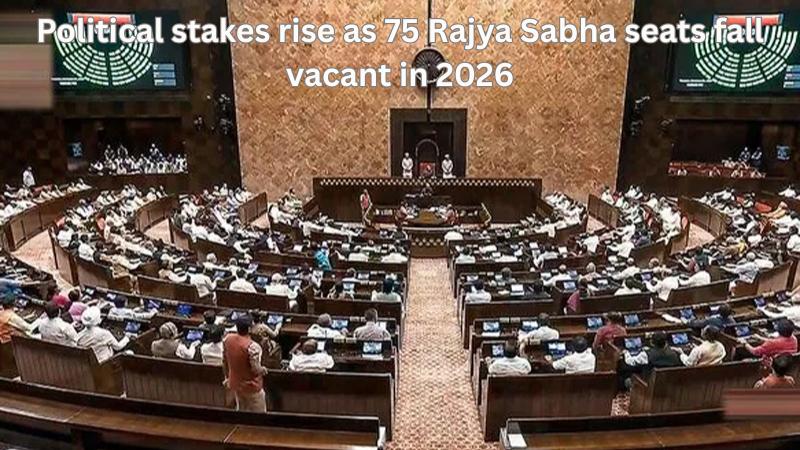
As India moves toward 2026, the political spotlight will not only be on major Assembly elections in states like West Bengal, Tamil Nadu, Kerala and Assam, but also on a massive churn in the Rajya Sabha. As many as 75 seats in the Upper House of Parliament are set to fall vacant across April, June and November 2026, potentially reshaping the balance of power between the ruling NDA and the opposition INDIA alliance.
These vacancies span a wide range of states, including Uttar Pradesh, Bihar, Maharashtra, Karnataka, West Bengal, Tamil Nadu, Telangana, Andhra Pradesh and several northeastern states. With such a broad geographical spread, the outcome of these elections could significantly influence the legislative agenda, political negotiations and party strategies in the years leading up to the next general election.
Several high-profile political figures are among those whose terms will end in 2026. These include Congress president Mallikarjun Kharge, former Prime Minister H. D. Deve Gowda, veteran leaders Sharad Pawar and Digvijaya Singh, along with Union ministers such as Hardeep Singh Puri. Whether these leaders return to the Rajya Sabha or make way for new faces remains one of the key political questions ahead.
The scale of change becomes clear when looking at state-wise vacancies. Bihar will see five Rajya Sabha seats fall vacant in April 2026, while Maharashtra will have seven seats up for election around the same time. Karnataka will witness four vacancies, including those of Kharge and Deve Gowda. Uttar Pradesh, the largest contributor, will elect members to ten Rajya Sabha seats by November 2026, making it a decisive battleground.
Smaller but politically significant changes will also take place in states such as Jharkhand, Andhra Pradesh, Telangana, West Bengal and Tamil Nadu, along with Assam, Arunachal Pradesh, Meghalaya, Manipur, Mizoram, Uttarakhand, Himachal Pradesh, Rajasthan and Chhattisgarh. Even nominated members are part of this churn, with the term of former Chief Justice of India Ranjan Gogoi set to conclude in March 2026.
At present, the NDA holds a clear majority in the Rajya Sabha with 129 seats, while the opposition controls 78. The 2026 elections will determine whether the ruling alliance can consolidate its dominance or if the opposition can claw back ground, particularly in states where recent Assembly election results have altered political equations.
Rajya Sabha elections are decided by the composition of state assemblies, making recent and upcoming Assembly elections critical to the outcome. In states like Maharashtra and Bihar, shifting alliances and post-election realignments have already created uncertainty about who will secure the available seats. In Uttar Pradesh, the BJP’s numerical strength gives it an advantage, but opposition parties are expected to focus on retaining or expanding their limited presence.
Beyond numbers, the elections carry symbolic weight. The possible exit of senior leaders could signal generational change within parties, while the entry of new faces may redefine political messaging and priorities. For the government, a stronger Rajya Sabha presence would make it easier to pass key legislation. For the opposition, gains in the Upper House could act as a check on the ruling alliance and shape national politics ahead of future electoral battles. With 75 seats at stake and several political heavyweights involved, the 2026 Rajya Sabha elections are shaping up to be one of the most consequential parliamentary contests in recent years, with the potential to influence India’s political direction well beyond the Upper House.