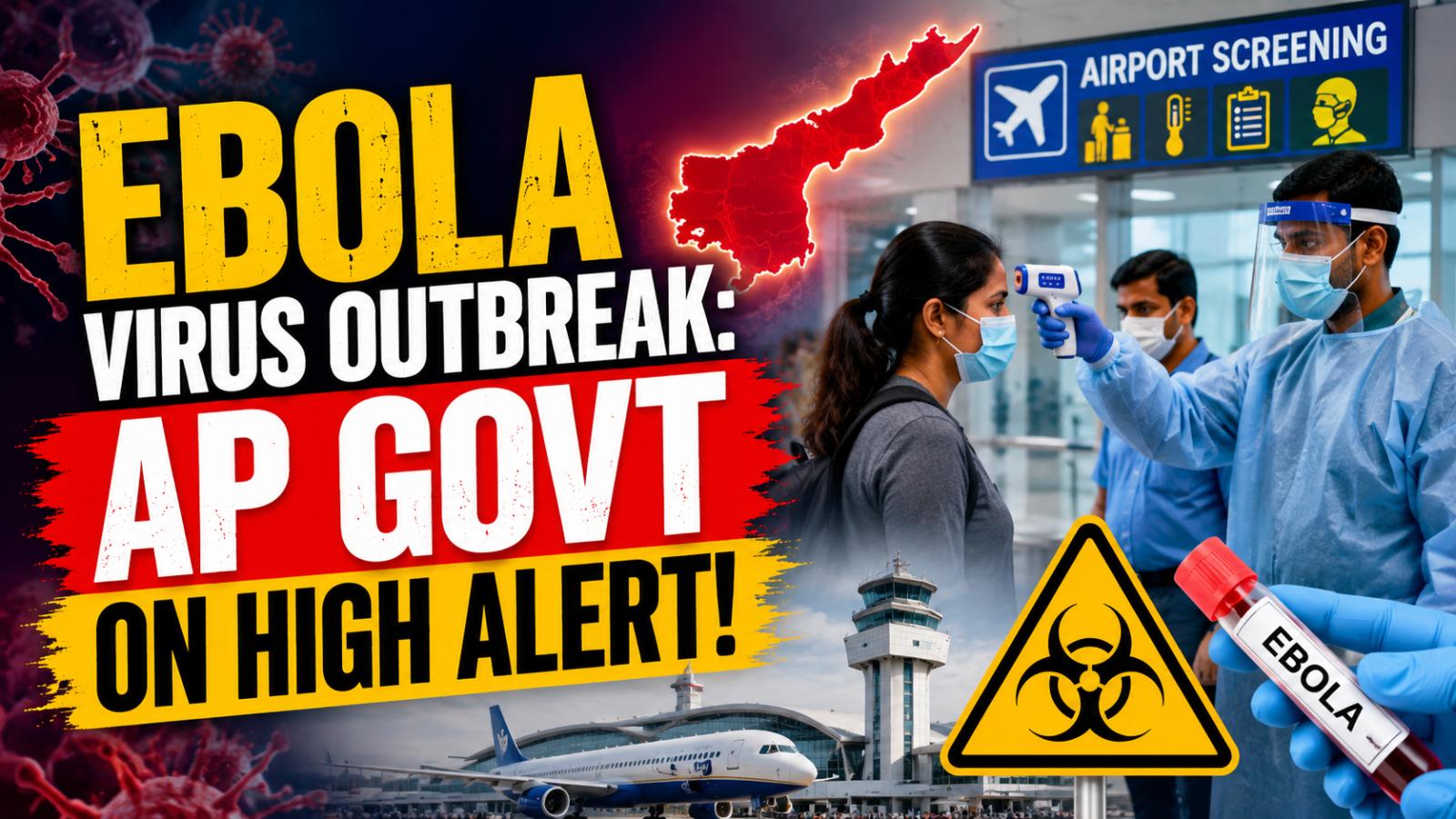
Vijayawada, May 24, 2026: Andhra Pradesh has stepped up Ebola screening at Visakhapatnam, Tirupati and Vijayawada airports as a precautionary public health measure. Travellers from high-risk countries are being monitored, and anyone showing suspected symptoms will be shifted to quarantine and given medical support.
AP Steps Up Ebola Screening At Airports
The Andhra Pradesh government has placed health authorities on high alert following global concern over the Ebola virus outbreak. As a precautionary move, screening has been intensified at key airports in the state, including Visakhapatnam, Tirupati and Vijayawada. The state is focusing on early identification of passengers arriving from high-risk countries and quick isolation of suspected cases.
Minister Anagani Sathya Prasad said airport authorities have been instructed to monitor passengers closely and identify anyone showing symptoms linked to Ebola virus disease. Travellers with suspected symptoms are to be shifted immediately to quarantine facilities and provided medical support. Reports said Andhra Pradesh has started screening passengers at three airports as part of preventive surveillance.
The move comes after international health agencies raised concern over the Ebola outbreak caused by the Bundibugyo strain in parts of Africa. The World Health Organization said that, as of May 16, 2026, eight laboratory-confirmed cases, 246 suspected cases and 80 suspected deaths had been reported in Ituri Province of the Democratic Republic of the Congo.
WHO Alert Triggers Precautionary Measures
The Union Health Ministry has also issued a travel advisory in the context of Ebola disease after WHO’s IHR Emergency Committee issued temporary recommendations on May 22, 2026. The advisory refers to the ongoing outbreak of the Bundibugyo strain affecting the Democratic Republic of the Congo and Uganda and calls for stronger disease surveillance at points of entry.
For Andhra Pradesh, the immediate focus is not panic but preparedness. Airports are the first line of defence because international travellers may transit through several cities before reaching the state. Officials are expected to check travel history, watch for symptoms and coordinate with health teams if any passenger appears unwell.
Ebola is a serious viral disease, but it does not spread casually like common cold or flu. It usually spreads through direct contact with the blood or body fluids of an infected person or contaminated materials. That distinction matters because public fear can easily run ahead of facts. The practical response is surveillance, isolation of suspected cases, protective measures for healthcare workers and clear public communication.
Health experts say early symptoms may include fever, headache, muscle pain, sore throat, weakness and body aches. As the disease progresses, some patients may develop vomiting, diarrhoea, drowsiness, altered behaviour and bleeding. Ebola can be fatal, but outcomes depend on the strain, speed of diagnosis, quality of care and patient condition. The common claim of a 50 percent fatality rate is a broad estimate and should not be treated as a fixed figure for every outbreak.
Travellers From High-Risk Countries Under Watch
Andhra Pradesh officials have made it clear that travellers from high-risk countries will be screened more carefully. This includes passengers with recent travel history to countries affected by the outbreak. Anyone showing possible symptoms will be isolated and monitored as per health protocols.
The state’s decision follows a wider pattern seen globally. Several countries have tightened airport checks and public health screening after the outbreak in Africa. The United States also announced enhanced Ebola screening for travellers from affected countries, showing that the concern is being handled as an international public health issue rather than a localised warning.
For the public, the key point is simple: Andhra Pradesh has not announced a confirmed Ebola case in the state based on the available reports. The current action is preventive. The government is trying to avoid the mistakes seen during past viral outbreaks, where delayed screening and slow communication created larger risks.
The comparison with Covid is understandable, but it should not be stretched too far. Covid spread rapidly through respiratory transmission, while Ebola generally requires direct contact with infected body fluids. That means Ebola can be contained effectively if suspected cases are identified quickly, isolated properly and treated by trained medical teams.
The real test for Andhra Pradesh will be execution. Airport screening must be consistent, quarantine facilities must be ready, medical staff must have protective equipment, and public communication must remain calm and factual. Overhyping the threat can create unnecessary panic, while underplaying it can weaken preparedness.
For now, the AP government’s high-alert move is a precautionary health response. Passengers arriving from affected regions may face additional screening at Vizag, Tirupati and Vijayawada airports. Citizens are advised to follow official health updates, avoid rumours and seek medical help if they have relevant travel history along with symptoms such as fever, weakness, body pain, vomiting or bleeding.