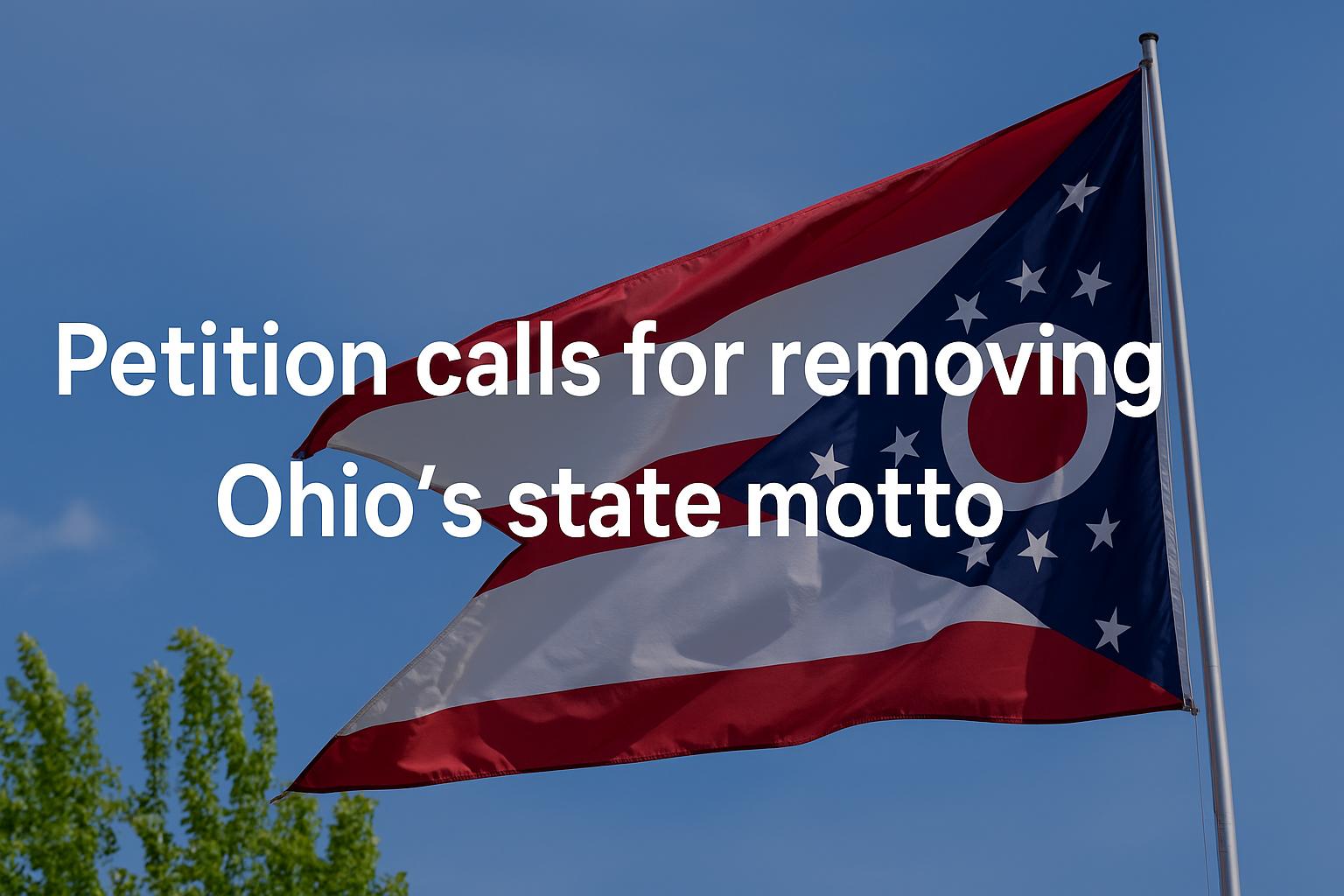
The state of Ohio is once again at the center of a debate over religion and government after an online petition was launched to remove its official motto, “With God, all things are possible.” The phrase, drawn directly from the Bible’s Gospel of Matthew 19:26, has been a fixture of Ohio identity since 1959 but has faced challenges over the years from those who believe it promotes a specific religion in violation of the principle of separation of church and state.
The petition, started on September 8 by Cleveland resident Tyquawn Darrisaw, has quickly gained attention online. At 21 years old, Darrisaw argues that the state motto creates a perception that Ohio officially endorses Christianity, which may alienate residents of different faiths or no faith at all. He contends that a state motto should unite all citizens under a message of inclusivity rather than create divisions based on religious identity. By midweek, the petition had collected nearly 600 signatures toward its goal of 1,000, boosted largely by discussions on social media platforms such as Reddit.
According to Darrisaw, reaching the 1,000-signature milestone would be just the beginning. He has indicated that further steps might include printing flyers, putting up posters, and collecting physical signatures to continue building support. He stressed that his aim is not to attack religion but to promote fairness and equality in how Ohio presents itself to all residents. He believes the current motto unfairly puts non-religious individuals or those of non-Christian faiths in an uncomfortable position, especially when the motto appears on items such as driver’s licenses and official documents.
Ohio is unique in that while several states have mottos with general references to God, it is the only state with a motto that is a direct quote from scripture. This distinction has long been controversial. Ohio originally adopted the Latin phrase “Imperium in Imperio” in 1866, but it was quickly abandoned after public backlash over what critics described as its pretentious undertone. Nearly a century later, in 1959, 12-year-old Cincinnati resident James Mastronardo successfully petitioned lawmakers to adopt “With God, all things are possible,” a phrase cherished by his mother. Since then, the motto has adorned government letterheads, the Franklin County flag, state IDs, and even engravings near the Ohio Statehouse.
Legal challenges to the motto have also shaped its history. In 1997, the American Civil Liberties Union filed a lawsuit arguing that the motto improperly intertwined government and religion. A panel of the 6th U.S. Circuit Court of Appeals initially agreed, ruling that the state motto constituted a government endorsement of Christianity. However, the full court later overturned that decision, concluding that the phrase was a generic reference to God rather than an explicit promotion of one faith. The ruling aligned with broader federal precedent allowing for non-specific religious expressions in government symbols, such as “In God We Trust” on U.S. currency and “one Nation under God” in the Pledge of Allegiance.
Supporters of the motto argue that it conveys optimism rather than doctrine. Ohio’s official state website asserts that the phrase is not meant to endorse a specific deity but to reflect a message of hope. Critics like Darrisaw, however, maintain that the origin of the motto in the Christian Bible makes it impossible to interpret as fully neutral. For him and others who share this view, even if courts deem the motto permissible, its presence in public life can leave nonbelievers and minority religious groups feeling excluded.
The debate over the motto also reveals how religious identity and public symbolism continue to shape American politics. Advocates for change say that mottos and symbols should reflect the diversity of the population, not the dominance of a single religious tradition. Religious leaders, meanwhile, have offered differing perspectives. Rev. Jack Sullivan Jr., Executive Director of the Ohio Council of Churches, suggested that scripture is best used to inspire individuals to act through love, justice, and nonviolence rather than as a state motto for a diverse population. His perspective reflects a recognition that scripture has more power when embodied through action than when inscribed in government emblems.
While spokespeople for Ohio’s Republican and Democratic caucuses have yet to issue formal statements, the issue highlights the difficulty lawmakers face when navigating the balance between cultural traditions and constitutional neutrality. Federal courts have generally permitted broad references to God, but public sentiment often shifts as generational attitudes toward religion evolve. With petitions like Darrisaw’s gaining traction, the question of whether Ohio should retain a Bible-quoted motto or replace it with something more inclusive is likely to persist.
For now, “With God, all things are possible” remains Ohio’s official motto, but the renewed debate underscores a deeper conversation about representation, inclusivity, and the role of religion in public life. Whether or not the petition succeeds, it has reignited discussion about how symbols shape civic identity and the values that guide Ohio’s future.