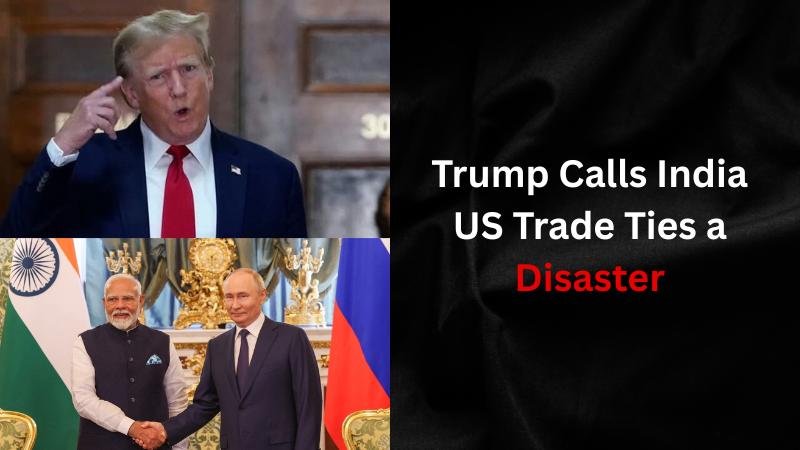
United States President Donald Trump launched a fresh attack on India’s trade policies, describing India–US trade ties as a “one-sided disaster.” His comments came on September 1, against the backdrop of the Shanghai Cooperation Organisation Summit in Tianjin, China, where Indian Prime Minister Narendra Modi, Russian President Vladimir Putin and Chinese President Xi Jinping were seen engaging with each other on the sidelines. Trump’s remarks highlighted his continuing dissatisfaction with India’s trade practices and its purchase of oil from Russia.
In a lengthy post on his social media platform, Trump argued that India has benefited enormously from trade with the United States while giving very little in return. According to him, the relationship has been skewed for decades, with India selling large amounts of goods to the American market while restricting US exports. He claimed that India has offered a “zero tariff,” though officials in New Delhi have not confirmed or accepted this assertion. Trump framed the imbalance as an urgent issue, cautioning that “it’s getting late” to address these disparities.
Trump elaborated that many Americans do not understand how limited the business flow is from the United States to India compared to the volume that India enjoys while exporting to the American market. By labeling America as India’s biggest client, Trump underlined the asymmetry in the trade relationship. He reiterated that this imbalance has been tolerated for far too long and insisted that corrective measures, such as tariffs imposed during his administration, were justified.
The criticism also extended to India’s energy policies, particularly its decision to continue purchasing oil from Russia. Trump pointed out that India should have made adjustments to its policies earlier rather than waiting for pressure from Washington. He used this example to highlight what he viewed as India’s reluctance to cooperate fully with the United States on matters of mutual concern. By linking India’s oil purchases from Russia with trade tariffs, Trump attempted to portray a picture of India as unwilling to align with US expectations both economically and geopolitically.
These remarks are consistent with Trump’s long-standing approach toward India during his presidency, when he regularly raised concerns over tariffs on American goods and demanded greater access to Indian markets. While India and the United States have worked on strengthening their strategic partnership in various fields such as defense, technology and regional security, economic ties have remained a friction point. Trade talks between the two countries often stalled over tariff disagreements, intellectual property rights, and agricultural subsidies. Trump’s renewed criticism reflects his belief that despite shared interests in areas like security and counterterrorism, the trade imbalance continues to overshadow the bilateral relationship.
Observers note that Trump’s comments come at a sensitive moment when India is navigating its foreign policy priorities carefully. New Delhi has sought to maintain its long-standing ties with Russia while also building closer cooperation with the United States and other Western nations. India’s stance on Russian oil imports has been one of pragmatism, aiming to balance its energy security with its growing global partnerships. Trump’s rhetoric, however, suggests that he sees such moves as undermining the trust and balance required in the India–US relationship.
The timing of the outburst is also significant given the SCO Summit, where Modi was seen engaging warmly with leaders of Russia and China. Trump seized on this moment to stress his frustration with what he perceives as India’s preference for partners that do not always align with American interests. By pointing to the optics of Modi’s interactions at the summit, Trump hinted at a deeper concern that India’s global strategy may at times diverge from US priorities.
Analysts believe that Trump’s choice of words, particularly the description of the trade relationship as a “disaster,” is meant to resonate with his political base. Trade imbalances and economic nationalism were central themes of his presidency, and by reviving these issues, he underscores his consistent message of prioritizing American interests first. At the same time, such rhetoric adds pressure to policymakers in both Washington and New Delhi, as it raises questions about how to address trade concerns without undermining the broader strategic partnership that has become increasingly important in the Indo-Pacific region.
For India, Trump’s comments highlight the ongoing challenge of balancing global partnerships with national interests. While the country has made significant strides in improving market access and aligning with global trade practices, issues of tariffs and market restrictions continue to dominate discussions with the United States. Trump’s latest remarks serve as a reminder that the road to a balanced trade relationship remains complicated and requires careful negotiation from both sides.
Ultimately, the controversy underscores the fragile equilibrium in India–US relations. While both nations share common ground in countering global threats and expanding cooperation in technology and defense, the recurring disputes over trade suggest that much work remains to be done. Trump’s warning that “it’s getting late” reflects his impatience with the pace of change, but it also serves as a stark reminder that in the world of global trade and politics, timing and perception are as critical as policy itself.