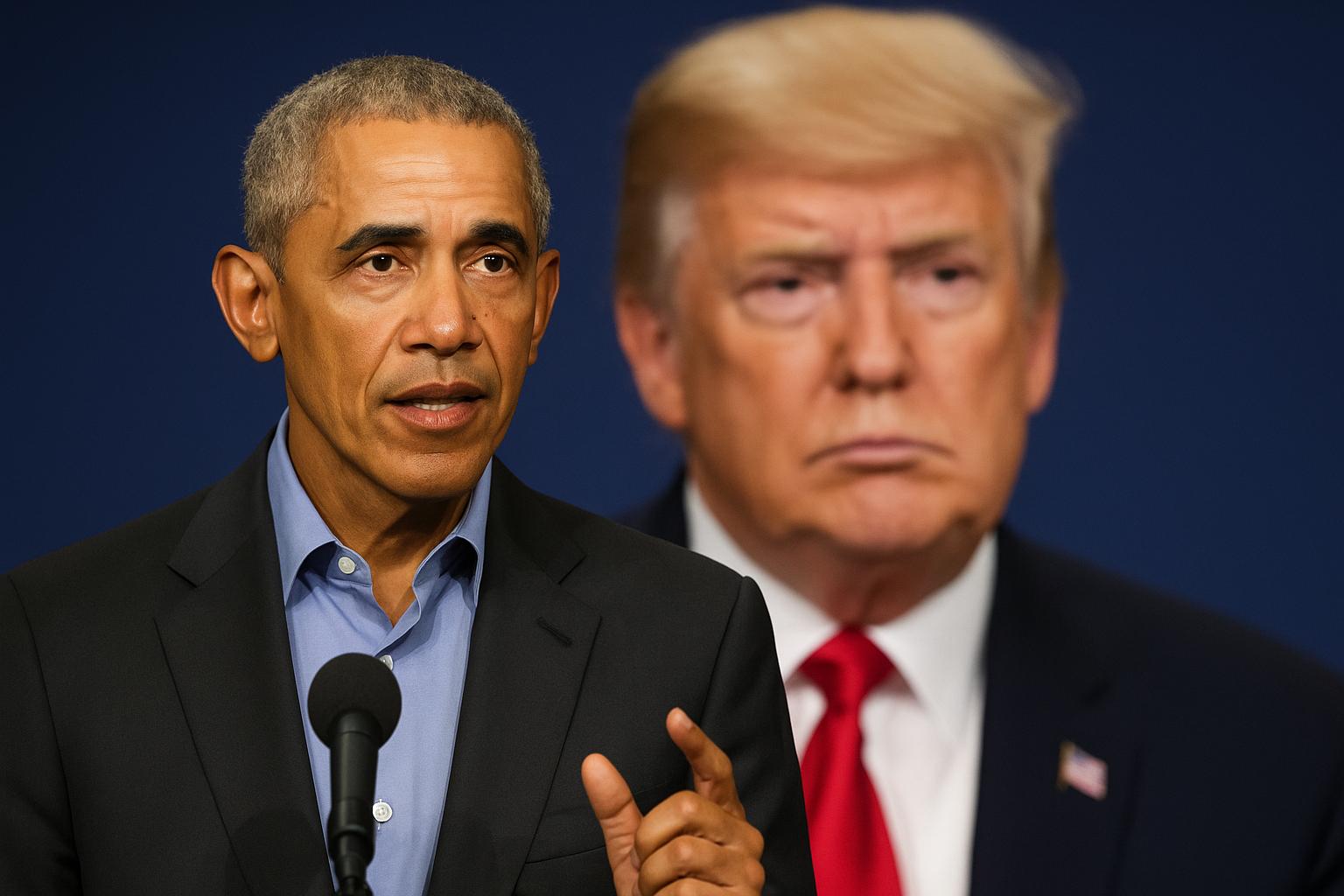
Former United States President Barack Obama has sharply criticized ageing leaders and took a direct swipe at his successor Donald Trump during a public conversation in London. Speaking with historian David Olusoga, Obama argued that a large part of the world’s problems stem from older men who refuse to step aside from power, holding on due to fear of irrelevance. He went on to say that many such leaders seek permanence by etching their names on grand projects, comparing them to pyramid builders of the past. At 64, Obama noted that 80 percent of political and social crises globally involve this tendency, adding that the obsession with legacy is linked to fear of mortality and insignificance.
The timing of Obama’s remarks has attracted attention, coming just weeks after Trump, now 77, defended his decision to deploy National Guard troops in Washington DC. Trump had justified the move by pointing to rising violent crime in the capital, but critics accused him of acting like a dictator. In response, Trump dismissed the criticism, declaring that he was not a dictator but simply a man of common sense. These exchanges have reignited debates around leadership styles, authoritarian tendencies, and the question of how long ageing leaders should continue to shape policy.
Obama’s observations about the dangers of entrenched leadership are not new. In 2019, he had already spoken on the global stage about the problem of ageing political figures refusing to step aside. He then emphasized that true public service requires leaders to see themselves as temporary custodians rather than permanent rulers. According to Obama, clinging to power is less about governance and more about ego, self-importance, and fear of losing relevance. This message appears even more relevant today as generational divides sharpen in politics worldwide.
Beyond his critique of ageing leadership, Obama also confronted Trump’s recent controversial statements linking paracetamol, commonly known as Tylenol, to autism in infants. Trump had suggested that pregnant women should consult doctors before using the drug, sparking outrage in the medical community. Obama described those remarks as a form of violence against truth, warning that such misinformation could damage public health, create unnecessary panic for pregnant women, and increase anxiety for parents of autistic children. By framing the issue in moral terms, Obama underlined the stakes of responsible political communication in a world already grappling with distrust in institutions.
At the same event, Obama painted a broader picture of competing visions for the United States and for humanity at large. He described a tug of war between progressive ideals seeking inclusive democracy and populist movements led by figures such as Trump that aim to restore older hierarchical views of society. In Obama’s view, his successor has not been shy in expressing nostalgia for a version of America where equality was not truly extended to all. He warned that such ideas risk cementing divisions and restricting the meaning of “we the people” to select groups.
Interestingly, Obama also turned a critical eye on progressives themselves. He argued that during the 1990s and 2000s, many who supported liberal democratic values grew complacent, believing that progress was permanent and unchallengeable. According to him, those values are now being tested in a harsher environment where populism and misinformation thrive. The challenge for progressives, he suggested, is to confront reality with humility and determination rather than assuming moral superiority.
Obama’s comments blend criticism of Trump, reflections on leadership, and warnings about public health misinformation, but they also offer a sobering assessment of generational shifts in politics. His reminder that leadership is meant to be service, not a lifelong entitlement, resonates widely at a time when several ageing leaders across the globe continue to dominate the political landscape. The discussion is particularly significant in the American context, where the age of top leaders has become a growing concern among voters who demand younger, more forward-looking representation.
By linking personal ego, public misinformation, and the dangers of populism, Obama has once again positioned himself as a voice urging balance, accountability, and democratic renewal. Whether his words influence ongoing debates in Washington or beyond remains to be seen, but they clearly underscore his belief that democracy must constantly be defended, refreshed, and freed from the clutches of leaders who cannot let go of power.