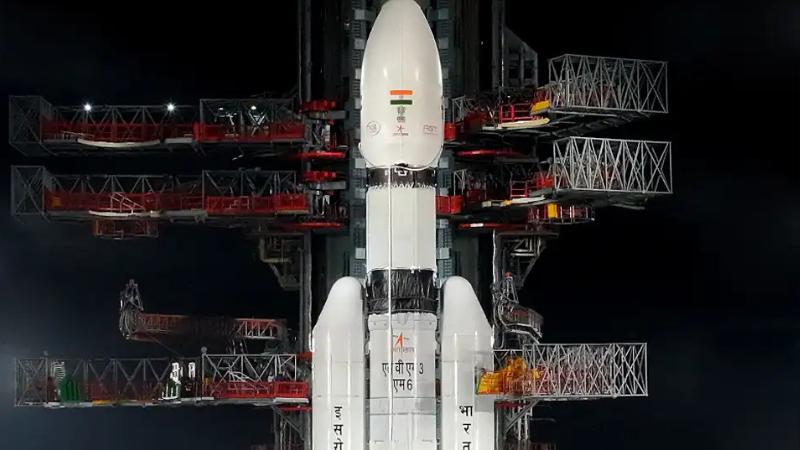
India marked another defining moment in its space journey as the powerful Bahubali rocket successfully blasted off carrying the heaviest satellite ever launched by the country. The Launch Vehicle Mark-3 M6 mission lifted off from the second launch pad at the Satish Dhawan Space Centre in Sriharikota, Andhra Pradesh, showcasing India’s growing dominance in heavy-lift and commercial space missions.
The 43.5-metre-tall LVM3 rocket, supported by two massive S200 solid boosters, took to the skies at 8:55 am on December 24, 2025, moments after the completion of a meticulously monitored 24-hour countdown. The launch carried BlueBird 6, a next-generation communications satellite developed by AST SpaceMobile. Designed to revolutionise satellite communications, the spacecraft aims to beam broadband connectivity directly to ordinary smartphones without the need for specialised equipment.
After a flight lasting around 15 minutes, the satellite was scheduled to separate from the rocket and enter its intended low Earth orbit at an altitude of approximately 520 kilometres. According to Indian Space Research Organisation, all stages of the mission performed as expected, reinforcing confidence in the LVM3 platform for future heavy and high-value payloads.
The mission was executed under a commercial agreement between NewSpace India Limited and AST SpaceMobile, marking another major success for India’s expanding space commerce ambitions. By launching its heaviest-ever satellite, India demonstrated its readiness to support advanced global communication systems and compete with established international launch providers.
BlueBird 6 belongs to the BlueBird Block-2 series and is among the most advanced commercial communication satellites deployed in low Earth orbit. Its deployment is expected to play a key role in expanding mobile connectivity, especially in remote and underserved regions across the world.
The launch, originally scheduled for 8:54 am, was delayed by 90 seconds as a precautionary safety measure. ISRO officials confirmed that the delay was implemented to avoid a possible collision or conjunction with space debris or other satellites along the rocket’s flight path. Such last-minute adjustments have become increasingly common as Earth’s orbital environment grows more congested with thousands of operational satellites.
Officials emphasised that the decision reflected ISRO’s cautious and responsible approach to space operations. With increasing traffic in low Earth orbit, collision avoidance has become a critical aspect of mission planning and execution. The successful Bahubali LVM3-M6 mission not only adds another feather to India’s space cap but also underlines the country’s transition from a national space programme to a trusted global launch partner. As demand rises for satellite-based broadband and direct-to-device connectivity, India’s heavy-lift capabilities position it strongly in the rapidly evolving global space economy.