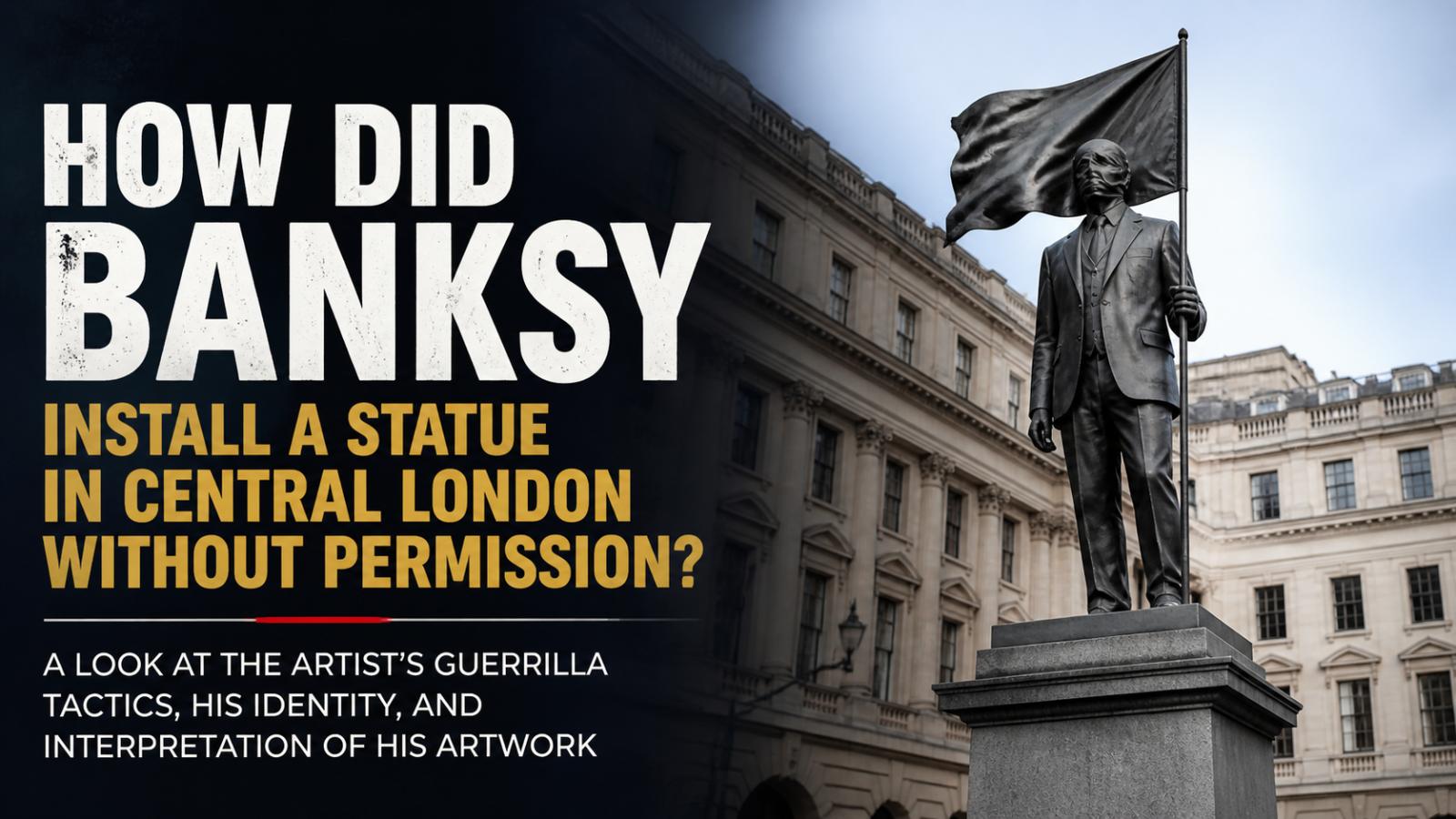
In a bold move that once again showcases his trademark guerrilla tactics, street artist Banksy installed a giant statue in Central London's Waterloo Place. The sculpture appeared in the early hours of a Wednesday morning, and by Thursday, Banksy himself confirmed in a playful Instagram video that he was behind the installation. The video also included behind-the-scenes footage of the sculpture’s setup. Before the artist’s confirmation, pedestrians had already gathered around the piece, speculating that it was Banksy’s work.
Who is Banksy, and why does he remain anonymous?
Banksy, who has remained anonymous for over 30 years, is renowned for his controversial street art, which often tackles social and political themes. His decision to keep his identity a secret serves a dual purpose: it helps maintain his brand image while allowing audiences to focus more on the message behind his art, rather than the person behind it. Though many have attempted to unmask him, Banksy’s identity remains elusive, with some speculating that his real name is Robin Gunningham.
How did Banksy install the sculpture without being caught?
The installation itself was nothing short of a reverse heist. Banksy’s crew, dressed in high-visibility vests and protective goggles, used a low-loader truck and a crane to lift the resin statue into place. The whole operation was executed in the dead of night, with traffic cones strategically placed to deflect attention. The BBC even noted that the crew appeared to have the expertise to pull off a Metallica concert setup in 24 hours. Spectators were left in awe as they wondered how such a large vehicle had managed to enter the highly secured area.
What does the sculpture represent?
As for the artwork, interpretations have been swift. The sculpture depicts a man in a corporate suit standing on a pedestal. Many see this as a commentary on blind patriotism. What is the message behind the figure’s posture and the flag covering its face? The figure represents not just a politician or bureaucrat, but an institution or syndicate blinded by power. The flag draped over the figure’s face acts as a metaphor for a mask that prevents one from seeing the truth. Though the figure strikes a stiff, prideful posture, the positioning and the location—Waterloo Place, a hub of British imperial power—invite questions about faith and authority.
What happens when those in power lose sight of the truth?
When those in power fail to see the truth, they become disconnected from reality, which often leads to misguided decisions and actions. This detachment can result in a loss of trust and accountability, affecting the broader society.
Who truly controls the direction when leaders are blind to their path?
In situations where leaders are unaware of where they are heading, the real power shifts. It could be the institutions, external influences, or even public opinion that dictate the course of events, making the leader's role less significant.