Bay Area gas prices eased slightly during the week ending Thursday, May 14, 2026, but drivers across Northern California were still paying some of the highest fuel costs in the United States.
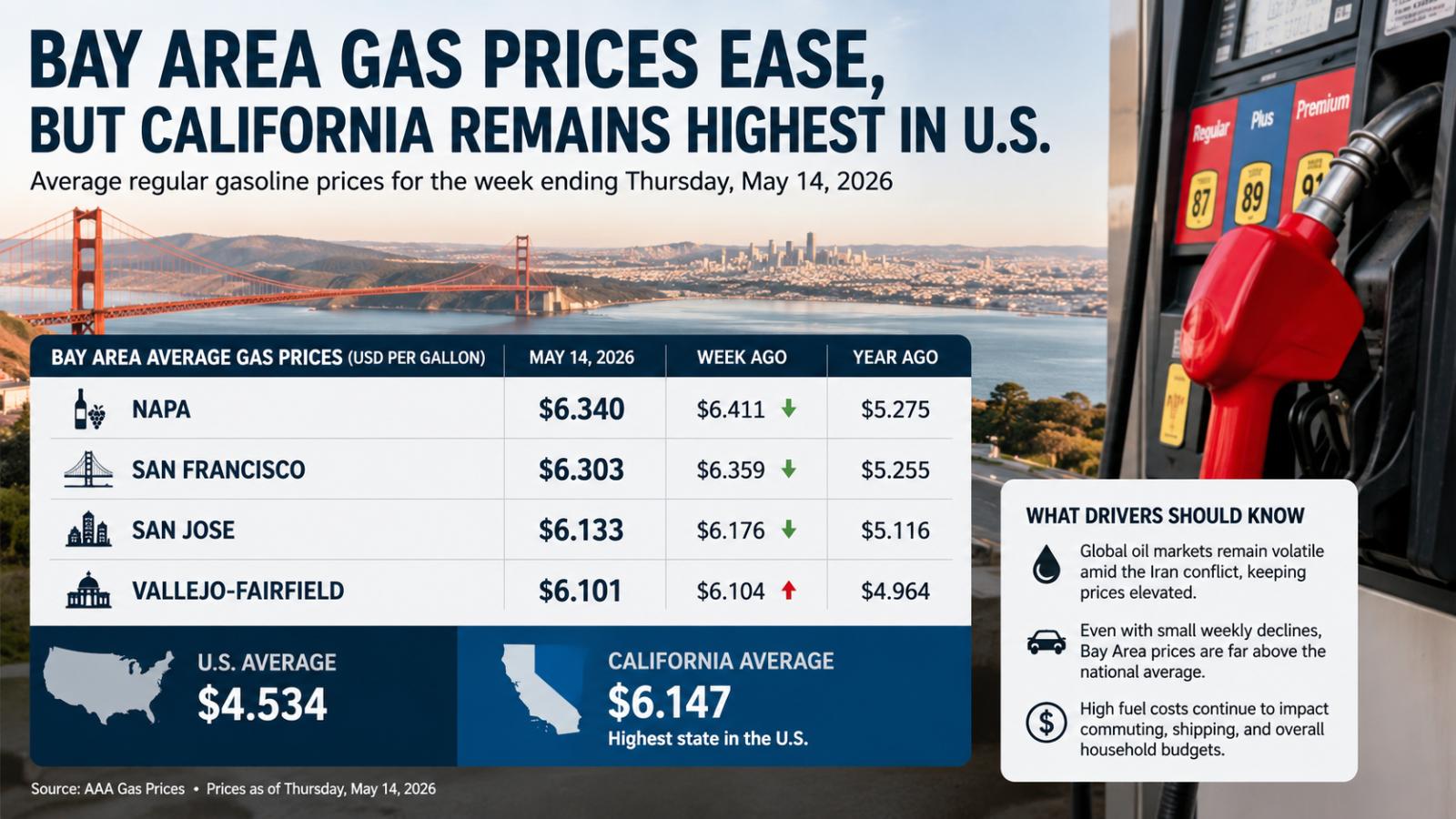
AAA data showed California’s average regular gasoline price at $6.147 per gallon on Thursday, compared with the national average of $4.534. California remained the most expensive state for regular gasoline in AAA’s state price data.
| Area | Current Avg. | Week Ago | Change |
|---|---|---|---|
| California | $6.147 | $6.165 | Down 1.8 cents |
| San Francisco | $6.303 | $6.359 | Down 5.6 cents |
| San Jose | $6.133 | $6.176 | Down 4.3 cents |
| Napa | $6.340 | $6.411 | Down 7.1 cents |
| Vallejo-Fairfield | $6.101 | $6.104 | Down 0.3 cents |
| U.S. average | $4.534 | $4.558 | Down 2.4 cents |
Bay Area Gas Prices Remain Above National Average
In the Bay Area, the San Francisco metro average fell to $6.303 per gallon, down from $6.359 a week earlier. San Jose stood at $6.133, compared with $6.176 a week earlier, according to AAA.
Napa averaged $6.340 per gallon, down from $6.411 a week earlier. Vallejo-Fairfield was nearly flat at $6.101, compared with $6.104 a week earlier.
Why California Gas Prices Are Still High
The small weekly declines may offer limited relief for commuters, but prices remain far above last year’s levels. San Francisco’s average was $5.255 a year earlier, while San Jose was $5.116, AAA data showed.
Fuel prices have remained under pressure as the Iran conflict continues to affect global energy markets. Reuters reported that U.S. gasoline prices have risen sharply since the start of the war, with national prices averaging more than $4.50 per gallon.
What It Means for Bay Area Drivers
For Bay Area households, high gasoline prices can raise commuting costs, delivery expenses and broader inflation pressure. The impact is especially sharp in a region where many workers travel long distances between housing markets and job centers.
The next key test for drivers will be whether prices keep easing before the summer travel season. If refinery supply remains tight and global oil markets stay volatile, Bay Area motorists may continue to pay well above the national average even if weekly prices move down by a few cents.