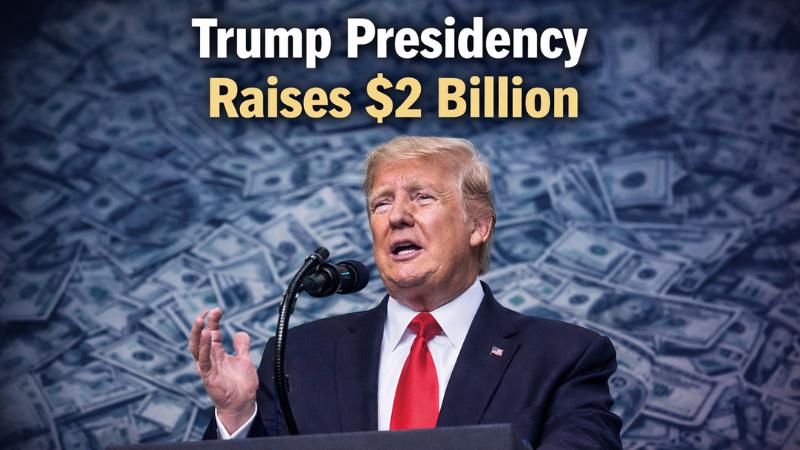
An investigation by The New York Times has revealed that the Donald Trump Presidency raised an unprecedented $2 billion in donations during 2025, making it the most heavily funded second-term presidency in American history. Among the hundreds of donors were at least six Indian-origin Americans or the companies they lead, many of whom reportedly benefited from decisions taken by the Trump administration.
The NYT report states that over 346 individuals donated $250,000 or more to Trump-aligned entities, with nearly 197 of them later receiving direct or indirect advantages such as government contracts, legal relief, policy relaxations, or prestigious appointments. The investigation highlights that many of these contributions were largely transactional, blurring the line between political donations and influence-buying.
The largest Indian-origin contributor named in the report is Satya Nadella, CEO of Microsoft, who donated a reported $3.5 million, including $1 million toward Trump’s inauguration. Nadella was subsequently invited to high-profile White House events and private dinners, while Microsoft benefited from federal actions limiting state-level regulation of artificial intelligence.
Sundar Pichai, CEO of Google, donated $1.2 million. According to the report, Google executives gained direct access to President Trump, and the administration settled a lawsuit involving Trump and Google following an additional financial agreement linked to a White House ballroom project.
Another donor named was Anjani Sinha, a Patna-born orthopaedic surgeon who donated $1 million before being nominated as the US Ambassador to Singapore. His appointment drew criticism during Senate hearings, with questions raised about his qualifications.
Other Indian-origin donors include Shantanu Narayen of Adobe, Sanjay Mehrotra of Micron Technology, and Arvind Krishna of IBM. Their donations ranged from $750,000 to $1 million, reportedly granting them privileged access to Trump, invitations to private events, and influence over policy discussions. Micron, in particular, benefited from federal support aimed at strengthening domestic chip manufacturing.
The NYT investigation found that the Trump Presidency used multiple channels to collect donations. MAGA Inc, a super Political Action Committee, raised at least $200 million between late 2024 and mid-2025. Trump’s inauguration committee broke records by collecting nearly $240 million, while an additional $350 million was reportedly raised for a White House ballroom project through the Trust for the National Mall, though only about $100 million has been independently verified.
Other Trump-aligned entities such as America250, the White House Historical Association, and Securing American Greatness also received substantial funding. Unlike PACs, many of these organisations are not legally required to disclose donor identities, adding to concerns about transparency. While the Trump administration has denied any quid pro quo arrangement, insisting that donations have no influence on policymaking, the scale of fundraising and the benefits enjoyed by major donors have raised serious ethical questions. As the investigation concludes, the Trump Presidency’s fundraising strategy in its second term marks a dramatic shift in American political norms, redefining how money, power, and access intersect at the highest levels of government.