Edit

Mamata Banerjee Dissolves TMC Committees Amid Widening Rebellion in Bengal

Mamata Banerjee Dissolves TMC Committees Amid Widening Rebellion in Bengal

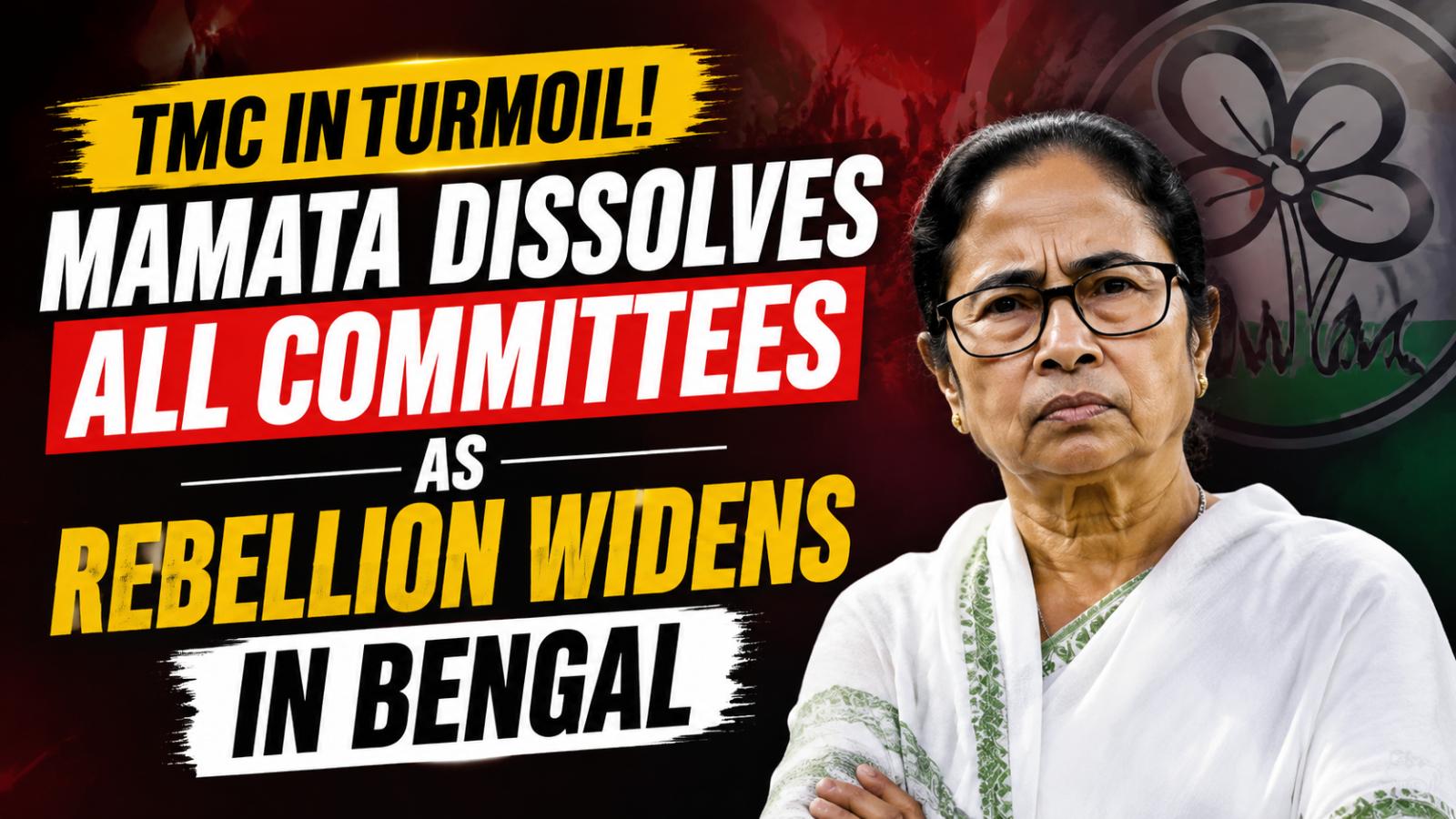
West Bengal Chief Minister Mamata Banerjee has taken the drastic step of dissolving all Trinamool Congress (TMC) committees and frontal organisations in the state with immediate effect as internal strife within the party reaches a critical juncture. The decision comes amid a rapidly widening rebellion among party legislators that has raised questions about unity, leadership authority, and political stability within one of India’s most powerful regional parties.

On Wednesday, several members of a self‑described rebel faction within the TMC publicly claimed they have the backing of a majority of the party’s 80 Members of the Legislative Assembly (MLAs), signalling a serious challenge to Mamata Banerjee’s leadership. The rebels objected to the appointment of Sobhandeb Chattopadhyay as the Leader of Opposition in the West Bengal Assembly, alleging that the process lacked legitimacy and was backed by questionable signatures.

TMC leaders have described the move as an unprecedented internal crisis, with multiple party MLAs skipping key organisational meetings and senior members distancing themselves from official party activities. This internal rebellion has sparked intense speculation across political corridors in Kolkata and beyond, with opposition parties and political analysts closely following developments that could reshape West Bengal’s political landscape.

The situation escalated further after the All India Trinamool Congress (AITC) expelled two of its own MLAs, Sandipan Saha and Ritabrata Banerjee, from the party for alleged anti‑party activities. The expulsions were seen as a pre‑emptive measure by the party leadership to curb defection and dissent, but instead appear to have deepened internal rifts and emboldened rebel leaders.

Several rebel MLAs, speaking to reporters, claimed to have a significant number of signatures supporting their stance. TMC MLA Mustafizur Rahman mentioned hearing reports of at least 59 signatures, though he stopped short of providing concrete confirmation. Another MLA, Priya Paul, avoided detailing her position until after party meetings concluded, reflecting the uncertainty and fluidity within party ranks.

Probe, Politics and Public Statements

The political escalation has drawn sharp reactions from leaders outside the TMC, notably West Bengal BJP leader Suvendu Adhikari. Addressing the media, Adhikari attacked the TMC leadership over allegations of forged signatures and internal miscommunication, asserting that legal and investigative processes will take their course under the Bharatiya Nyaya Sanhita (BNS). He warned that individuals involved in forgery or malpractice would not be spared, indicating a readiness to pursue the matter through formal channels.

Adhikari outlined the sequence of events leading to the controversy, starting with a letter dated May 9 from the AITC National General Secretary to the Assembly Speaker proposing Sobhandeb Chattopadhyay as Leader of the Opposition, Nayana Bandyopadhyay and Ashima Patra as deputy leaders, and Firhad Hakim as chief whip. This was followed by another letter on May 20 claiming to bear 70 signatures of party legislators. However, two TMC MLAs, Rithabrata Bandhopadhyay and Sandipan Saha, lodged a formal complaint alleging that the resolution to adopt this leadership structure was never put to a vote by the legislative party.

In response, the Assembly Speaker referred the matter to law enforcement, leading to the filing of an FIR at Hare Street Police Station. The case was later transferred to the Criminal Investigation Department (CID), which has since begun collecting signature samples from MLAs whose names appeared on the contested document. Adhikari stated that three TMC MLAs — Baharul Islam, Arup Roy, and Subhashish Das — reportedly told CID officials that they did not sign the document attributed to them. These developments underscore the complexity of the dispute and the legal scrutiny now surrounding internal party procedures.

Amid the political conflict and legal entanglements, Adhikari also addressed governance issues, highlighting the BJP‑led state administration’s efforts on welfare measures such as a new free bus service for women and reforms to the Annapurna Yojna application process. He urged calm and restraint among political workers, stressing that investigations should proceed through lawful channels and cautioning against taking matters into their own hands.

The ongoing developments within the TMC reflect broader tensions in West Bengal politics, where party loyalty, political power struggles, and legal controversies are intersecting in ways that could have significant implications for governance and legislative dynamics. As the situation continues to unfold, the focus remains on whether the rebel faction can sustain its claims of majority support and what this means for Mamata Banerjee’s leadership and the future of the TMC.

What is your response?

joyful Joyful 0%
cool Cool 0%
thrilled Thrilled 0%
upset Upset 0%
unhappy Unhappy 0%
AD
AD
AD
AD
AD
AD
AD
AD