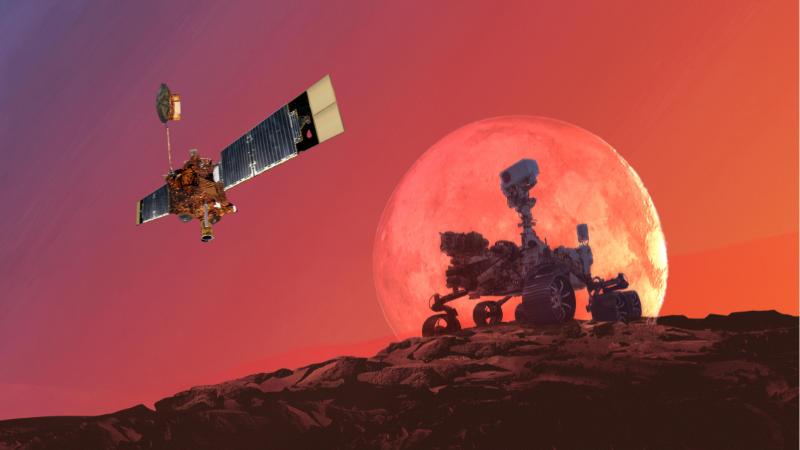
A potential breakthrough in planetary science is reshaping how researchers understand Mars. Recent analysis of seismic data from a mission to the Red Planet has revealed evidence suggesting that a vast reservoir of liquid water may be hidden deep beneath its surface. This discovery could explain where much of Mars’ ancient water went and raise new questions about the planet’s habitability—both past and future.
Though today’s Mars appears arid and lifeless, its surface is rich with geological features carved by ancient rivers, lakes, and possibly even oceans. These formations date back to the Noachian and Hesperian periods, approximately 4.1 to 3 billion years ago, when conditions may have supported a more temperate, wetter climate. But over time, as Mars lost its protective magnetic field and its atmosphere thinned, surface water began to vanish. Scientists believe some of it escaped into space, some froze in the polar caps, and some became chemically bound within Martian minerals.
Despite these theories, a significant portion of the water remains unaccounted for. Calculations suggest enough "missing" water existed to cover the planet in an ocean 700 to 900 meters deep. One leading hypothesis has been that this water seeped underground, becoming trapped within the crust as liquid, preserved from the freezing surface environment.
That idea has now gained strong support. By studying seismic waves generated by marsquakes and meteorite impacts, researchers have identified a subsurface zone between 5.4 and 8 kilometers deep where seismic energy slows markedly. This slowdown, or “low-velocity layer,” is consistent with porous rock saturated with liquid water, much like Earth’s deep aquifers.
Based on modeling, this potential aquifer may contain enough water to fill a global ocean between 520 and 780 meters deep—an amount strikingly close to estimates of the planet’s missing water. The region is thought to be warmed by geothermal energy, preventing the water from freezing even at such depths.
The seismic data responsible for this finding were recorded after two meteorite strikes in 2021 and a significant marsquake in 2022. These events sent seismic waves through the Martian crust, and the mission’s instruments recorded how those waves reflected and refracted through various underground layers. Using a technique called receiver function analysis, researchers mapped the changes in seismic wave behavior, revealing the hidden structure beneath the planet’s dusty surface.
This discovery could have significant implications for the search for extraterrestrial life. On Earth, microbes have been discovered thriving in deep rock formations where water seeps through fractures. If Mars has similar water-filled environments, even if isolated for billions of years, they might still harbor microbial life. These zones may also have once been connected to surface environments during wetter epochs, making them potential time capsules for ancient life forms.
From a human exploration standpoint, these underground reservoirs could prove invaluable. Water is critical not only for drinking but also for generating oxygen and rocket fuel. However, tapping into water sources kilometers below the surface would require advanced drilling technology, presenting one of the many engineering challenges for future missions.
Importantly, the seismic discovery covers only a small portion of the Martian surface. Researchers believe similar water-bearing zones may exist elsewhere, such as beneath the vast plains of Utopia Planitia, where radar has previously hinted at buried icy mud layers. Further missions with seismic and drilling capabilities will be essential for confirming the extent and composition of these reservoirs.
Any exploration of such sites must also consider planetary protection standards. The possibility of native Martian biology, no matter how small, requires that these areas remain uncontaminated by Earth organisms. This finding adds to a growing body of evidence that Mars is not as geologically dormant or biologically barren as once believed. The seismic hum of the planet continues to offer new insights, reminding us that even in its silence, Mars still has much to tell. Whether harboring traces of ancient life or offering resources for future exploration, the hidden waters of Mars may be one of the most important scientific frontiers in our solar system.
Though today’s Mars appears arid and lifeless, its surface is rich with geological features carved by ancient rivers, lakes, and possibly even oceans. These formations date back to the Noachian and Hesperian periods, approximately 4.1 to 3 billion years ago, when conditions may have supported a more temperate, wetter climate. But over time, as Mars lost its protective magnetic field and its atmosphere thinned, surface water began to vanish. Scientists believe some of it escaped into space, some froze in the polar caps, and some became chemically bound within Martian minerals.
Despite these theories, a significant portion of the water remains unaccounted for. Calculations suggest enough "missing" water existed to cover the planet in an ocean 700 to 900 meters deep. One leading hypothesis has been that this water seeped underground, becoming trapped within the crust as liquid, preserved from the freezing surface environment.
That idea has now gained strong support. By studying seismic waves generated by marsquakes and meteorite impacts, researchers have identified a subsurface zone between 5.4 and 8 kilometers deep where seismic energy slows markedly. This slowdown, or “low-velocity layer,” is consistent with porous rock saturated with liquid water, much like Earth’s deep aquifers.
Based on modeling, this potential aquifer may contain enough water to fill a global ocean between 520 and 780 meters deep—an amount strikingly close to estimates of the planet’s missing water. The region is thought to be warmed by geothermal energy, preventing the water from freezing even at such depths.
The seismic data responsible for this finding were recorded after two meteorite strikes in 2021 and a significant marsquake in 2022. These events sent seismic waves through the Martian crust, and the mission’s instruments recorded how those waves reflected and refracted through various underground layers. Using a technique called receiver function analysis, researchers mapped the changes in seismic wave behavior, revealing the hidden structure beneath the planet’s dusty surface.
This discovery could have significant implications for the search for extraterrestrial life. On Earth, microbes have been discovered thriving in deep rock formations where water seeps through fractures. If Mars has similar water-filled environments, even if isolated for billions of years, they might still harbor microbial life. These zones may also have once been connected to surface environments during wetter epochs, making them potential time capsules for ancient life forms.
From a human exploration standpoint, these underground reservoirs could prove invaluable. Water is critical not only for drinking but also for generating oxygen and rocket fuel. However, tapping into water sources kilometers below the surface would require advanced drilling technology, presenting one of the many engineering challenges for future missions.
Importantly, the seismic discovery covers only a small portion of the Martian surface. Researchers believe similar water-bearing zones may exist elsewhere, such as beneath the vast plains of Utopia Planitia, where radar has previously hinted at buried icy mud layers. Further missions with seismic and drilling capabilities will be essential for confirming the extent and composition of these reservoirs.
Any exploration of such sites must also consider planetary protection standards. The possibility of native Martian biology, no matter how small, requires that these areas remain uncontaminated by Earth organisms. This finding adds to a growing body of evidence that Mars is not as geologically dormant or biologically barren as once believed. The seismic hum of the planet continues to offer new insights, reminding us that even in its silence, Mars still has much to tell. Whether harboring traces of ancient life or offering resources for future exploration, the hidden waters of Mars may be one of the most important scientific frontiers in our solar system.