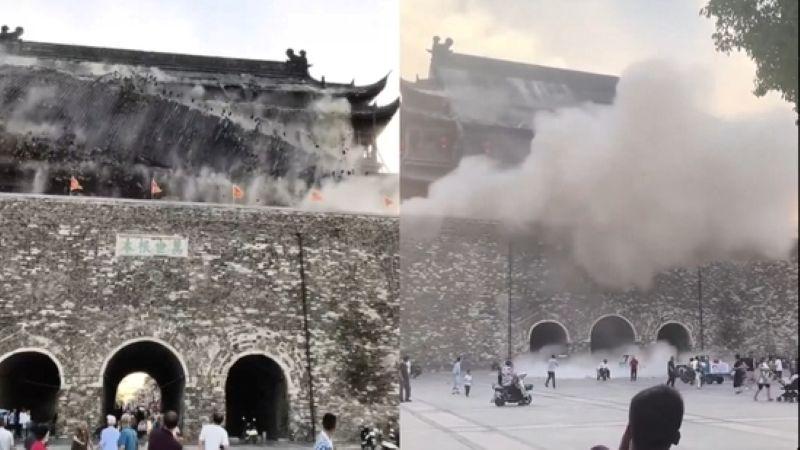
A historic monument in China, the 650-year-old Fengyang Drum Tower in Anhui province, suffered a partial collapse on Monday, sending shockwaves across social media and raising serious concerns over recent restoration efforts. A dramatic video capturing the moment the tiles and debris came crashing down has since gone viral, sparking a national conversation about the quality of modern restoration work on ancient heritage structures.
Built in 1375 during the Ming Dynasty, the Fengyang Drum Tower is a revered structure, situated about 320 kilometers from Beijing. It holds cultural and historical significance, not just as an architectural relic but also as a tribute to Zhu Yuanzhang, the founder of the Ming Dynasty, who hailed from Fengyang County.
The incident occurred in broad daylight while several tourists were in the vicinity. The video footage reveals large roof tiles suddenly breaking away from the upper section of the tower and falling from a height equivalent to two floors. Within moments, a thick cloud of dust engulfed the area, and panic set in as onlookers scrambled for safety. Miraculously, no injuries were reported.
Eyewitness accounts provide more detail on the unsettling event. “The tile falling lasted for a minute or two,” a witness told the Yangcheng Evening News. Another visitor who spoke with the Beijing News mentioned, “There was no one in the square and no one was injured; if it happened a little later, there would be many children playing (near the tower) after dinner.” The close call has intensified scrutiny over the maintenance and oversight of the structure.
The most controversial aspect of the incident is the timeline. The roof that partially collapsed was part of a restoration completed just over a year ago, in March 2024. Authorities launched a restoration project in 2023 to preserve and strengthen the iconic site. Given the age of the structure and the investments made, the failure of the newly restored section has ignited public outrage and criticism online.
Social media reactions reflect widespread concern. “Modern restoration construction compared to something built 650 years ago,” wrote one user. Another commented sarcastically, “Old Chinese building techniques, structure stands 600+ years. Modern Chinese renovation, collapses in under 2 years.” These sentiments underscore the perception that ancient craftsmanship often surpasses contemporary efforts, at least in durability.
Local authorities have since launched an investigation into the collapse. Preliminary assessments suggest the issue may be linked to poor construction quality or inadequate materials used during the recent renovation. No official statement has been made yet regarding accountability or the next steps for repairing and securing the site.
While the tower has seen various stages of reconstruction over the centuries including major rebuilding after damage during the Qing Dynasty in 1853 the latest collapse raises new concerns about balancing preservation with modernization. Experts argue that restoration projects on heritage sites require not only technical precision but also a deep understanding of historical architecture and materials.
The Fengyang Drum Tower has long been a major draw for tourists exploring Anhui province’s rich cultural history. This incident, though fortunately not fatal, could impact tourism in the short term and has certainly put pressure on Chinese authorities to reassess how historical monuments are maintained. With no injuries reported, the focus now shifts to ensuring that such structures are restored with the utmost care and authenticity so that monuments which have stood for centuries continue to stand the test of time, and not fall to negligence cloaked as modernization.