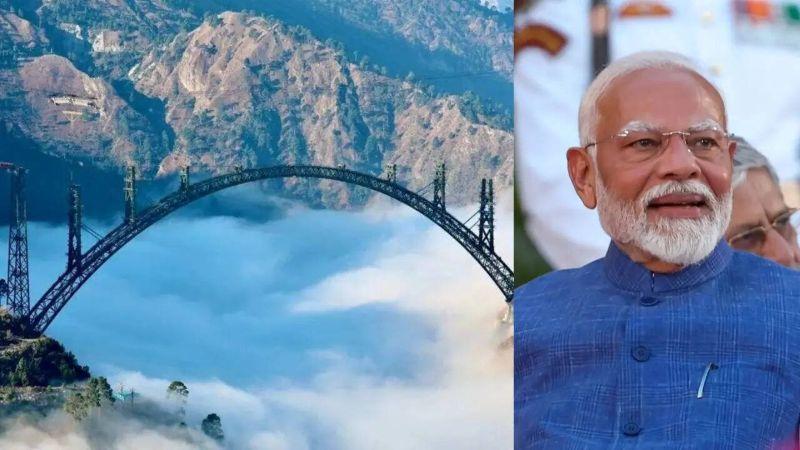
Prime Minister Narendra Modi marked a historic moment for Jammu and Kashmir by inaugurating the first-ever railway connection between the Kashmir Valley and the rest of India on June 6. At an event in Katra, the Prime Minister launched the much-awaited Vande Bharat train service between Katra and Srinagar, dramatically reducing travel time between the regions to just around three hours. This milestone also marks the opening of the world’s highest railway arch bridge over the Chenab River, an engineering marvel located 359 metres above the river and spanning 1,315 metres.
The occasion also saw the formal inauguration of the Anji Bridge, India's first cable-stayed railway bridge, and the completion of the massive Udhampur-Srinagar-Baramulla Rail Link (USBRL) project. Constructed at a cost of ₹43,780 crore, the 272-kilometre USBRL includes 36 tunnels and 943 bridges, connecting difficult mountainous terrain and ending decades-long transport isolation for the valley during harsh winters or inclement weather.
The Prime Minister also launched multiple development projects worth more than ₹46,000 crore aimed at enhancing infrastructure, healthcare, and last-mile connectivity across the union territory. Among these is the foundation stone laying of the Shri Mata Vaishno Devi Institute of Medical Excellence in Katra, valued at over ₹350 crore and set to become the first medical college in Reasi district.
The new railway network, long awaited since the 1970s and made possible through sustained investment over decades, is set to transform mobility, tourism, and trade in the region. It also symbolises a major strategic and socio-economic milestone, especially in the wake of recent regional tensions. The first Vande Bharat train between Delhi and Srinagar via Katra has now officially linked the Kashmir Valley with India’s national rail network.