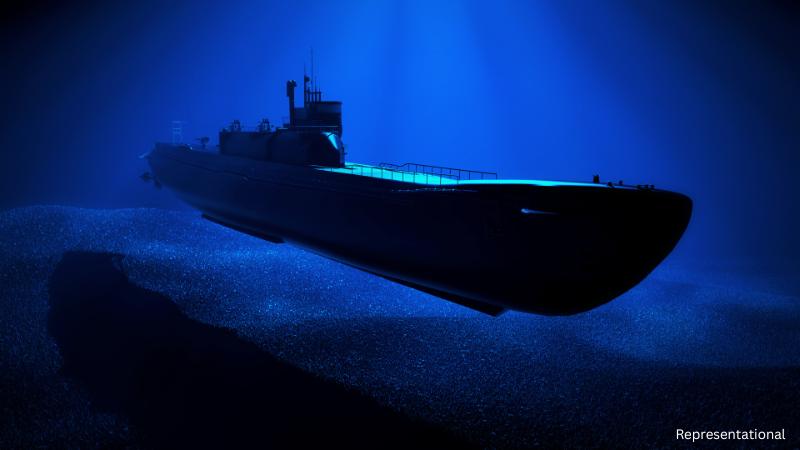
In a move that has intensified already strained relations between Washington and Moscow, US President Donald Trump announced on Friday that he has ordered the deployment of two nuclear submarines to regions near Russia. This decision came as a direct response to threats issued by former Russian President Dmitry Medvedev, who recently warned of potential nuclear retaliation using the Cold War-era Dead Hand system. The move signals a significant escalation in the ongoing standoff between the United States and Russia, drawing global attention to the possibility of heightened nuclear tensions.
Trump made the announcement in a statement, emphasizing that the deployment was a precautionary measure in light of Medvedev’s recent remarks. “I have ordered two nuclear submarines to be positioned in the appropriate regions, just in case these foolish and inflammatory statements are more than just that,” Trump said. His words underline the seriousness with which the US administration views the current threats emanating from Moscow, despite hopes that the situation can still be managed diplomatically.
Dmitry Medvedev, who now serves as the deputy chairman of Russia’s Security Council, invoked the Dead Hand system in his warning. The Dead Hand is an automated nuclear response mechanism developed during the Cold War to ensure that a retaliatory strike would be launched even if the Russian leadership were incapacitated in the event of a nuclear attack. By referencing this system, Medvedev signaled Russia’s readiness to respond to any perceived aggression with overwhelming force, further raising global concerns.
The deployment of US nuclear submarines near Russia serves multiple purposes. It sends a clear message of deterrence, demonstrating Washington’s commitment to defending its interests and those of its allies. It also reflects the US administration’s strategy of maintaining military readiness in the face of unpredictable threats. These submarines, capable of carrying nuclear warheads, are among the most powerful assets in America’s strategic arsenal, and their positioning in sensitive regions is seen as a strong show of force.
This development comes at a time when tensions between the United States and Russia are already high due to conflicts in Ukraine, disputes over NATO expansion, and accusations of cyber interference. The latest exchange of threats underscores how quickly the situation can escalate when nuclear rhetoric enters the conversation. Analysts warn that both sides must exercise caution to avoid misunderstandings that could spiral into a larger confrontation.
While Trump’s order has been framed as a defensive measure, it has also drawn criticism from some quarters, with concerns that such actions could provoke an aggressive response from Moscow. However, the administration insists that the positioning of the submarines is purely a safeguard against potential aggression and not an offensive move. Officials maintain that the United States remains open to dialogue but will not hesitate to act decisively if its security is threatened.
International observers are closely monitoring the situation, particularly given the historical implications of invoking the Dead Hand system. The Cold War-era mechanism was designed to guarantee a retaliatory strike under any circumstances, embodying the principle of mutually assured destruction. Its mention by a high-ranking Russian official is viewed by many as a dangerous escalation of nuclear brinkmanship.
The coming days will be critical in determining how this standoff evolves. Diplomatic channels between Washington and Moscow remain open, but the rhetoric on both sides has grown increasingly combative. The US military’s show of strength is aimed at ensuring that threats do not translate into actions, but the risk of miscalculation cannot be ignored.
As the world watches, the strategic deployment of these submarines highlights the fragile balance of power between the two nations. It also serves as a reminder of the enduring influence of Cold War dynamics on modern geopolitics. The use of nuclear deterrence as a policy tool remains controversial, but in this instance, it underscores the seriousness of the threats being exchanged.
The situation is expected to continue evolving, with further statements anticipated from both US and Russian officials in the coming days. For now, the deployment stands as a stark warning to Moscow that the United States is prepared to respond to any escalation with equal or greater force. This latest chapter in US-Russia relations serves as a clear example of how quickly tensions can flare when nuclear threats are involved, leaving the international community hoping for a de-escalation before the situation reaches a critical point.