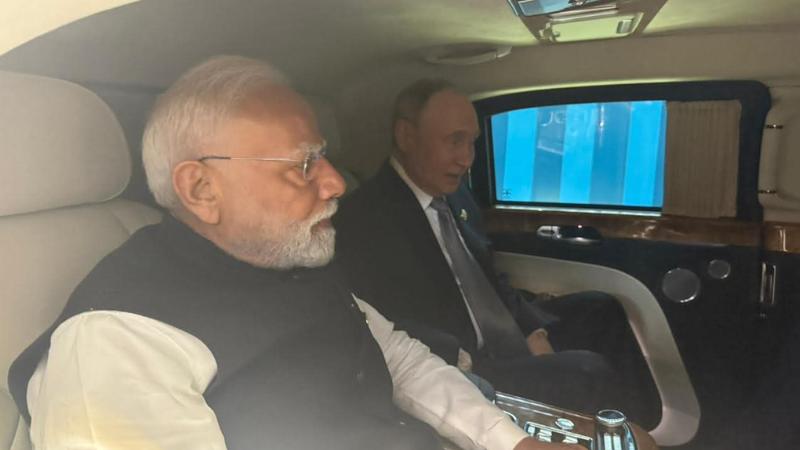
Prime Minister Narendra Modi’s visit to China entered its second day with a major highlight being his bilateral meeting with Russian President Vladimir Putin. The meeting followed the Shanghai Cooperation Organisation (SCO) leaders’ summit held in Tianjin, which brought together more than 20 heads of state and representatives from 10 major international organisations. In a symbolic gesture underscoring the warmth between the two nations, Modi and Putin chose to travel together in the same car to the venue of their bilateral discussions, reflecting both camaraderie and the significance of their strategic partnership.
The SCO summit itself has drawn considerable global attention as it serves as an important platform for participating nations to address collective concerns. Issues such as regional security, counterterrorism, financial stability, and the growing role of the Global South have been key talking points during this year’s gathering. India, under Modi’s leadership, has emphasized the importance of multilateral cooperation to counter global challenges, while also pushing for reforms in institutions that govern global finance and security frameworks.
Modi’s interactions in Tianjin extended beyond the formal SCO deliberations. The bilateral meeting with Putin served as a crucial moment for India and Russia to reinforce their long-standing ties. Both nations share decades of cooperation in defense, energy, and trade, and the leaders reportedly discussed ways to deepen this relationship further in light of shifting global dynamics. The symbolism of traveling together in one car has not gone unnoticed in diplomatic circles, as it projects an image of unity and trust at a time when global alliances are constantly evolving.
India’s participation in the SCO is strategically important as it places New Delhi in close dialogue with Eurasian powers and provides a stage for engagement with neighboring countries that share security concerns. Modi’s presence highlights India’s intent to play an active role in shaping the regional agenda, especially when it comes to countering terrorism and ensuring stability in the Asia-Pacific. The discussions in Tianjin also gave India an opportunity to align more closely with partners who support a multipolar global order, something that resonates with the aspirations of the Global South.
The Modi-Putin meeting also provided an opportunity to discuss energy cooperation, defense collaboration, and trade diversification. Russia has been a key supplier of defense equipment to India for decades, and the partnership has expanded to include nuclear energy, space technology, and hydrocarbons. At a time when the global energy landscape is undergoing significant change, both leaders are expected to have explored new avenues for cooperation, ensuring that their countries remain reliable partners in these critical sectors.
Beyond defense and energy, Modi and Putin are also believed to have touched upon regional security, particularly the situation in Afghanistan and the evolving dynamics in Central Asia. Both India and Russia share concerns about the spread of extremism and instability in the region, and their cooperation through the SCO framework is aimed at addressing these challenges in a coordinated manner.
The symbolic gestures and substantive discussions in Tianjin underline the enduring strength of the India-Russia relationship. For Modi, the visit to China was not just about multilateral engagements at the SCO summit but also about reaffirming India’s deep ties with key global players. The choice of traveling together with Putin ahead of their meeting highlights how personal diplomacy can complement official dialogues in creating lasting impressions on the global stage.
As Modi continues his visit, attention remains focused on his other scheduled interactions with world leaders. The SCO platform provides India with an opportunity to assert its vision for a stable, secure, and prosperous region, while bilateral meetings such as the one with Putin reinforce India’s strong partnerships that extend beyond immediate geographic boundaries. This visit marks yet another chapter in Modi’s proactive diplomacy, showcasing India’s readiness to engage constructively with both established and emerging powers.
The SCO summit itself has drawn considerable global attention as it serves as an important platform for participating nations to address collective concerns. Issues such as regional security, counterterrorism, financial stability, and the growing role of the Global South have been key talking points during this year’s gathering. India, under Modi’s leadership, has emphasized the importance of multilateral cooperation to counter global challenges, while also pushing for reforms in institutions that govern global finance and security frameworks.
Modi’s interactions in Tianjin extended beyond the formal SCO deliberations. The bilateral meeting with Putin served as a crucial moment for India and Russia to reinforce their long-standing ties. Both nations share decades of cooperation in defense, energy, and trade, and the leaders reportedly discussed ways to deepen this relationship further in light of shifting global dynamics. The symbolism of traveling together in one car has not gone unnoticed in diplomatic circles, as it projects an image of unity and trust at a time when global alliances are constantly evolving.
India’s participation in the SCO is strategically important as it places New Delhi in close dialogue with Eurasian powers and provides a stage for engagement with neighboring countries that share security concerns. Modi’s presence highlights India’s intent to play an active role in shaping the regional agenda, especially when it comes to countering terrorism and ensuring stability in the Asia-Pacific. The discussions in Tianjin also gave India an opportunity to align more closely with partners who support a multipolar global order, something that resonates with the aspirations of the Global South.
The Modi-Putin meeting also provided an opportunity to discuss energy cooperation, defense collaboration, and trade diversification. Russia has been a key supplier of defense equipment to India for decades, and the partnership has expanded to include nuclear energy, space technology, and hydrocarbons. At a time when the global energy landscape is undergoing significant change, both leaders are expected to have explored new avenues for cooperation, ensuring that their countries remain reliable partners in these critical sectors.
Beyond defense and energy, Modi and Putin are also believed to have touched upon regional security, particularly the situation in Afghanistan and the evolving dynamics in Central Asia. Both India and Russia share concerns about the spread of extremism and instability in the region, and their cooperation through the SCO framework is aimed at addressing these challenges in a coordinated manner.
The symbolic gestures and substantive discussions in Tianjin underline the enduring strength of the India-Russia relationship. For Modi, the visit to China was not just about multilateral engagements at the SCO summit but also about reaffirming India’s deep ties with key global players. The choice of traveling together with Putin ahead of their meeting highlights how personal diplomacy can complement official dialogues in creating lasting impressions on the global stage.
As Modi continues his visit, attention remains focused on his other scheduled interactions with world leaders. The SCO platform provides India with an opportunity to assert its vision for a stable, secure, and prosperous region, while bilateral meetings such as the one with Putin reinforce India’s strong partnerships that extend beyond immediate geographic boundaries. This visit marks yet another chapter in Modi’s proactive diplomacy, showcasing India’s readiness to engage constructively with both established and emerging powers.