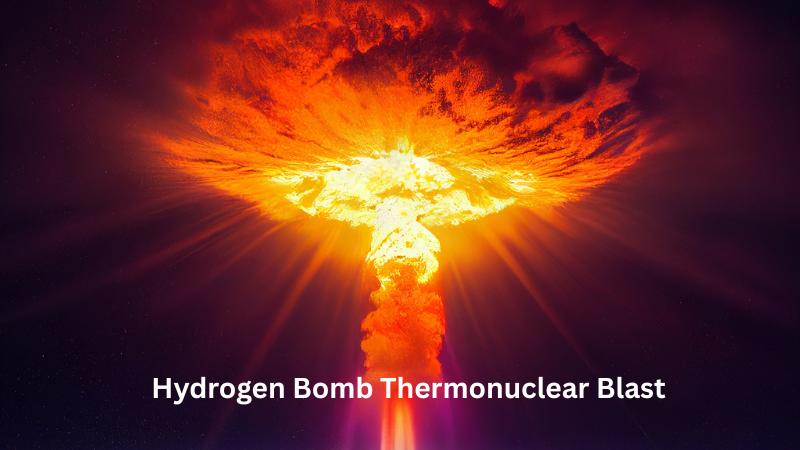
What exactly is a hydrogen bomb, the most destructive weapon ever built? Unlike the atomic bombs dropped on Hiroshima and Nagasaki in 1945, which relied on the fission of heavy elements like uranium and plutonium, a hydrogen bomb unleashes its fury through a two-stage process that combines nuclear fission and nuclear fusion. Fission provides the spark, generating immense heat and pressure, under which isotopes of hydrogen such as deuterium and tritium fuse together. This is the same reaction that powers the Sun, and it releases energy on a staggering scale.
While an atomic bomb’s yield is measured in kilotons, a hydrogen bomb’s destructive power is measured in megatons, millions of tons of TNT equivalent. A single thermonuclear device can be thousands of times more powerful than Hiroshima. To achieve this, a fission bomb acts as the “primary,” igniting fusion fuel in the “secondary,” setting off an almost incomprehensible chain reaction.
The United States detonated the first hydrogen bomb in 1952, producing an explosion 700 times more destructive than Hiroshima. The Soviet Union pushed limits further in 1961 with the Tsar Bomba, yielding 50 megatons and sending shockwaves that circled the globe. These weapons not only flatten cities but can alter weather patterns and spread radioactive fallout across continents. Possessed by only a few nations, hydrogen bombs remain symbols of ultimate military power and existential peril, reminding humanity of the devastating scale of destruction that science has made possible.