Southwest Airlines passengers completed their final boarding-day routines under the carrier’s open seating model on Monday, closing a chapter on a system that defined the airline for more than five decades. Beginning Tuesday, Southwest officially transitioned to assigned seating, a move that places the Dallas-based airline closer to industry norms followed by most major U.S. carriers.
Under the new approach, customers flying Southwest will receive designated seat assignments and may pay additional fees to secure preferred seating closer to the front of the aircraft or seats offering extra legroom. Tickets reflecting these changes have been available for purchase since July, allowing travelers to gradually adjust to the updated structure ahead of its full rollout.
For years, Southwest’s open seating process required passengers to check in exactly 24 hours before departure in hopes of earning an early boarding position. Travelers were grouped into A, B, or C boarding categories, with those in the A group typically securing aisle or window seats, while later groups often faced limited options. The system was originally designed to speed up boarding, reduce aircraft turnaround time, and maximize operational efficiency, helping the airline maintain profitability for decades prior to the pandemic.
Over time, however, the system became less egalitarian as paid early boarding options expanded. As customer expectations shifted and competition intensified, the airline began reassessing whether its once-distinctive process still aligned with traveler preferences.
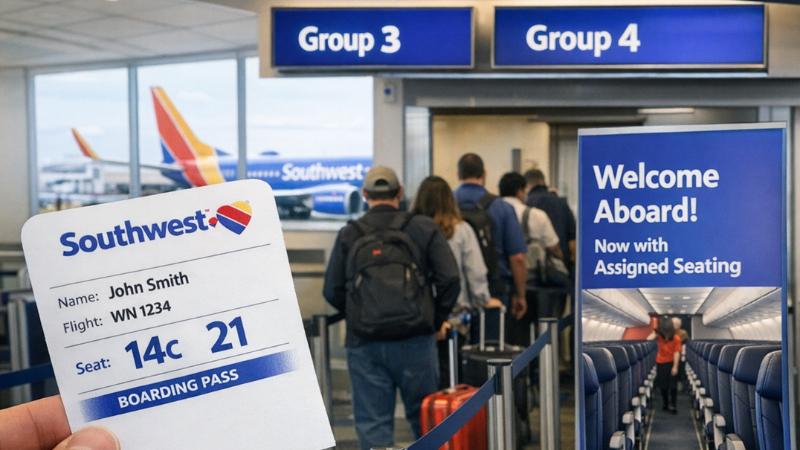
The replacement structure introduces eight boarding groups and eliminates the familiar numbered gate columns. Passengers will board through two alternating lanes based on their assigned group. Southwest said gate-area modifications will occur in phases, starting Monday night, and may take up to two months to complete. During the transition, remaining columns will have identifying numbers removed or covered.
Seating options now vary by fare type. Some travelers will receive standard seat assignments at check-in, while others may select preferred or extra-legroom seats at the time of booking for an additional cost. On select flights, customers may also purchase priority boarding beginning 24 hours before departure.
Boarding passes have been redesigned to clearly display seat assignments and boarding groups. Reservations for nine or fewer passengers, including families, will be grouped together to streamline boarding. Group placement will be determined by several factors, including seat location, fare class, loyalty status, and airline credit card benefits. Passengers with extra-legroom seats are expected to board in the earliest groups, while those with basic fares may board later.
The seating transition also brings policy changes for travelers requiring additional space. Effective Tuesday, passengers who cannot fit comfortably within a single seat’s armrests must purchase an extra seat in advance. While refunds may still be issued under certain conditions, they are no longer guaranteed and depend on seat availability and fare type, replacing a more flexible previous policy.
These updates follow another significant shift earlier this year, when Southwest ended its long-standing “bags fly free” policy and introduced baggage fees for most travelers. Together, the changes represent one of the most substantial transformations in the airline’s history.
Company leadership has attributed the move to evolving customer preferences and investor pressure to improve profitability. Surveys conducted by the airline found that many travelers now prefer knowing their seat assignment before arriving at the airport, and open seating was cited as a key reason some customers chose competing airlines.
As Southwest implements these changes, the carrier aims to attract new customer segments while adapting to a more competitive airline landscape, signaling a strategic pivot away from several practices that once set it apart.