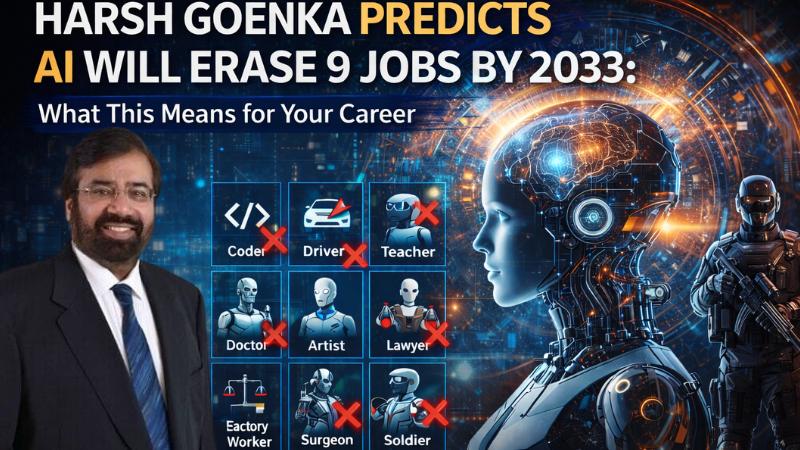
In a recent post on X, Harsh Goenka, the Chairman of RPG Enterprises, warned that artificial intelligence (AI) could replace entire professions by 2033, raising concerns about the future job market and the types of careers that will thrive in an AI-driven world. His predictions highlight a shift in the workforce, where automation and AI technologies are expected to displace jobs across various sectors, including transportation, healthcare, law, and creative fields. These changes are set to occur between 2028 and 2033, and experts are already discussing the potential consequences for the global economy and individual careers.
According to Goenka, by 2028, coding jobs could be entirely redefined. AI systems capable of writing and maintaining code autonomously will dramatically change the role of software developers. What once required large teams of coders will be handled by intelligent systems that can adapt and optimize on their own. Furthermore, by 2029, self-driving vehicles are expected to replace taxi drivers, truckers, and delivery drivers, leading to a massive shift in the transportation industry. In education, AI could revolutionize personalized learning, with AI tutors offering 24/7 lessons tailored to each student’s needs, making traditional classroom instruction obsolete.
As AI begins to impact expert professions between 2030 and 2032, several industries will feel the shift. By 2030, AI diagnosis in healthcare could surpass human abilities in accuracy and speed. Doctors may find themselves replaced by AI-driven systems capable of analyzing symptoms and medical histories more efficiently. Similarly, creative fields such as art, music, writing, and design may see more AI-generated content, challenging the very nature of artistic work. In law, AI will likely take over tasks like legal drafting, case research, and contract preparation, reducing the need for junior lawyers and paralegals. By 2031, factories could be fully automated, with robots operating continuously without human supervision. Moreover, in the field of surgery, robotic precision coupled with AI planning will enhance surgical accuracy, making human surgeons' roles more about overseeing procedures than performing them.
The future of military operations may also be significantly impacted by AI. By 2033, autonomous systems could carry out reconnaissance, tactical decision-making, and offensive operations with minimal human intervention, marking a dramatic shift in military strategy and deployment. These predictions highlight the increasing dominance of AI in sectors that were once dominated by humans, raising important questions about the future of work and the necessary skills workers will need to stay relevant.
As AI continues to advance, Goenka’s timeline raises significant concerns about job security in traditional fields. While AI will undoubtedly replace some jobs, it also presents new opportunities. The key will be to adapt by acquiring human-centric skills such as creativity, empathy, and critical thinking, which AI cannot replicate. The real question is not which jobs AI will replace, but rather how workers can prepare for new roles that will emerge in the AI-driven economy. As industries evolve, workers must prioritize lifelong learning and adaptability, two critical components for success in the future job market.
The rise of AI presents both opportunities and challenges for the workforce. The shift towards automation and AI could lead to the replacement of several professions, but it also creates space for new, innovative careers. As Goenka predicts, the next decade will see AI profoundly reshaping industries, and staying relevant in this changing landscape will require individuals to be adaptable, continually developing skills that complement AI rather than compete with it.