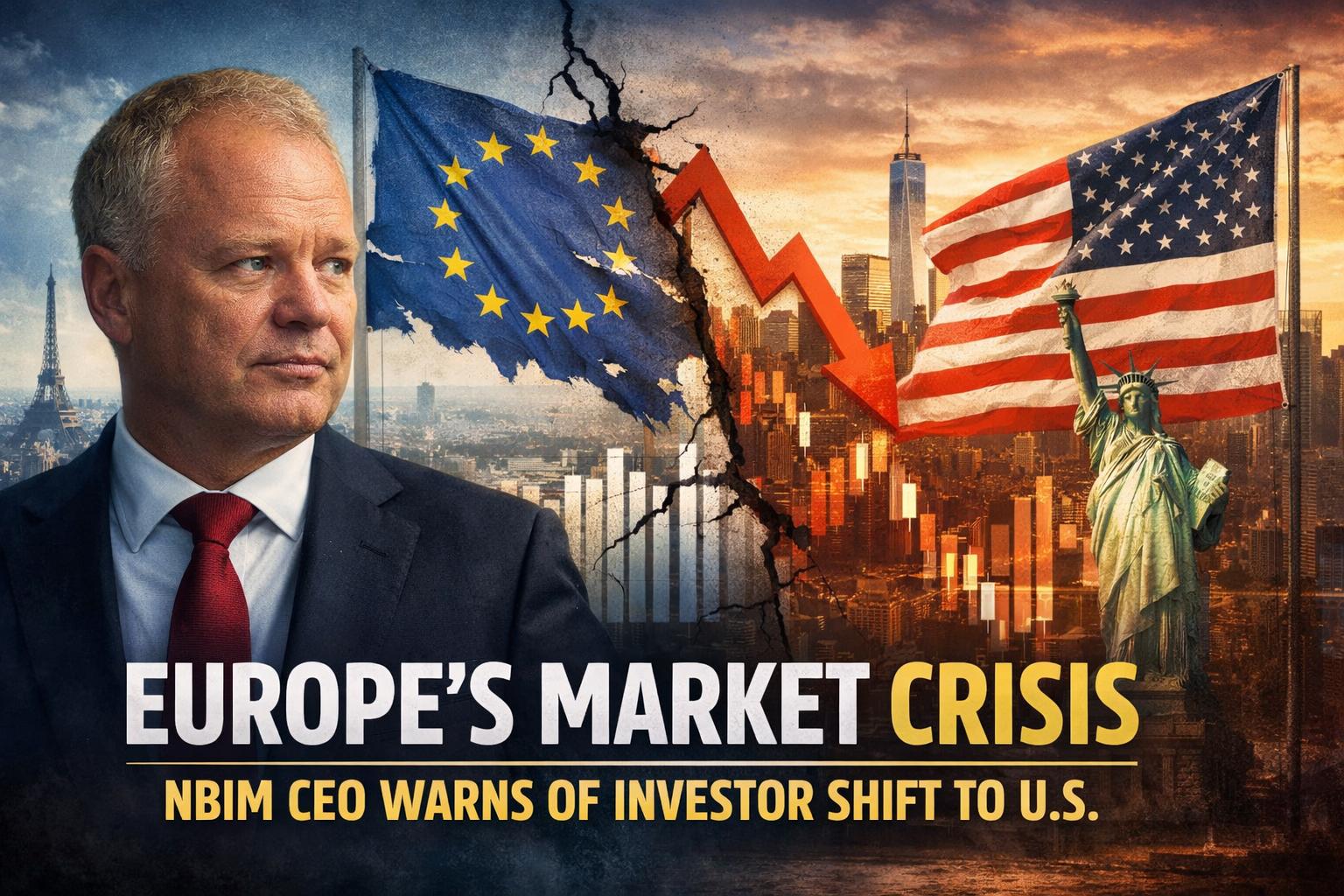
Europe’s financial markets are facing a critical moment and must urgently reform to remain competitive in a rapidly shifting global investment landscape, according to the head of the world’s largest sovereign wealth fund. Nicolai Tangen, chief executive of Norges Bank Investment Management, which oversees Norway’s $2 trillion wealth fund, has issued a stark warning that Europe risks falling further behind unless it addresses long-standing structural issues in its capital markets. Speaking at a major financial conference in Paris, Tangen emphasized that the continent’s fragmented system is no longer sustainable in an environment where global capital increasingly gravitates toward efficiency, scale and higher returns.
Tangen highlighted that the lack of integration across European capital markets is one of the region’s biggest weaknesses. Investors, he explained, naturally move toward markets where liquidity is deeper and valuations are more attractive. This has increasingly favored the United States, which benefits from a unified and highly efficient financial ecosystem. Europe, by contrast, continues to operate through a patchwork of national systems, regulations and exchanges, making it harder for companies to raise capital and for investors to deploy funds effectively across borders. According to Tangen, this fragmentation ultimately reduces Europe’s appeal and competitiveness on the global stage.
The shift in investment patterns over the past decade underscores this growing imbalance. Tangen revealed that the sovereign wealth fund’s equity portfolio has undergone a significant transformation, with a much larger allocation now directed toward U.S. stocks. European equities, which once made up a substantial portion of the fund’s holdings, have seen their share decline sharply. At the same time, exposure to U.S. markets has expanded considerably, reflecting stronger performance, higher liquidity and better growth prospects. This trend is not unique to Norway’s fund but mirrors a broader global movement among institutional investors seeking more dynamic and scalable opportunities.
A key factor driving this shift is the concentration of leading technology companies in the United States. Firms such as Nvidia, Apple and Microsoft have become dominant forces in global markets, attracting significant investment due to their innovation, profitability and market influence. Norway’s wealth fund itself holds notable stakes in these companies, illustrating how global capital is increasingly flowing toward sectors and regions that offer strong long-term growth potential. Europe, despite having a robust industrial base and strong financial institutions, has struggled to produce companies of similar scale and global impact in emerging sectors.
Tangen’s remarks also carry a broader message about the urgency of reform. He stressed that in global finance, scale and speed matter, and delays in addressing structural issues can have lasting consequences. If Europe fails to act decisively, it risks a continued erosion of its position in global capital markets, with more investment capital shifting abroad. This could have implications not only for financial markets but also for economic growth, innovation and job creation across the region.
The call for reform is not new, but Tangen’s comments add weight to the argument at a time when competition for global capital is intensifying. Policymakers across Europe have long discussed the need for a more integrated capital markets union, but progress has been slow and uneven. The current environment, marked by rapid technological change and evolving investment trends, has made the need for action more pressing than ever.
Ultimately, the message from one of the world’s most influential investors is clear: Europe must act collectively and decisively to strengthen its financial system. Without meaningful reform, the continent risks being overshadowed by more agile and unified markets, particularly in the United States. For Europe to remain a key player in the global financial system, it will need to break down barriers, enhance liquidity and create a more attractive environment for both companies and investors.
Tangen highlighted that the lack of integration across European capital markets is one of the region’s biggest weaknesses. Investors, he explained, naturally move toward markets where liquidity is deeper and valuations are more attractive. This has increasingly favored the United States, which benefits from a unified and highly efficient financial ecosystem. Europe, by contrast, continues to operate through a patchwork of national systems, regulations and exchanges, making it harder for companies to raise capital and for investors to deploy funds effectively across borders. According to Tangen, this fragmentation ultimately reduces Europe’s appeal and competitiveness on the global stage.
The shift in investment patterns over the past decade underscores this growing imbalance. Tangen revealed that the sovereign wealth fund’s equity portfolio has undergone a significant transformation, with a much larger allocation now directed toward U.S. stocks. European equities, which once made up a substantial portion of the fund’s holdings, have seen their share decline sharply. At the same time, exposure to U.S. markets has expanded considerably, reflecting stronger performance, higher liquidity and better growth prospects. This trend is not unique to Norway’s fund but mirrors a broader global movement among institutional investors seeking more dynamic and scalable opportunities.
A key factor driving this shift is the concentration of leading technology companies in the United States. Firms such as Nvidia, Apple and Microsoft have become dominant forces in global markets, attracting significant investment due to their innovation, profitability and market influence. Norway’s wealth fund itself holds notable stakes in these companies, illustrating how global capital is increasingly flowing toward sectors and regions that offer strong long-term growth potential. Europe, despite having a robust industrial base and strong financial institutions, has struggled to produce companies of similar scale and global impact in emerging sectors.
Tangen’s remarks also carry a broader message about the urgency of reform. He stressed that in global finance, scale and speed matter, and delays in addressing structural issues can have lasting consequences. If Europe fails to act decisively, it risks a continued erosion of its position in global capital markets, with more investment capital shifting abroad. This could have implications not only for financial markets but also for economic growth, innovation and job creation across the region.
The call for reform is not new, but Tangen’s comments add weight to the argument at a time when competition for global capital is intensifying. Policymakers across Europe have long discussed the need for a more integrated capital markets union, but progress has been slow and uneven. The current environment, marked by rapid technological change and evolving investment trends, has made the need for action more pressing than ever.
Ultimately, the message from one of the world’s most influential investors is clear: Europe must act collectively and decisively to strengthen its financial system. Without meaningful reform, the continent risks being overshadowed by more agile and unified markets, particularly in the United States. For Europe to remain a key player in the global financial system, it will need to break down barriers, enhance liquidity and create a more attractive environment for both companies and investors.