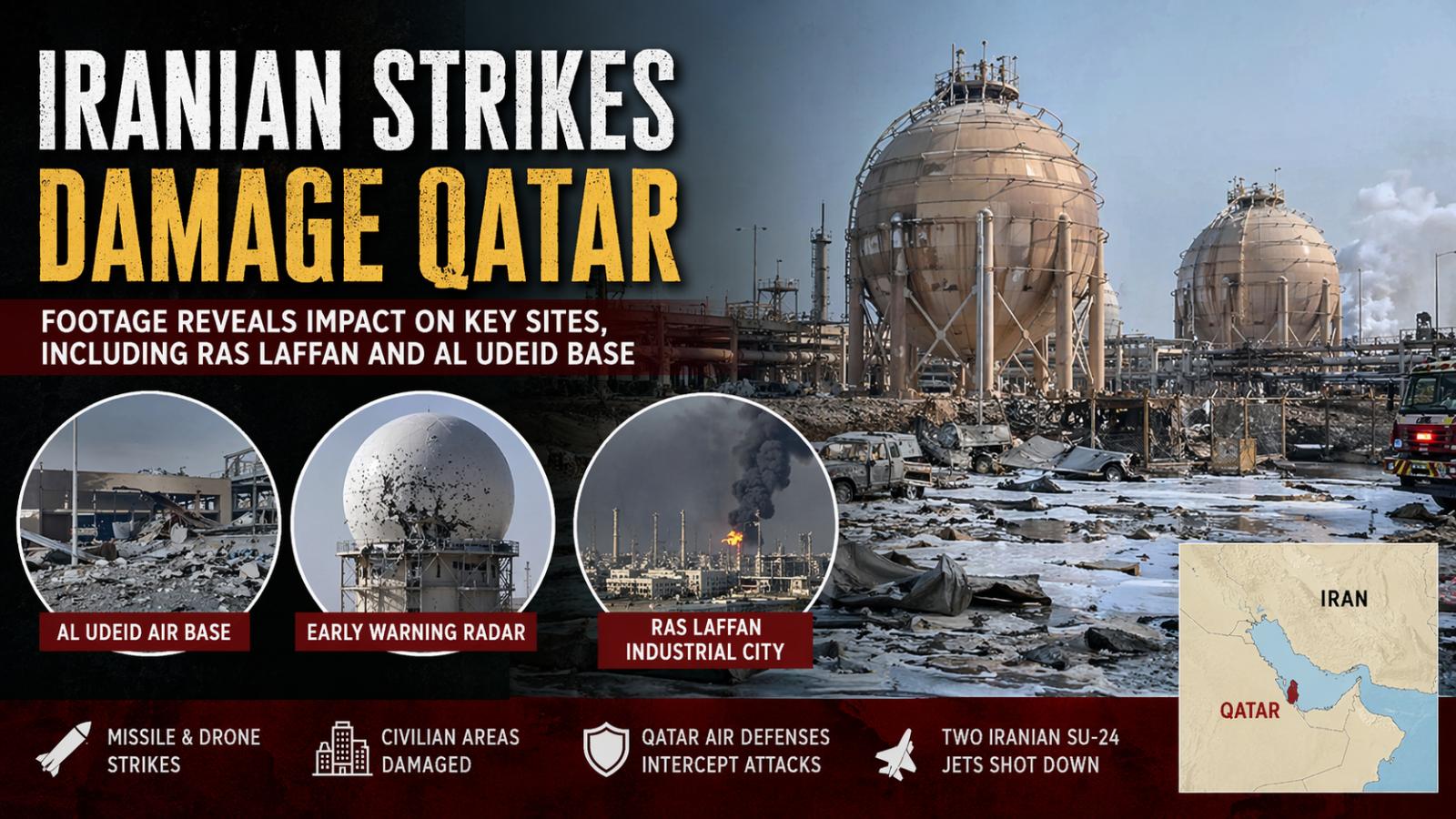
Newly released footage from Qatar provides a detailed look at the extent of damage caused by Iranian missile and drone strikes across the country, highlighting impacts on both military and civilian infrastructure. The visuals, aired in a recent investigative program, show destruction at multiple locations, including the Al Udeid Air Base, early warning radar systems in northern Qatar, and Ras Laffan Industrial City, one of the world’s most critical liquefied natural gas hubs.
The footage captures missile impacts, debris fields, and damaged roads and residential areas, along with rare visuals of aerial interception efforts by Qatari air defenses. Authorities in Doha stated that most incoming missiles and drones were intercepted, and also reported that two Iranian Su-24 aircraft were shot down during the attacks.
Iran has maintained that its strikes targeted U.S.-linked military assets in Qatar. However, Qatari officials have rejected that claim, asserting that civilian neighborhoods and economic infrastructure were also hit. The government emphasized that its territory, including Al Udeid Air Base, was not used to launch attacks on Iran during the conflict.
The strikes occurred during a broader escalation that began in late February and continued into April, before a two-week ceasefire brought a temporary pause in hostilities. Ras Laffan Industrial City, a key node in global LNG supply, sustained significant damage, raising concerns about potential disruptions to energy markets.
While the immediate impact is regional, analysts note broader implications for global energy supply chains. Countries heavily dependent on Qatari natural gas could face tighter supply conditions and rising costs if disruptions persist.
In response to the escalating situation, authorities in Doha have maintained heightened security measures. Airspace remains temporarily closed, and flight operations are suspended. Officials have also extended entry visas issued before Friday, February 28, 2026, by one month, pending further review.
Qatar released the footage to counter Iran’s claims and underscore the extent of damage to civilian and economic infrastructure, reinforcing its position amid ongoing geopolitical tensions in the region.