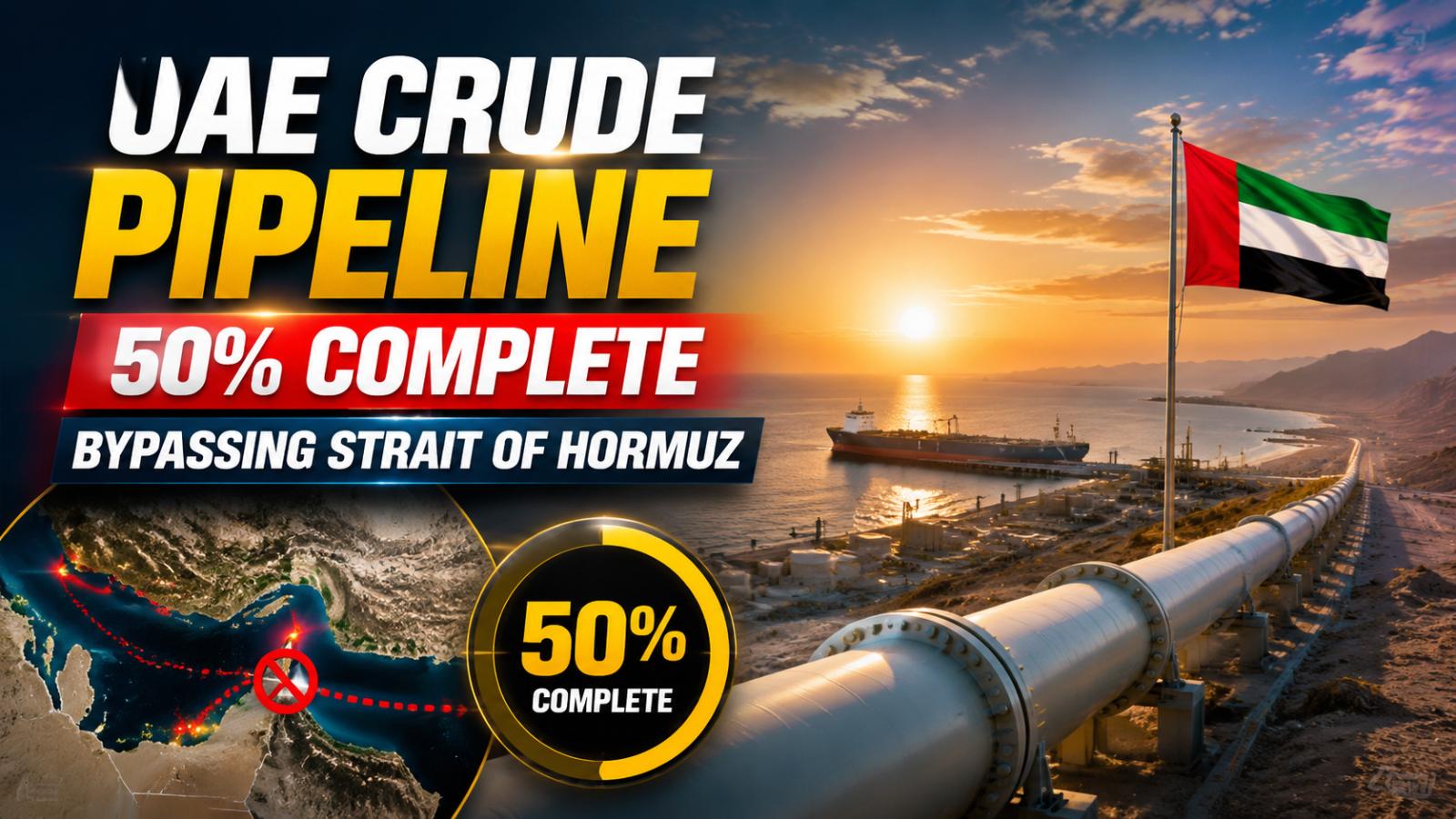
The United Arab Emirates has achieved a major milestone with 50% completion of the West-East Pipeline, a strategic crude oil project designed to bypass the Strait of Hormuz. Managed by ADNOC and accelerated under Crown Prince Sheikh Khaled bin Mohamed bin Zayed, the pipeline aims to increase crude export capacity via the port of Fujairah by 2027.
ADNOC CEO Sultan Al Jaber highlighted that even after the resolution of regional conflicts, global oil flows could take several months to reach pre-crisis levels, underlining the importance of diversifying export routes.
Strengthening UAE’s Energy Security
The Strait of Hormuz has faced intermittent closures since February 28 due to regional tensions, causing disruptions in global energy supply. The West-East Pipeline, together with the existing Abu Dhabi Crude Oil Pipeline, which handles 1.8 million barrels per day, ensures that the UAE can maintain steady exports along the Gulf of Oman.
Diversifying transportation routes is central to energy security, preventing any single chokepoint from controlling crude flows and stabilizing the international oil market.
Mitigating Impact of Regional Conflicts
The UAE has endured thousands of missile and drone attacks targeting infrastructure, including oil facilities. Even if hostilities end suddenly, Al Jaber noted that normal crude flows through the Strait of Hormuz would not fully resume before early 2027. The accelerated pipeline project allows the UAE to reduce reliance on high-risk maritime routes while sustaining export volumes.
Supporting Global Oil Supply
Global upstream investments of around $400 billion per year currently struggle to compensate for natural decline rates in oil production. With spare crude capacity hovering near 3 million barrels per day, the West-East Pipeline strengthens both UAE energy security and the global supply chain, ensuring that markets remain resilient amid geopolitical tensions.
By proactively developing this infrastructure, the UAE positions itself as a reliable exporter, reducing risks to global oil flow and contributing to long-term market stability.
Conclusion
The UAE’s West-East Pipeline is more than just a transport route—it’s a strategic shield for energy security and a stabilizing force for international oil markets. Its 50% completion signals progress in safeguarding global crude supply amid geopolitical uncertainty.