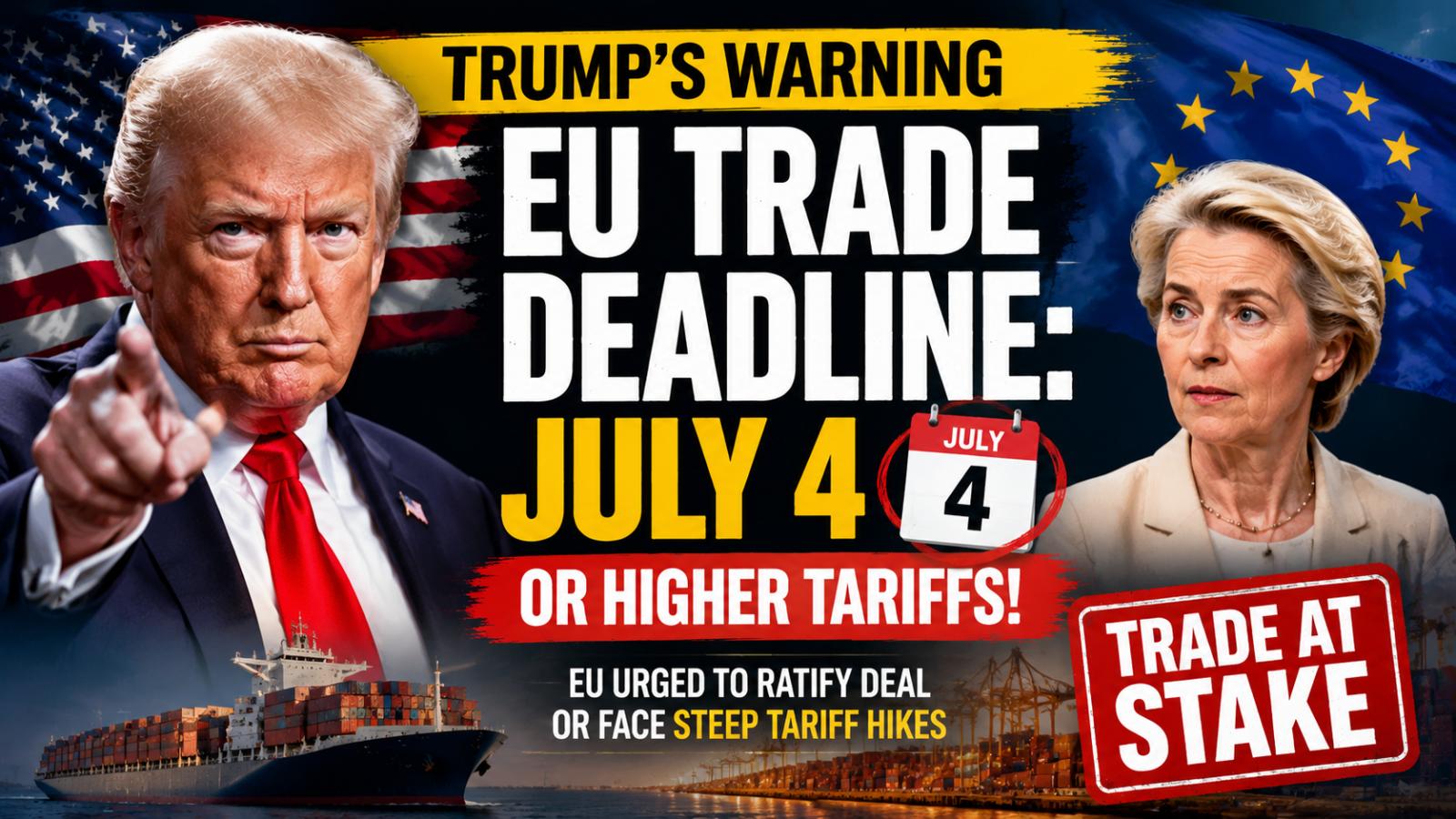
President Donald Trump issued a firm ultimatum on Thursday (May 7) to the European Union (EU), demanding that the 27-member bloc finalize and ratify its trade agreement with the United States by July 4, or face significantly higher tariffs. Trump’s statement followed a recent conversation with European Commission President Ursula von der Leyen, during which they discussed delays in approving the trade agreement. Trump set a deadline for the deal to be finalized by the U.S. Independence Day celebrations, emphasizing that failure to meet this deadline would result in tariffs increasing to much higher levels.
This year marks the 250th anniversary of the American colonies declaring independence from Britain, which Trump linked to the deadline for the trade deal. The preliminary agreement, which the U.S. and EU reached last July, included a 15% tariff on most European goods entering the U.S. market. However, the deal still requires approval from individual EU member states, causing growing frustration in Washington. Trump has intensified pressure by threatening to raise tariffs on European cars and trucks to 25%, arguing that the EU has not honored its commitments under the agreement.
Cyprus, which currently holds the rotating presidency of the Council of the European Union, has expressed hope to maintain “positive momentum” in discussions with the European Parliament on May 19. In a post on Truth Social, Trump expressed his frustration with the slow progress of the deal, saying, “I’ve been waiting patiently for the EU to fulfill their side of the Historic Trade Deal we agreed in Turnberry, Scotland, the largest Trade Deal, ever!”
While the European Parliament approved the tariff agreement in principle earlier this year, lawmakers requested additional safeguards before the deal can be fully implemented. Negotiations with individual EU member states must be concluded before the agreement can take effect across the entire bloc. With the July 4th deadline looming, the EU faces significant pressure from the Trump administration to resolve the trade deal and avoid the imposition of higher tariffs on European goods.